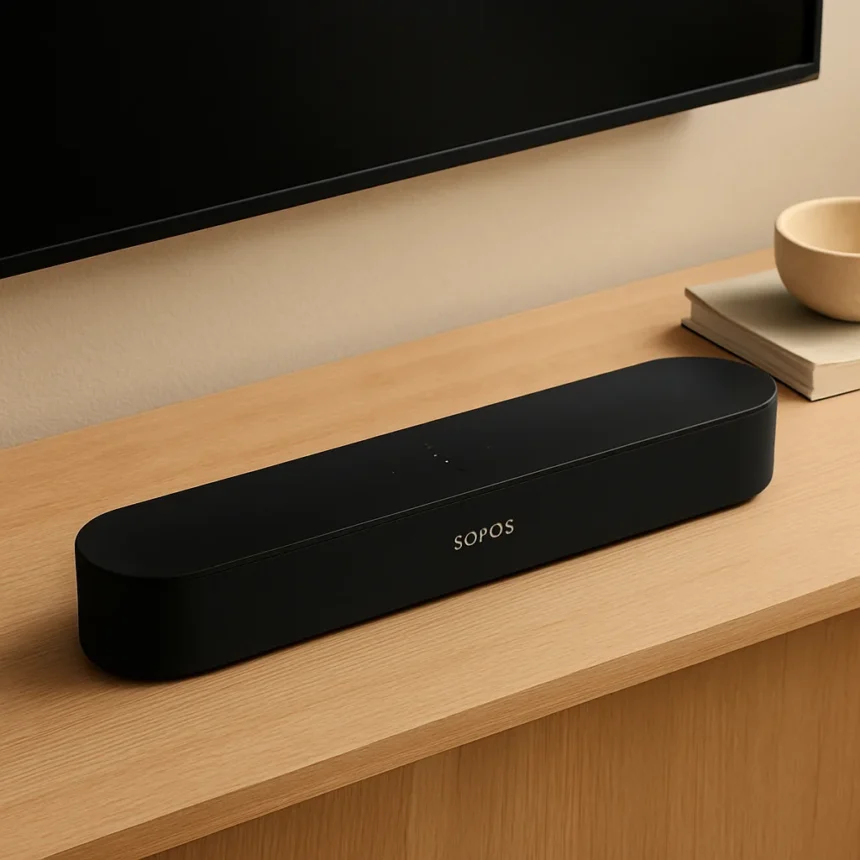
The Sonos Beam Gen 2 is a compact Dolby Atmos smart soundbar made by Sonos, designed for small to mid-size rooms and available globally through Sonos directly and major retailers. It sits in the middle of the Sonos soundbar lineup, below the flagship Arc and above the entry-level Ray, making it the most interesting option for buyers who want real spatial audio without a full home cinema footprint.
TL;DR: The Sonos Beam Gen 2 delivers Dolby Atmos support, smart home integration, and a compact form factor in one tidy package. It’s the right soundbar for smaller rooms and Sonos ecosystem owners, though buyers in larger spaces should look at the Arc instead.
What makes the Sonos Beam Gen 2 worth buying?
The Sonos Beam Gen 2 earns its reputation by combining Dolby Atmos decoding with a genuinely compact chassis — something few rivals manage convincingly. It supports HDMI eARC for lossless audio passthrough and integrates with the broader Sonos ecosystem, meaning it can be paired with Sonos surrounds and a sub for a full system later. That upgrade path alone separates it from most competitors at this price tier.
The second-generation design brought HDMI eARC as the headline hardware upgrade over the original Beam, which was limited to HDMI ARC. That single change unlocks Dolby Atmos from compatible TVs and streaming services — a meaningful real-world improvement for anyone watching Atmos-encoded content on Netflix, Disney+, or Apple TV+. It’s not a minor spec bump; it’s the difference between simulated and actual spatial audio.



Smart assistant support is built in, with both Amazon Alexa and Google Assistant available depending on your preference. For households already invested in a smart home ecosystem, that’s a genuine convenience rather than a marketing checkbox.
How does the Sonos Beam Gen 2 compare to other Dolby Atmos soundbars?
The Sonos Beam Gen 2 sits in a competitive segment where buyers are choosing between brand ecosystems as much as raw audio specs. Against rivals in the same general size category, the Beam Gen 2’s strongest card is the Sonos app and its multi-room audio capability — few competitors offer the same depth of whole-home integration.



Within Sonos’s own range, the comparison is straightforward. The Arc is the better soundbar for large rooms, full stop. It’s physically larger, louder, and better suited to open-plan spaces. The Beam Gen 2 is the right call for bedrooms, smaller living rooms, or anyone who doesn’t want a soundbar dominating the furniture. The Ray, meanwhile, lacks Dolby Atmos entirely — so if spatial audio matters, the Beam Gen 2 is the minimum viable Sonos option.
What the Beam Gen 2 doesn’t do is produce the kind of wide, room-filling soundstage that larger soundbars with upward-firing drivers can achieve. Dolby Atmos on a compact bar is always a compromise — the height channels are simulated rather than physically projected. That’s true of most soundbars in this class, not a unique Sonos limitation.
Is the Sonos Beam Gen 2 good for smaller rooms?
For smaller rooms, the Sonos Beam Gen 2 is arguably the best-positioned smart soundbar available. Its compact dimensions mean it won’t overwhelm a 40 to 55-inch TV setup, and its tuning is optimised for closer listening distances rather than the kind of wide dispersion needed in larger spaces. Buyers with a dedicated home cinema room and a large screen should look elsewhere — but that’s not who this soundbar is for.
The Sonos ecosystem’s greatest strength in a smaller room context is Trueplay, the automatic room calibration feature that uses the device’s microphones to tune the sound to the specific acoustic environment. It’s the kind of feature that makes a real audible difference in a room with lots of soft furnishings or awkward wall placement — and it works without any manual configuration. That’s a genuine differentiator against competitors that either skip room correction entirely or bury it in complex setup menus.



Is the Sonos Beam Gen 2 compatible with all TVs?
The Sonos Beam Gen 2 connects via HDMI eARC, which requires a compatible HDMI eARC port on your TV. Most TVs released after 2019 include eARC, but it’s worth checking before purchasing. Optical audio is not supported on the Beam Gen 2 — a deliberate design choice that occasionally frustrates owners of older televisions. If your TV only has optical out, the Beam Gen 2 is not the right fit without an adapter, and even then Dolby Atmos won’t pass through correctly.
For buyers with a compatible TV, the HDMI eARC connection handles both audio and basic control functions, meaning the soundbar responds to your TV remote’s volume commands without additional setup. It’s a small convenience that adds up over daily use.
What are the main criticisms of the Sonos Beam Gen 2?
No soundbar is perfect, and the Beam Gen 2 has real limitations worth acknowledging. Bass output is modest without a Sonos Sub — the compact cabinet simply can’t move enough air for deep low-end reproduction, and action film soundtracks in particular can feel thin. Adding a Sub solves the problem but also significantly increases the total cost.
The lack of an optical input is a recurring complaint from buyers with older TV setups, and it’s a legitimate one. Sonos made a deliberate choice to push buyers toward HDMI eARC, and while that’s the right long-term standard, it leaves a segment of potential customers unable to use the product at all without upgrading their TV.
Is the Sonos Beam Gen 2 worth it for a first soundbar?
For a first soundbar upgrade from built-in TV speakers, the Sonos Beam Gen 2 is an excellent choice — provided your TV has HDMI eARC. The improvement in clarity, dialogue intelligibility, and spatial audio width over typical TV speakers is dramatic, and the Sonos app makes setup and ongoing management straightforward. First-time soundbar buyers are unlikely to miss the bass depth that more experienced listeners notice, especially in smaller rooms where the Beam Gen 2 performs at its best.
Does the Sonos Beam Gen 2 support surround sound expansion?
The Sonos Beam Gen 2 supports expansion with Sonos Era 100 or Era 300 speakers as wireless surrounds, as well as the Sonos Sub for bass reinforcement. This modular approach means buyers can start with the soundbar alone and build toward a full 5.1 or more complex setup over time — a genuine advantage over sealed systems that can’t be expanded. The wireless surround configuration is handled entirely through the Sonos app and requires no additional cables or receiver hardware.
The Sonos Beam Gen 2 isn’t trying to be the loudest or most technically impressive soundbar on the market. It’s trying to be the most liveable — easy to set up, easy to expand, and genuinely better than the TV it sits beneath. On those terms, it succeeds. Whether a current discount tips the decision for you depends on your room size and existing setup, but the fundamentals here are strong enough that the Beam Gen 2 earns a recommendation at any price that makes it competitive with the broader mid-range soundbar field.
Where to Buy
Sonos Beam (Gen 2): | 476 Amazon customer reviews | £449 | just $369 at Amazon
Edited by the All Things Geek team.
Source: What Hi-Fi?