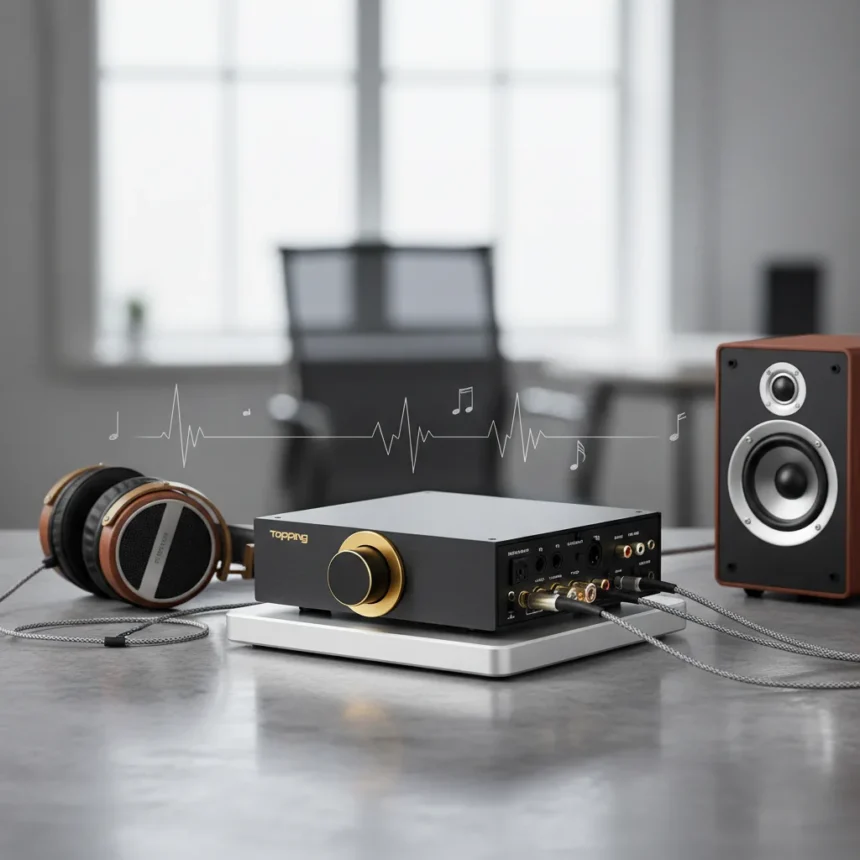
The Topping DX9 Discrete DAC is Topping’s latest entry into the discrete DAC space, positioning itself as a versatile solution for both headphone and speaker playback. The device arrives as Topping continues its aggressive expansion in the affordable high-performance audio market, where it competes against established players like iFi, Burson, and its own flagship lineup.
Key Takeaways
- Topping DX9 Discrete DAC supports both headphone and speaker outputs in a single chassis
- Builds on Topping’s proven DAC/preamp/headphone amp formula seen in D900 and DX5 II models
- Designed to drive demanding headphones including planar designs
- Positions between the compact DX5 II and flagship D900 in Topping’s product hierarchy
- Promotional claims of “remarkable” sound lack independent testing or performance benchmarks
Where the Topping DX9 Discrete DAC Fits in Topping’s Lineup
The Topping DX9 Discrete DAC arrives at a crowded moment in Topping’s own portfolio. The company already offers the flagship D900, a DAC/preamp combination priced at £1799 that includes an aluminum remote, colour screen, touch buttons, and programmable rotary control. Below that sits the DX5 II, a more compact hi-res DAC/preamp/headphone amp that undercuts rivals in price while driving planar headphones and offering a 2-inch colour screen with file info, spectrum analyzer, and VU meters. The DX9 Discrete’s exact positioning—and whether it slots between these two or targets a different market segment—remains unclear without official pricing and specifications. This positioning ambiguity is the first red flag: without knowing the DX9’s price or exact feature set, it is impossible to assess whether it genuinely offers value or simply adds noise to Topping’s already dense product ecosystem.
The Discrete DAC Promise: What Sets It Apart
The “discrete” designation suggests the DX9 uses discrete semiconductor components rather than integrated DAC chips, a design philosophy that appeals to audiophiles who believe discrete implementations sound superior. Topping’s commitment to this architecture implies the company is betting on component-level transparency and low-noise performance. However, without detailed technical specifications—chipsets, sample rate support, power output for headphones, or noise floor measurements—the promotional claim of “remarkable” sound from both headphones and speakers reads as marketing assertion rather than engineering evidence. Independent reviews and performance benchmarks for the Topping DX9 Discrete DAC do not yet exist, leaving potential buyers to trust Topping’s reputation rather than measured proof.
Topping DX9 Discrete DAC vs. Established Competitors
The Topping DX9 Discrete DAC enters a market where alternatives already deliver proven performance. The iFi Neo iDSD 3 headphone amp, for example, delivers up to 2532mW RMS (5550mW maximum at 32 ohms), drawing design heritage from iFi’s Diablo 2. The Burson Conductor Stellar combines DAC, Class A headphone amp, and desktop preamp functions, targeting everything from IEMs to planar headphones with an ultra-low-noise stage. The Chord Hugo 2 offers portable DAC/headphone amp functionality with coaxial, optical, and aptX inputs alongside RCA outputs. The Gustard X30 delta-sigma DAC is noted for versatility across amps, headphones, and speakers. These competitors have established track records and measurable specifications. The DX9 Discrete’s advantage, if any, likely rests on Topping’s reputation for value engineering rather than on technical differentiation that has not yet been disclosed or tested.



The Missing Piece: Independent Verification
Topping’s marketing materials promise “remarkable” sound, yet no independent testing, measurement data, or head-to-head comparisons have emerged to validate this claim. This is not unusual for newly announced audio equipment—independent reviewers typically require hands-on units and time to conduct rigorous listening tests and measurements. However, the absence of any technical specifications in public sources is unusual. A credible product announcement typically includes sample rates, bit depths, output power, impedance, noise floor, or distortion figures. The Topping DX9 Discrete DAC’s silence on these fundamentals makes it impossible to assess whether it advances the state of discrete DAC design or simply repackages existing technology in a new chassis.
Should You Wait for Reviews?
Absolutely. Until independent reviews surface with listening impressions and measured performance data, the Topping DX9 Discrete DAC remains an unproven product backed by vendor claims. Topping has earned credibility in the budget and mid-range DAC space through models like the DX5 II, which offers genuine feature density at competitive pricing. That reputation is worth something. However, reputation is not a substitute for evidence. If you are considering the DX9 Discrete for either headphone or speaker-driven listening, wait for reviews from established audio publications. Compare measured specs against the D900, DX5 II, iFi Neo iDSD 3, Burson Conductor Stellar, and Gustard X30. Only then will you have enough information to determine whether the DX9 Discrete delivers on its “remarkable” promise or simply occupies shelf space in Topping’s increasingly crowded catalog.



Is the Topping DX9 Discrete DAC better than the D900?
Unknown without pricing, specs, and reviews. The D900 is Topping’s flagship at £1799 with proven features like a color screen and programmable controls. The DX9 Discrete’s positioning relative to the D900 has not been officially clarified. If the DX9 costs significantly less, it may target a different audience; if priced similarly, it must offer comparable or superior performance to justify its existence.
Can the Topping DX9 Discrete DAC drive planar headphones?
Topping’s marketing indicates the DX9 is designed to drive demanding headphones including planar designs, but without power output specifications, this claim cannot be independently verified. The DX5 II demonstrably drives planars and includes published specs; the DX9 Discrete DAC has not provided equivalent technical detail.
The Topping DX9 Discrete DAC represents another entry in an increasingly crowded market. Without independent reviews, technical specifications, or clear pricing, it remains a promise rather than a proven product. Topping’s track record suggests the device will likely deliver competent performance, but “competent” and “remarkable” are different claims. Wait for evidence before committing.
Edited by the All Things Geek team.



Source: What Hi-Fi?