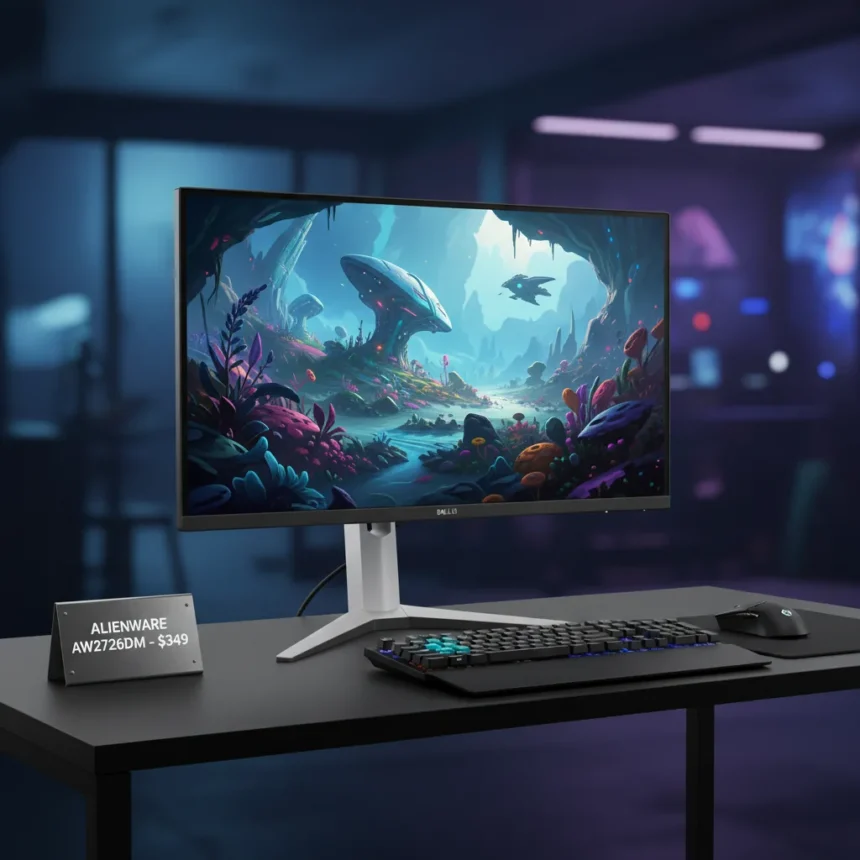
The Alienware AW2726DM is a 27-inch QD-OLED gaming monitor made by Dell’s Alienware brand, priced at $349.99, available now for purchase. For years, OLED gaming displays have been locked behind premium price tags, forcing budget-conscious gamers to choose between fast refresh rates and exceptional image quality. The AW2726DM breaks that barrier by delivering QD-OLED panel technology, 2560 x 1440 resolution, and 240Hz performance at a fraction of what competitors charge.
Key Takeaways
- 27-inch QD-OLED panel with anti-reflective coating at $349.99
- 2560 x 1440 resolution, 240Hz refresh rate, 0.03ms response time
- Supports AMD FreeSync Premium and VESA AdaptiveSync
- SDR brightness rated at 200 nits—lower than premium OLED models
- Strategic cost cuts include reduced ports and no G-Sync certification
Why the Alienware AW2726DM matters right now
The gaming monitor market has a problem: OLED panels deliver stunning contrast, perfect blacks, and lightning-fast response times, but they’ve historically cost $600 to $1000 or more. Alienware’s decision to bring QD-OLED technology to the $349 price point is not incremental—it’s disruptive. The company achieved this by making deliberate tradeoffs rather than cutting corners on the panel itself. That distinction matters.
QD-OLED (Quantum Dot OLED) combines organic light-emitting diode technology with quantum dot color enhancement, delivering superior brightness and color accuracy compared to standard OLED panels. By positioning the Alienware AW2726DM as an entry-level QD-OLED option, Alienware is essentially saying: you can have OLED gaming performance without paying flagship prices. For gamers stuck between a $200 budget TN panel and a $700 OLED monitor, this is the option they’ve been waiting for.
Specifications and what they mean for gaming
The Alienware AW2726DM runs a 2560 x 1440 (QHD) native resolution at 240Hz with a 0.03ms response time. That response time is where OLED shines—traditional LCD panels struggle to match that speed, and the difference is noticeable in fast-paced games like Counter-Strike 2 or Valorant where every millisecond counts. The 27-inch screen size pairs well with QHD resolution, offering a sweet spot between screen real estate and pixel density without requiring a high-end graphics card to drive high frame rates.


Connectivity includes two HDMI 2.1 ports, one DisplayPort 1.4, a 3.5mm audio output, and a lock slot. The monitor supports AMD FreeSync Premium and VESA AdaptiveSync, which means G-Sync and FreeSync users can both benefit from variable refresh rate technology. However, Alienware did not pursue official G-Sync certification on this model—a deliberate cost-saving choice that avoids Nvidia’s licensing fees. For AMD users, this is irrelevant; for Nvidia users, VESA AdaptiveSync still works, though official G-Sync certification carries marketing cachet.
SDR brightness is rated at 200 nits, which is lower than Alienware’s premium QD-OLED models. In bright rooms, you might notice this limitation. In typical gaming environments with controlled lighting, 200 nits is adequate for SDR content. HDR brightness figures were not detailed in the available review material, but the anti-reflective finish helps mitigate glare and perceived brightness loss.



How the Alienware AW2726DM stacks against premium alternatives
Alienware’s own higher-end QD-OLED models command significantly higher prices by including official G-Sync certification, higher brightness levels, increased refresh rates, and additional connectivity options. The cost difference can exceed $200, making those premium models targets for enthusiasts who demand every possible feature. The AW2726DM accepts certain limitations—lower brightness, fewer ports, no G-Sync badge—to reach the $349 price floor without compromising the core OLED panel quality.
Compared to standard LCD gaming monitors in the $300–400 range, the Alienware AW2726DM offers superior contrast, faster response times, and zero backlight bleed. Traditional LCD panels cannot match OLED’s instant pixel response or the visual impact of true blacks. Budget LCD monitors often sacrifice color accuracy and refresh rate consistency; the AW2726DM delivers both because the panel technology is inherently superior, not because Alienware added extra processing.
The value proposition is almost too good
At $349.99, the Alienware AW2726DM is positioned as a price-to-performance inflection point. Gamers who would have spent $250 on a decent 240Hz LCD monitor can now spend $349 and get OLED image quality. That $100 difference is not trivial for budget shoppers, but the jump in visual fidelity—deeper blacks, faster response, better color—is immediately obvious. Alienware is betting that once gamers experience OLED gaming, they will not want to go back to LCD, and at this price, the upgrade is defensible.
The monitor targets competitive gamers who care about refresh rate and response time but also appreciate the visual advantages of OLED for single-player games and content consumption. It is not a monitor for professional color grading or content creation—those users need higher brightness and certified color spaces. It is a monitor for players who want the best gaming experience without spending four figures.



What the cost cuts actually mean for users
Removing G-Sync certification is a smart cost-saving move. Nvidia’s licensing fee adds $50–100 to monitor prices, and for users with AMD graphics cards or Nvidia cards using VESA AdaptiveSync, the fee is wasted money. The reduction in SDR brightness from, say, 300 nits (on premium models) to 200 nits is more noticeable but manageable in controlled lighting. The fewer ports are a minor inconvenience for users who need multiple simultaneous connections, but for most gaming setups—one DisplayPort or HDMI input, headphones—the port selection is adequate.
The anti-reflective finish on the QD-OLED panel is a thoughtful addition that reduces glare without sacrificing color vibrancy. Glossy OLED panels can be reflective under bright conditions, and the matte coating helps in less-than-ideal lighting situations. This is a feature that adds real value without inflating the price.
Is the Alienware AW2726DM worth buying?
Yes, if you are a gamer with a budget under $400 who values refresh rate, response time, and image quality equally. Yes, if you have an AMD graphics card or do not care about official G-Sync certification. Yes, if you game in a moderately lit room and do not need maximum brightness for HDR content. No, if you require professional color accuracy, maximum brightness for content creation, or official Nvidia certification. No, if you need a monitor for a bright office or streaming setup where 200 nits is insufficient.
The Alienware AW2726DM is the monitor that proves QD-OLED gaming does not have to cost $700. It is a genuine category disruptor that will likely be massively popular because it solves a real problem: making OLED gaming accessible to players who were previously priced out.
FAQ
What is the response time on the Alienware AW2726DM?
The Alienware AW2726DM has a 0.03ms response time, which is essentially instantaneous and typical of OLED panels. This speed gives competitive gamers an edge in fast-paced titles where pixel responsiveness matters.
Does the Alienware AW2726DM support G-Sync?
The Alienware AW2726DM does not carry official G-Sync certification, but it supports VESA AdaptiveSync, which works with Nvidia graphics cards. Alienware skipped G-Sync certification to reduce costs. AMD FreeSync Premium is also supported.
Is 200 nits brightness enough for gaming?
For SDR gaming in typical room lighting, 200 nits is adequate. In very bright environments, you may notice the limitation. For HDR gaming, brightness performance depends on HDR peak levels, which were not detailed in the available specifications.
The Alienware AW2726DM represents a turning point in gaming monitor pricing. For the first time, QD-OLED technology is within reach of mainstream gamers, not just enthusiasts willing to spend premium dollars. Whether you are upgrading from a budget LCD panel or reconsidering OLED after dismissing it as too expensive, this monitor deserves serious consideration. Alienware has cracked the code on affordable OLED gaming, and the market will likely respond with overwhelming demand.
Where to Buy
Edited by the All Things Geek team.
Source: Windows Central