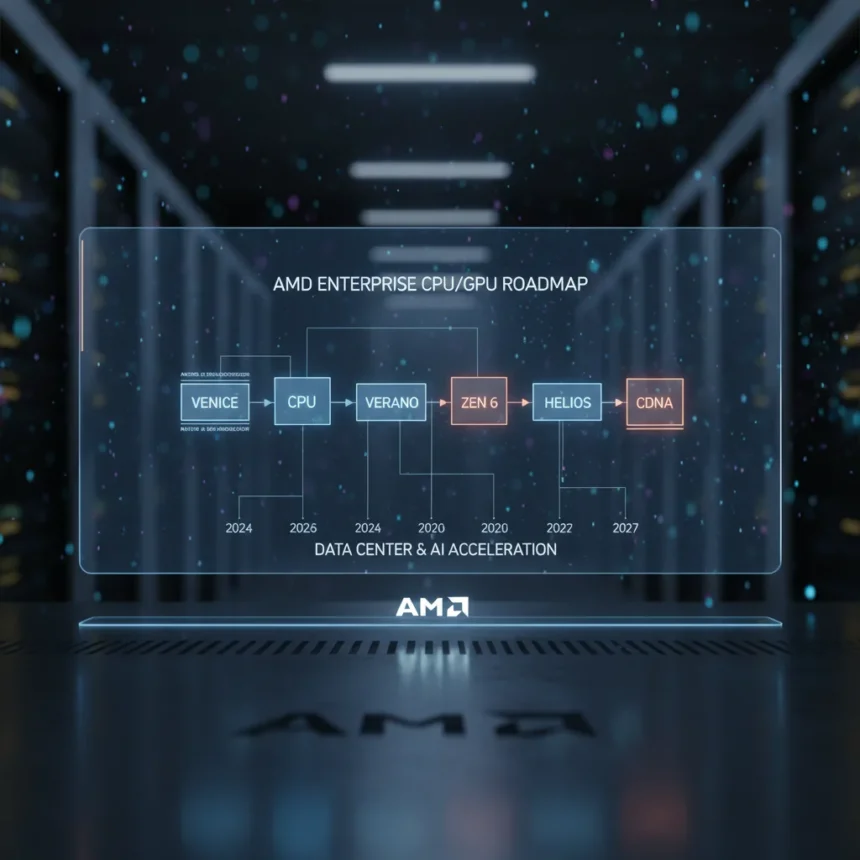
AMD’s enterprise CPU and GPU roadmap spans five major product families—Venice, Verano, Zen 6, Helios, and CDNA—positioning the company to capture over 50% of server CPU revenue and 60% data center CAGR by 2027. The strategy targets hyperscalers and enterprises racing to deploy AI infrastructure while Intel faces production delays and market uncertainty.
Key Takeaways
- Venice Zen 6 CPUs launch H2 2026 with up to 256 cores, 1.7x better performance-per-watt than Turin, and 16 memory channels.
- Helios rack-scale platform debuts Q3 2026 with MI450 Series GPUs, delivering leadership in memory capacity and scale-out bandwidth.
- MI500 Series GPUs powered by CDNA 6 on 2nm process launch in 2027 with HBM4E memory for extended AI performance.
- AMD projects datacenter AI revenue CAGR exceeding 80% over the next 3-5 years, driven by MI350/MI355X ramp and MI450 adoption.
- Venice widens performance-per-core advantage over Intel Diamond Rapids, while SP8 platform offers 128-core alternative where Intel cancels equivalent SKUs.
Venice and Zen 6: The Next-Gen Data Center CPU
Venice represents AMD’s second-half 2026 launch of its next-generation EPYC data center processor, built on the Zen 6 microarchitecture and delivering what AMD claims extends its leadership in enterprise computing. The flagship configuration reaches 256 cores with substantially improved instructions-per-clock (IPC) and introduces new AI instruction sets including AVX512_FP16, AVX_VVNI_INT8, and AVX512_BMM for bit matrix multiplication, addressing accelerated inference and training workloads directly on CPU. Memory architecture receives a major upgrade: 16 channels replace Genoa’s 12, supporting multiplexed memory (MRDIMM-12800) at 1.64TB/s bandwidth—2.67 times faster than Turin’s memory subsystem. AMD also delivers an SP8 platform variant with up to 128 Zen 6c cores as the successor to EPYC 8004 Siena, capturing the compact socket segment where Intel recently cancelled equivalent offerings.
Performance-per-watt metrics show Venice’s advantage in the SPECrate2017_int_base benchmark, where a single 256-core Venice outperforms Turin’s 192-core configuration by over 1.7x. This efficiency gain matters in hyperscale environments where power budgets constrain deployment density. Against Intel’s competing Diamond Rapids processors expected in 2026-2028, AMD’s core-to-core performance gap widens further, according to industry analysis, as Zen 6’s architectural improvements compound the core count advantage. Improved core-to-core latency via a new die-to-die interconnect addresses the latency-sensitive workloads that cloud providers and financial institutions depend on for real-time analytics.
Helios and MI450: Rack-Scale AI Leadership
Helios emerges as AMD’s rack-scale AI platform launching in Q3 2026, built around the Instinct MI450 Series GPUs and delivering what AMD describes as industry-leading memory capacity and scale-out bandwidth. The MI450 lineup includes three variants: MI455X for AI superclusters, MI430X for HPC and sovereign AI deployments, and MI440X for enterprise 8-GPU training and inference clusters. Multiple original equipment manufacturers including Meta Platforms plan to deploy Helios systems, signaling strong customer demand for AMD’s alternative to Nvidia’s established GPU ecosystem.


The MI350 and MI355X predecessors are ramping at the fastest pace in AMD history, with Oracle Cloud leading adoption and demonstrating customer appetite for AMD’s AI acceleration outside Nvidia’s traditional stronghold. This momentum positions MI450 for a production ramp beginning in H2 2026 extending into 2027, as enterprise and cloud customers integrate the new GPUs into their AI infrastructure. Helios’ architectural focus on memory capacity and bandwidth addresses the bottleneck that constrains large language model inference and fine-tuning at scale—a critical differentiator as enterprises move beyond inference-only deployments.
CDNA 6 and MI500: The 2027 Horizon
Beyond MI450, AMD’s CDNA 6 architecture powers the MI500 Series GPUs launching in 2027, built on a 2nm process with HBM4E memory. This generational leap extends AMD’s AI roadmap well into the next phase of hyperscaler expansion, when transformer model sizes and training requirements will push memory and bandwidth demands even higher. Verano, the generation pairing Zen 7 and Zen 7c processors with MI500 GPUs and Vulcano DPUs in rack-scale systems, represents the full-stack integration AMD pursues to compete against Nvidia’s vertically integrated approach.



AMD’s financial projections underpin the confidence in this roadmap: the company targets over 50% server CPU revenue share, exceeding 40% client CPU share, with data center CAGR surpassing 60% and overall revenue CAGR exceeding 35% over the next 3-5 years. Most aggressively, AMD projects datacenter AI revenue CAGR exceeding 80%, reflecting the belief that AI workloads will dominate new capacity additions across cloud providers and enterprises. These projections hinge on execution—Venice’s on-time launch, MI450’s customer ramp, and MI500’s successful integration into next-generation systems.
Competitive Positioning and Market Impact
Intel’s position weakens as Venice and Helios approach. The company faces first-half 2026 supply constraints amid strong x86 demand, and its equivalent data center offerings lack the architectural improvements AMD brings. AMD’s Zen 6 architecture delivers higher performance-per-core than Intel’s competing processors, and the gap widens versus Diamond Rapids expected in 2026-2028. Additionally, Intel cancelled its own SP8-equivalent platform, ceding that segment entirely to AMD.
Nvidia‘s AI GPU dominance remains the unspoken competitor throughout AMD’s roadmap. Helios and MI450 target enterprises and hyperscalers seeking alternatives to Nvidia’s pricing and supply constraints. The MI350/MI355X ramp demonstrates that customers will adopt AMD GPUs when availability and performance align—a lesson that informs MI450’s aggressive positioning. Yet Nvidia’s software ecosystem (CUDA, cuDNN, TensorRT) and installed base remain formidable advantages AMD must overcome through superior hardware value and developer outreach.
What This Means for Enterprise Buyers
For cloud providers and enterprises planning 2026-2027 infrastructure investments, AMD’s roadmap signals viable alternatives to Nvidia for AI workloads and to Intel for general-purpose data center computing. Venice’s memory architecture and AI instruction sets address real constraints in current-generation deployments. Helios’ Q3 2026 availability aligns with the timeline when hyperscalers must finalize GPU procurement for 2027 capacity. The risk lies in execution: any delay in Venice’s launch or MI450 production ramp would shift momentum back to Intel and Nvidia.



Does AMD’s roadmap challenge Nvidia’s GPU dominance?
AMD’s MI350/MI355X ramp and MI450/MI500 pipeline create genuine alternatives for enterprises and hyperscalers, particularly where Nvidia supply is constrained or pricing is prohibitive. However, Nvidia’s CUDA ecosystem and software maturity remain significant barriers to market share gains. AMD must prove MI450 delivers comparable ease-of-use and developer support, not just raw performance.
When will Venice and Helios actually launch?
Venice launches in the second half of 2026, while Helios systems with MI450 GPUs begin shipping in Q3 2026 from multiple OEMs. These timelines assume no major delays; any slip would impact enterprise procurement plans for that period.
What makes Zen 6 different from current EPYC processors?
Zen 6 introduces higher instructions-per-clock, larger core domains, new AI instruction sets (AVX512_FP16, AVX_VVNI_INT8, AVX512_BMM), 16 memory channels instead of 12, and improved core-to-core latency via a new die-to-die interconnect. These changes combine to deliver over 1.7x better performance-per-watt than the 192-core Turin in SPECrate2017_int_base benchmarks.
AMD’s enterprise roadmap reflects confidence backed by strong customer momentum in MI350 deployments and clear architectural advantages in Venice’s Zen 6 design. Success hinges on flawless execution across multiple product launches in 2026-2027, but the strategy positions AMD to capture meaningful data center share as enterprises and hyperscalers diversify away from single-vendor dependence.
Edited by the All Things Geek team.
Source: Tom's Hardware