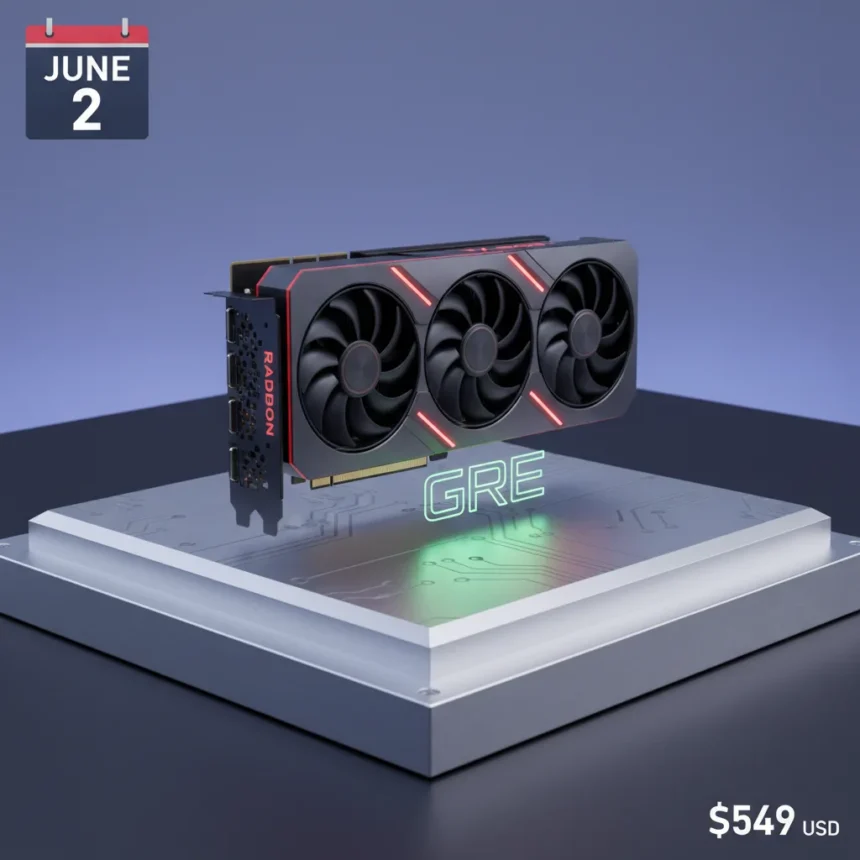
The Radeon RX 9070 GRE is a mid-range graphics card from AMD, built on the RDNA 4 architecture and previously sold exclusively in China. AMD is now taking the card global with a $549 USD MSRP and a launch date of June 2, positioning it between the RX 9060 XT and RX 9070 in the company’s current GPU lineup.
Key Takeaways
- The Radeon RX 9070 GRE launches globally on June 2 at a $549 USD MSRP.
- The card was previously exclusive to China, where it launched at 4,199 RMB.
- It uses the Navi 48 GPU with 48 Compute Units, 3,072 Stream Processors, and 12 GB of VRAM on a 192-bit bus.
- Board power is rated at 220 W, and no reference design is available — only add-in board partner cards.
- Asus, Sapphire, and XFX are among the board partners confirmed for the global rollout.
What is the Radeon RX 9070 GRE and where does it fit?
The Radeon RX 9070 GRE — GRE standing for Great Radeon Edition — is a cut-down variant of the Navi 48 GPU that also powers the RX 9070 and RX 9070 XT. It carries 48 Compute Units and 3,072 Stream Processors, along with 12 GB of VRAM on a 192-bit memory bus. That puts it meaningfully below the full RX 9070 in raw compute, but well above what the RX 9060 XT offers in memory bandwidth and VRAM capacity.
AMD’s strategy here is straightforward: use an existing silicon design, dial back the configuration, and hit a price point that the RX 9070 can’t reach. The $549 global MSRP slots in below the RX 9070 while staying above the RX 9060 XT, giving buyers a third option in the RDNA 4 stack without AMD needing to tape out an entirely new chip. Whether that gap needed filling is a fair question, but the specs suggest this card has a genuine use case for buyers who want Navi 48 silicon without paying full RX 9070 prices.
How does the RX 9070 GRE compare to the RX 9070 and RX 9060 XT?
The Radeon RX 9070 GRE sits between two established RDNA 4 cards in AMD’s lineup. It shares the Navi 48 GPU family with the RX 9070 and RX 9070 XT but runs a trimmed configuration, while the RX 9060 XT sits below it with a different positioning in the stack. The 12 GB VRAM figure is particularly relevant — it gives the GRE headroom that more budget-oriented cards often sacrifice.


The 192-bit memory bus is a notable spec point. It’s narrower than what you’d find on a higher-end card, but for a card at this price tier it’s a reasonable trade-off. The 220 W board power rating means buyers will want to confirm their PSU is adequately specced before ordering. The card supports AMD’s FSR upscaling and Frame Generation technologies, which matters for buyers who want to stretch performance in demanding titles.
No reference design exists for this card — AMD is relying entirely on add-in board partners for the global launch. Asus, Sapphire, and XFX are confirmed participants, which means pricing and cooling solutions will vary by model.



Why did the Radeon RX 9070 GRE start as a China exclusive?
AMD’s GRE branding has a history of appearing first in China before going global, and the RX 9070 GRE follows that same pattern. The card launched in China at 4,199 RMB, which translated to roughly $575 USD at the time of that regional release. The global MSRP of $549 actually comes in lower than that Chinese launch price, which is an interesting reversal — buyers outside China are getting a slightly better headline price than early Chinese adopters paid.
The China-first approach lets AMD test market appetite for a mid-stack SKU before committing to a broader rollout. Given that the RX 9070 GRE uses existing Navi 48 silicon rather than a new design, the risk of a global expansion is relatively low. AMD is essentially unlocking a wider market for a card it already manufactures.
Is the AMD Radeon RX 9070 GRE worth buying at $549?
At $549, the Radeon RX 9070 GRE asks buyers to pay more than entry-level RDNA 4 options while stopping short of the full RX 9070 experience. The 12 GB VRAM and Navi 48 silicon are genuine selling points, and FSR Frame Generation support adds longevity. But the value case depends heavily on how the add-in board partner cards are priced once they hit shelves — $549 is the MSRP floor, not a guaranteed street price.
Buyers who have been eyeing the RX 9070 but find it out of reach have a new option on June 2. Those already satisfied with the RX 9060 XT probably don’t need to move up unless VRAM capacity or the Navi 48 architecture is a specific priority. The GRE fills a real gap, but it’s a gap that not every buyer will feel.



What does GRE stand for in AMD’s GPU naming?
GRE stands for Great Radeon Edition. AMD has used this branding for China-market variants of its Radeon cards before, and the RX 9070 GRE follows that naming convention. The global launch marks the first time this particular GRE card is available outside China.
Does the RX 9070 GRE have a reference design?
No. AMD is not offering a reference design for the RX 9070 GRE globally. The card will be available exclusively through add-in board partners, with Asus, Sapphire, and XFX confirmed for the launch. Pricing and cooler designs will vary between models, so it’s worth comparing partner cards before buying.
How much VRAM does the RX 9070 GRE have?
The RX 9070 GRE comes with 12 GB of VRAM on a 192-bit memory bus. This matches AMD’s broader positioning for the RDNA 4 mid-range and gives the card more memory than many competing options at this price tier.
The Radeon RX 9070 GRE going global is a smart move by AMD — it expands the RDNA 4 lineup without new silicon costs and gives international buyers a genuine mid-range option between two existing cards. June 2 is the date to watch, and the $549 MSRP is competitive enough to make this a serious consideration for anyone upgrading in the mid-range segment. Just check what the board partners are actually charging before you commit.
Edited by the All Things Geek team.
Source: Tom's Hardware