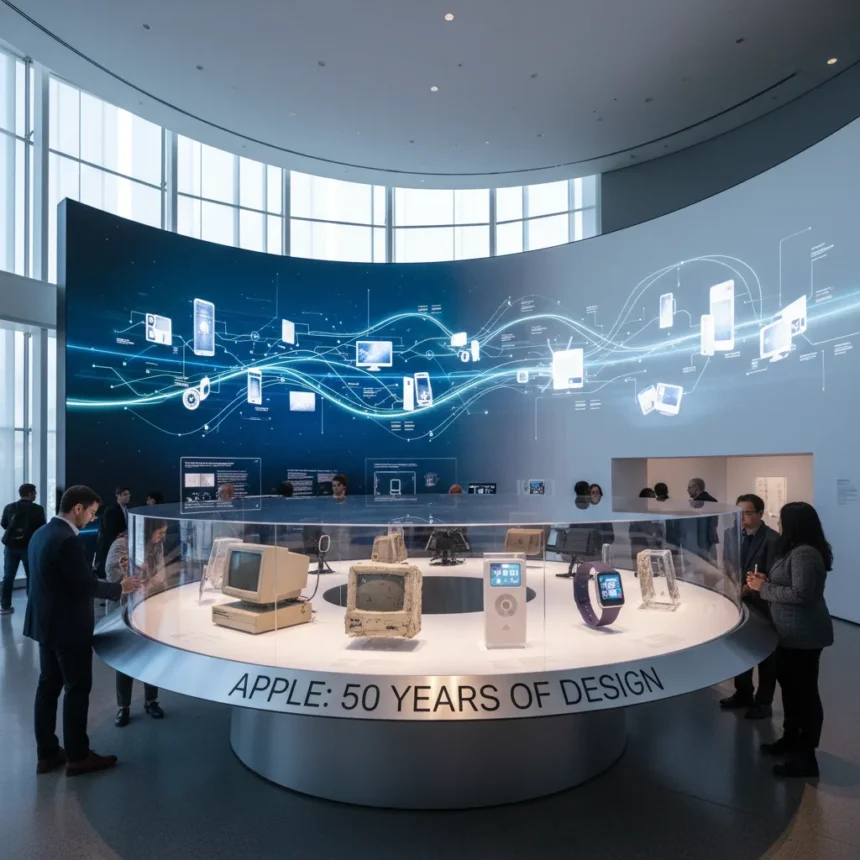
Apple’s 50-year design legacy began in a garage on April 1, 1976, when Steve Jobs and Steve Wozniak launched a company built on a single principle: technology should be personal. Five decades later, that philosophy—captured in the phrase “thinking different”—has shaped how billions interact with computers, phones, and wearables.
Key Takeaways
- Apple was founded April 1, 1976, by Steve Jobs and Steve Wozniak in a garage.
- The Computer History Museum hosts Apple@50 exhibit until September 7, 2026, featuring rare prototypes and monthly demos.
- Iconic products include the Apple II, Macintosh, iPod, iPhone, iPad, and Apple Watch.
- Tim Cook’s letter reflects on 50 years of innovation and community recognition.
- Apple’s designs are recognized in museums like MoMA for cultural significance.
How Apple’s 50-year design legacy redefined personal computing
The Apple 50-year design legacy rests on a simple but radical idea: computing power should empower individuals, not confine them to corporate mainframes. The Apple II, launched in 1977, brought color graphics and expandability to the mass market for the first time. The Macintosh followed, democratizing computing by making graphical interfaces intuitive. Each product iteration—from the iPod’s elegant scroll wheel to the iPhone’s touchscreen—eliminated unnecessary complexity and placed power directly in users’ hands.
This design philosophy extended beyond hardware. Apple’s services ecosystem—the App Store, Apple Music, Apple Pay, iCloud, and Apple TV+—tied devices together with the same principle: intuitive design that feels invisible. The result is an integrated experience that competitors have spent decades trying to replicate but rarely match. Where other companies layered features on top of features, Apple removed what users didn’t need.
The rare prototypes behind Apple’s 50-year design legacy
The Computer History Museum’s Apple@50 exhibit, open until September 7, 2026, displays the physical artifacts that tell this story. Visitors can see the original Apple I and Apple IIc, the Lisa and Macintosh that pioneered graphical computing, the Newton that imagined mobile devices before smartphones existed, and the first iPod and iPhone—each a turning point in how humans interact with technology.


The exhibit goes beyond display cases. A curated audio tour walks visitors through the timeline of milestones, and a featured interview with Paul Terrell, the first retailer to stock the Apple I, provides firsthand perspective on the company’s unlikely rise from hobbyist project to cultural force. Monthly demos run 2–4 PM PST on the 2nd and 4th Saturday of every month from March 14 through September, included with general admission. These hands-on sessions let visitors interact with working prototypes and understand the engineering decisions that shaped each era.
Why Apple’s 50-year design legacy matters beyond the tech world
Apple’s influence extends far beyond quarterly earnings. The company’s designs are housed in museums like MoMA, recognized not as tech gadgets but as cultural artifacts. The Apple Watch introduced health monitoring—heart rate, fall detection, ECG—to a wearable that people actually wanted to wear, normalizing personal health tracking. The iPad created an entirely new product category in 2010, proving that tablets could be more than oversized phones.



Tim Cook, Apple’s CEO, reflected on this legacy in a letter shared on apple.com: “Thinking different has always been at the heart of Apple. It’s what has driven us to create products that empower people to express themselves, to connect, and to create something wonderful”. That statement captures why Apple’s 50-year design legacy matters. The company didn’t just sell devices—it changed what billions of people expected from technology.
How Apple’s 50-year design legacy shaped the smartphone era
Before the iPhone, smartphones were tools for professionals: small screens, physical keyboards, steep learning curves. Apple’s approach was different. The iPhone removed the keyboard, enlarged the screen, and made touch intuitive. It created the app economy, allowing third-party developers to extend functionality in ways Apple never imagined. That single product spawned an industry worth trillions and fundamentally altered how humans access information, communicate, and create.
The iPad followed a similar pattern. When the device launched in 2010, skeptics called it an oversized iPod touch with no purpose. Instead, it became the template for tablets worldwide and proved that Apple’s 50-year design legacy wasn’t about following trends—it was about creating categories others would chase.
What does Apple’s 50-year design legacy reveal about the future?
Apple marked its 50th anniversary on April 1, 2026, with global celebrations announced on March 30, 2026. The company reflected not just on past innovations but on emerging technologies like Apple Vision Pro, signaling that the philosophy of personal, intuitive technology continues to guide product development. The Computer History Museum exhibit, open through September 2026, serves as both retrospective and prologue—a reminder of where Apple came from and a hint at where the company’s design thinking might lead next.



Is the Computer History Museum exhibit free to visit?
The Apple@50 exhibit and monthly demos are included with general admission to the Computer History Museum. Visitors can purchase tickets through the museum’s website. The demos, held 2–4 PM PST on the 2nd and 4th Saturday monthly from March through September, offer hands-on access to working prototypes at no additional cost.
What products are on display at the Apple@50 exhibit?
The exhibit features rare prototypes including the Apple I, Apple IIc, Lisa, Macintosh, Newton, iPod, and iPhone. Each represents a major inflection point in computing history. The museum also includes an audio tour, a timeline of milestones, and an interview with Paul Terrell, the first retailer to sell the Apple I.
Why did Apple emphasize “thinking different” as its core philosophy?
“Thinking different” captured Apple’s belief that technology should empower individuals rather than constrain them. This philosophy drove the company to strip away unnecessary complexity, create intuitive interfaces, and design products that felt personal rather than corporate. It became the lens through which Apple evaluated every feature, every interface, and every product decision across five decades.
Apple’s 50-year design legacy proves that longevity in tech isn’t about chasing every trend or packing products with features. It’s about understanding what people actually need, removing everything else, and designing so well that the technology disappears. That principle, born in a garage in 1976, remains as relevant today as it was when the first Apple II shipped.
Edited by the All Things Geek team.
Source: Tom's Guide