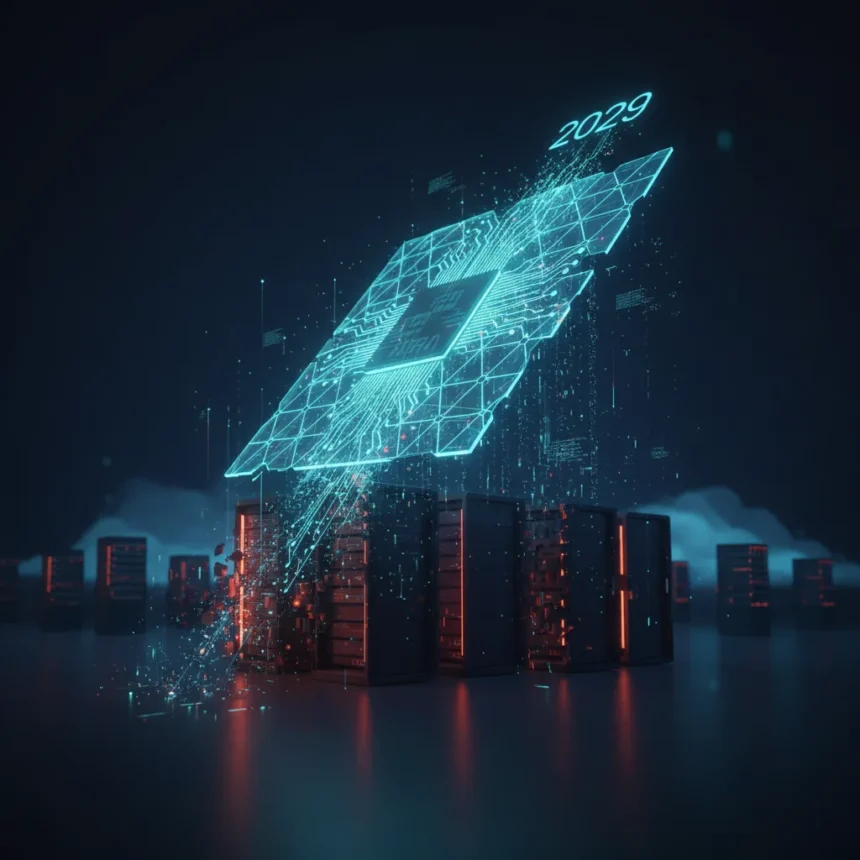
Arm chips are positioned to dominate AI server deployments, with research projecting that Arm-based custom processors will power 90% of AI server CPU installations by 2029. This dramatic shift reflects a fundamental realignment in data center infrastructure, where hyperscalers like Amazon, Google, Meta, and Microsoft are abandoning off-the-shelf x86 processors in favor of proprietary silicon tailored to their specific workloads.
Key Takeaways
- Arm-based custom CPUs projected to capture 90% of AI server market by 2029, marginalizing x86 and RISC-V
- Arm launched its AGI CPU in March 2026, delivering 2x performance per rack versus x86 alternatives
- Hyperscalers including Meta and OpenAI are now customers requesting finished Arm processors, not just IP licenses
- Custom Arm silicon enables up to $10 billion in CAPEX savings per gigawatt of data center capacity
- Arm’s shift from IP licensing to direct silicon manufacturing marks a historic business model transformation
Why Hyperscalers Are Abandoning x86 for Arm Chips
The migration toward Arm chips in AI servers stems from a single advantage: architectural flexibility. Unlike x86’s rigid instruction set, Arm’s design allows companies to customize processors at a fundamental level, integrating proprietary interconnects, memory subsystems, and compute architectures that x86 vendors cannot match. This customization enables hyperscalers to optimize for their exact workload requirements rather than accepting generic trade-offs baked into commercial CPUs.
Meta was the first major customer to request that Arm provide finished CPU parts rather than just architectural designs, with OpenAI following closely behind. This shift signals a critical turning point: Arm is no longer merely licensing intellectual property. The company is now competing directly with Intel and AMD by manufacturing its own silicon, fundamentally reshaping the competitive landscape.
For hyperscalers operating at planetary scale, even marginal efficiency gains translate to enormous cost savings. The economics are stark: custom Arm silicon can potentially enable up to $10 billion in CAPEX savings per gigawatt of AI data center capacity, according to early projections. At that scale, the difference between a generic CPU and a purpose-built processor becomes a line item on corporate balance sheets.


Arm’s AGI CPU: The Product That Changes Everything
On March 24, 2026, Arm announced its first proprietary production silicon, the Arm AGI CPU, built on the Neoverse V3 platform with 136 cores in a 300-watt envelope. This is not a minor product refresh. This is Arm’s declaration that it is now a silicon manufacturer, not just an IP licensor. The AGI CPU is purpose-built for agentic AI orchestration—the emerging workload category that defines next-generation data centers.
The performance claims are substantial: the AGI CPU delivers more than 2x performance per rack compared to x86 CPUs. That metric matters because hyperscalers measure success in performance per kilowatt and performance per dollar spent. A 2x advantage is not a marginal win. It is transformational. Multiple ODMs and customers are already committed to production, indicating that the AGI CPU is not vaporware—it has real demand before it ships at scale.



The Market Collapse for x86 and RISC-V in AI
The 90% projection for Arm chips by 2029 is not hyperbole. It reflects a fundamental architectural mismatch between x86 and the needs of modern AI infrastructure. x86 processors were designed for general-purpose computing, with instruction sets optimized for a broad range of workloads. That flexibility is a liability in specialized domains like AI training and inference, where workload patterns are known and repetitive.
RISC-V, the open-source instruction set architecture, fares even worse. While RISC-V has attracted academic interest and niche applications, it lacks the ecosystem maturity, manufacturing partnerships, and customer relationships that Arm now possesses. By 2029, RISC-V will likely remain a theoretical alternative rather than a practical competitor in hyperscaler deployments.
Intel and AMD face a strategic crisis. They cannot match the customization advantages of Arm, and they are locked into x86 compatibility requirements that limit their ability to innovate. Hyperscalers are not waiting for x86 vendors to evolve. They are moving now, and by the time Intel or AMD develop competitive alternatives, Arm’s 90% market share will be locked in through long-term supply agreements and integration lock-in.
What This Means for the Data Center Industry
This shift represents a permanent structural change in how data centers are built. For decades, x86 dominance was treated as inevitable. Hyperscalers bought commodity CPUs from Intel or AMD, accepted the performance characteristics, and optimized their software around hardware constraints. That model is dead.


The new model is vertical integration. Hyperscalers design their own silicon, control their entire stack from instruction set to memory hierarchy, and extract every joule of efficiency from their infrastructure. Arm’s willingness to license its architecture to custom silicon manufacturers—and now to compete directly with its own AGI CPU—has made this transition viable at scale.
Smaller cloud providers and enterprises without the resources to design custom silicon will face a dilemma: adopt Arm-based instances from hyperscalers, or pay a premium for legacy x86 infrastructure that becomes increasingly obsolete. The economics will eventually force consolidation toward Arm.
Is Arm’s dominance guaranteed?
The 90% projection assumes that Arm continues to execute on its manufacturing partnerships and that hyperscalers continue to prioritize custom silicon over off-the-shelf solutions. Both assumptions appear sound, but they are not risk-free. If Arm stumbles on production capacity or if the AGI CPU underperforms in real-world deployments, the timeline could slip. However, the underlying economic incentives are so strong that even a delay would not reverse the trend—only postpone it.
Will x86 disappear entirely from data centers?
No. Legacy applications, traditional databases, and non-AI workloads will continue to run on x86 for decades. However, the strategic center of gravity in data center spending is shifting decisively toward AI infrastructure, where Arm chips are now the default choice. x86 will become a shrinking legacy segment, not the dominant architecture.
What should enterprises do about this shift?
Organizations deploying AI workloads should begin evaluating Arm-based instances from cloud providers now, rather than waiting until 2029 when x86 options become scarce and expensive. Early adoption of Arm-optimized software and infrastructure will provide competitive advantages as hyperscalers pass through efficiency gains to customers. Betting on x86 for new AI projects is betting against the entire industry’s direction.
The data center industry’s shift toward Arm chips is not speculation—it is already underway. By 2029, the 90% projection will likely seem conservative. The question for enterprises is not whether Arm will dominate AI servers, but how quickly they can adapt their infrastructure and applications to capture the efficiency gains that custom silicon delivers.
Edited by the All Things Geek team.
Source: Tom's Hardware