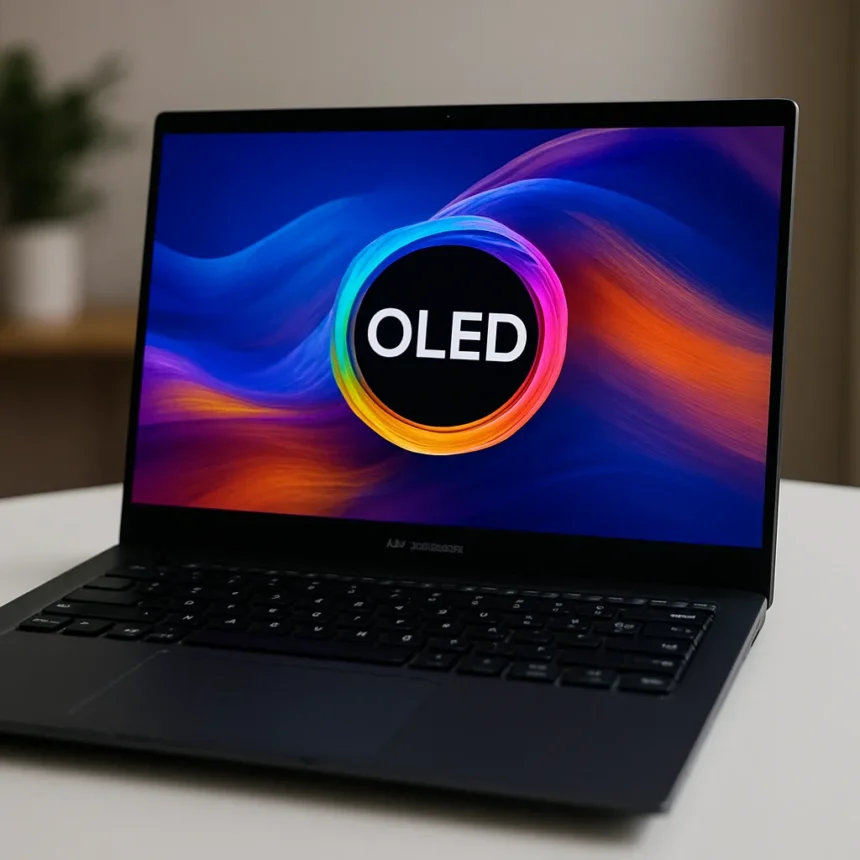
The ASUS Zenbook A14 is a 14-inch OLED Windows laptop made by ASUS, powered by the Snapdragon X2 Elite processor, and available at $699 after a $300 Best Buy discount in its base 16GB configuration. It weighs just 990g, runs Windows 11, and delivers the one thing Apple’s MacBook Neo conspicuously refuses to include: an OLED display. That omission matters, and ASUS knows it.
TL;DR: The ASUS Zenbook A14 offers a 14-inch OLED display, an 18-core Snapdragon X2 Elite chip, and over 33 hours of continuous video playback battery life at $699 — specs that make the MacBook Neo look overpriced and underpowered for creative and mobile users.
What makes the ASUS Zenbook A14 worth buying right now
The ASUS Zenbook A14 lands at a price point that should make Apple uncomfortable. At $699, it delivers a 14-inch WUXGA OLED panel with 100% DCI-P3 color coverage, 0.2ms response time, and TÜV Rheinland certification — the kind of display quality that belongs in laptops costing twice as much.
Under the hood, the Snapdragon X2 Elite (X2E88100) is no entry-level chip. It runs 18 cores across 18 threads, boosts to 4.7GHz on a single core, and delivers up to 4.0GHz across all cores simultaneously — with 53MB of cache and 152GB/s memory bandwidth. The Qualcomm Hexagon NPU pushes up to 80 TOPS of AI performance, which qualifies the Zenbook A14 as a Windows 11 Copilot+ PC. That matters for anyone running local AI workloads, whether that’s real-time transcription, image generation, or on-device translation.


The chassis is made from Ceraluminum, ASUS’s proprietary aluminum-ceramic material, keeping the entire machine under one kilogram. That’s genuinely sub-1kg territory — a category most Windows laptops can’t touch without compromising on build quality or thermals.
ASUS Zenbook A14 OLED display vs MacBook Neo LCD
The MacBook Neo ships without an OLED display. That’s the story. Apple’s decision to stick with LCD panels in its more affordable MacBook lines means buyers who want true blacks, per-pixel dimming, and professional-grade color accuracy have to look elsewhere — and the ASUS Zenbook A14 is right there waiting.



The Zenbook A14’s OLED panel runs at a 16:10 aspect ratio with 1920×1200 resolution, a 90% screen-to-body ratio, and a peak brightness range of 400 to 600 nits in HDR mode. The 60Hz refresh rate is the one concession here — competing ASUS models like the Zenbook A16 push 120Hz on a 2880×1800 OLED touch panel — but for document work, creative editing, and video consumption at this price, 60Hz is entirely acceptable.
Is a 60Hz OLED better than a 120Hz LCD? For most users who aren’t gaming competitively, yes. The color depth and contrast ratio of OLED at 60Hz beats the motion smoothness of a washed-out LCD at 120Hz for real-world productivity and media use.
Battery life: where the Zenbook A14 pulls further ahead
ASUS claims up to 35 hours of video playback, and independent testing has recorded over 33 hours of continuous playback — numbers that put most Windows ultraportables to shame. The 70Whr battery supports 100W fast charging, reaching 50% in around 30 minutes. ASUS also rates the battery for 1.2x standard lifespan, suggesting longer-term durability than typical lithium cells.
Real-world battery performance will vary depending on workload, screen brightness, and connectivity settings — ASUS’s figures are based on specific test conditions. But even discounting for real-world use, this is a machine that comfortably survives a full working day without hunting for a power outlet.



How does the ASUS Zenbook A14 compare to other Zenbook models?
The Zenbook A14 sits at the accessible end of ASUS’s 2026 refresh lineup, but it’s not alone. The Zenbook A16 steps up to the Snapdragon X2 Elite Extreme, 48GB of LPDDR5X RAM, a 1TB SSD, and a 16-inch 2880×1800 OLED touchscreen at 120Hz. For buyers who need more screen real estate or heavier multitasking headroom, the A16 is the natural next step.
Within the 14-inch tier, ASUS also offers AMD and Intel variants. The AMD model runs a Ryzen AI 5 440 with RDNA 3.5 graphics, while the Intel version pairs a Core Ultra 8 285H with Intel Arc 140T graphics and bumps the display to 120Hz OLED. The Snapdragon X2 Elite version of the A14 is the pick for AI-heavy workloads and maximum battery efficiency, while the Intel variant suits users who need faster display refresh rates and broader app compatibility.
Is the ASUS Zenbook A14 good for AI workloads?
The Qualcomm Hexagon NPU inside the Zenbook A14 delivers up to 80 TOPS of AI performance, which is among the highest available in this laptop category. This qualifies it for Windows 11’s Copilot+ feature set, enabling on-device AI tasks without routing data to the cloud. For professionals handling sensitive data — legal, medical, financial — local AI processing is a genuine differentiator, not a marketing bullet point.
What are the connectivity options on the Zenbook A14?
The Zenbook A14 supports Wi-Fi 7 (802.11be) with triple-band 2×2 configuration and Bluetooth 5.4. It includes a full port selection with an audio combo jack and supports output to up to four simultaneous displays — a feature that makes it a credible desktop replacement when docked, not just a travel machine.
Does the Zenbook A14 run hot or loud?
Under light tasks, the Zenbook A14 operates below 25dB — quieter than a library whisper. ASUS also cites a 15% improvement in fan back pressure resistance, meaning the cooling system maintains airflow efficiency even in a compact chassis. For anyone who’s suffered through a thin-and-light that sounds like a jet engine during a Teams call, that’s a meaningful engineering choice.
The ASUS Zenbook A14 is the rare Windows ultraportable that wins on specs, wins on price, and wins on portability simultaneously. Apple’s refusal to put OLED in the MacBook Neo isn’t a mystery — it’s a cost decision — but it leaves a gap that ASUS is filling with confidence. At $699 with an 18-core Snapdragon chip, 33-hour battery, and a display that genuinely earns the word beautiful, the Zenbook A14 doesn’t just compete with the MacBook Neo. It makes the argument that you’d have to actively choose to spend more for less.
Edited by the All Things Geek team.
Source: Windows Central