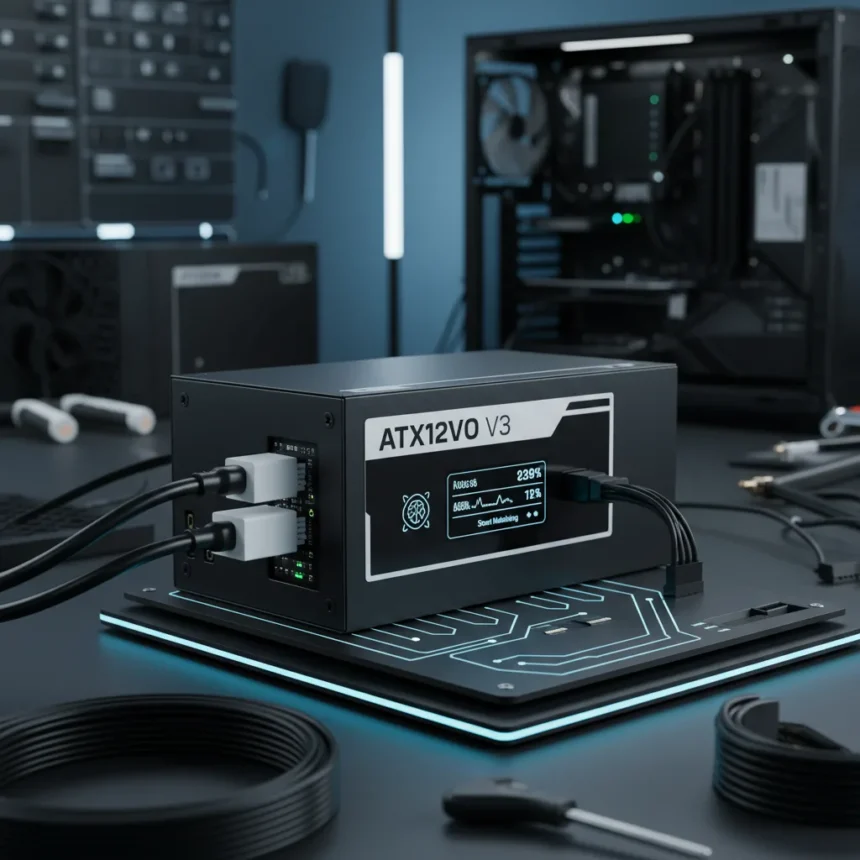
The ATX12VO V3 standard represents Intel’s latest push toward simpler, more efficient desktop power supplies by delivering 12V power exclusively and adding smarter monitoring capabilities. This 12V-only approach shifts voltage regulation from the power supply to the motherboard, fundamentally changing how PC components receive power.
Key Takeaways
- ATX12VO V3 delivers only 12V power, with the motherboard stepping down voltage for components needing 3.3V or 5V
- The standard uses smaller main power connectors compared to traditional 24-pin ATX designs
- PMBus support enables advanced power supply monitoring and telemetry
- Intel finalized ATX 12V v3.0 guidance on February 1, 2022
- The design simplifies PSU manufacturing while improving efficiency and durability
How ATX12VO V3 Simplifies Power Delivery
The ATX12VO V3 standard eliminates the complexity of multi-voltage power supplies by requiring PSUs to deliver only a single 12V rail. Traditionally, desktop PSUs juggle 3.3V, 5V, and 12V outputs simultaneously, adding cost and design overhead. In the ATX12VO V3 model, the motherboard contains the hardware to step down the 12V supply to lower voltages for components such as RAM, SSDs, and USB devices that require them. This allows the ATX12VO PSU to be much simpler in design, theoretically reducing manufacturing complexity and improving reliability.
The smaller connector footprint is a practical benefit for system builders. Rather than the bulky 24-pin main connector found on traditional ATX supplies, ATX12VO V3 uses a more compact 8-pin connector design, freeing up space inside the chassis and simplifying cable routing.
ATX12VO V3 vs. Traditional ATX and ATX 3.0
The distinction between ATX12VO V3 and Intel’s broader ATX 3.0 standard matters for understanding where the industry is headed. ATX 3.0 retains the traditional 24-pin main connector and adds high-power GPU support through the new 16-pin 12VHPWR connector, capable of delivering up to 600W to add-in cards. ATX12VO V3, by contrast, abandons the multi-voltage design altogether in favor of 12V-only delivery with an 8-pin connector.


This creates an interesting transition period. Enermax has demonstrated a PSU platform supporting both ATX 3.0 and ATX12VO in a single unit, showing that manufacturers are preparing for an ecosystem where both standards coexist. The industry is not making an abrupt switch; instead, it is hedging bets on which architecture will dominate next-generation systems.
Smarter Monitoring with PMBus Support
One of the most significant additions in ATX12VO V3 is PMBus (Power Management Bus) support, which enables advanced telemetry and real-time monitoring of power supply health. This allows motherboards and system management software to track PSU performance, temperature, and efficiency metrics directly, moving beyond the passive role traditional supplies play in a PC.



Intel’s published design guidelines for ATX12VO V3 require comprehensive protections including overvoltage protection (OVP), short-circuit protection (SCP), no-load protection, and overcurrent protection (OCP). These safeguards, combined with PMBus monitoring, create a more intelligent and responsive power delivery ecosystem. System builders and overclockers gain visibility into power supply behavior that was previously invisible.
Efficiency Gains and Design Benefits
By consolidating voltage regulation onto the motherboard, ATX12VO V3 PSUs can focus on what they do best: delivering stable 12V power efficiently. The single-rail architecture reduces the overhead of managing multiple voltage domains, potentially improving overall efficiency. Intel’s earlier ATX v3.0 guidance set ambitious efficiency targets, with recommendations for above 60% efficiency at 10W or 2% of max-rated capacity, and 70% as an aspirational benchmark.
The smaller, lighter design also appeals to system builders working with compact cases or fanless builds. By removing the bulk of a traditional 24-pin connector and its associated wiring, ATX12VO V3 PSUs can be manufactured more compactly without sacrificing capacity.
What This Means for PC Builders
ATX12VO V3 adoption will likely be gradual. Motherboard manufacturers must redesign their voltage regulation modules to handle 12V-to-lower-voltage conversion, and PSU makers must retool their designs. However, the long-term direction is clear: Intel is pushing the industry toward simpler, more efficient power architectures. Builders should expect ATX12VO V3-compatible systems to emerge as manufacturers integrate the standard into next-generation platforms.



The monitoring capabilities also open doors for advanced power management software, allowing users to diagnose power delivery issues more easily and optimize system performance based on real-time PSU telemetry.
Will ATX12VO V3 replace traditional ATX PSUs?
Not immediately. Traditional ATX supplies will remain common for several years as the ecosystem transitions. However, ATX12VO V3 represents the future direction for new builds, particularly high-end systems where efficiency and compact design matter most.
What is the 8-pin connector in ATX12VO V3?
The 8-pin connector is the new main power connector for ATX12VO V3 PSUs, replacing the traditional 24-pin design. It carries 12V power to the motherboard, which then regulates lower voltages internally.
Does ATX12VO V3 work with older motherboards?
No. ATX12VO V3 requires motherboards specifically designed with the necessary voltage regulation hardware to step down 12V to 3.3V and 5V. Older ATX motherboards cannot use ATX12VO V3 supplies.
The ATX12VO V3 standard marks a meaningful shift in how desktop PCs will receive power. By simplifying PSU design, shrinking connectors, and adding intelligent monitoring, Intel is laying groundwork for more efficient and compact systems. For PC builders, this means watching for motherboard and PSU compatibility as manufacturers adopt the standard over the coming years.
Edited by the All Things Geek team.
Source: Tom's Hardware