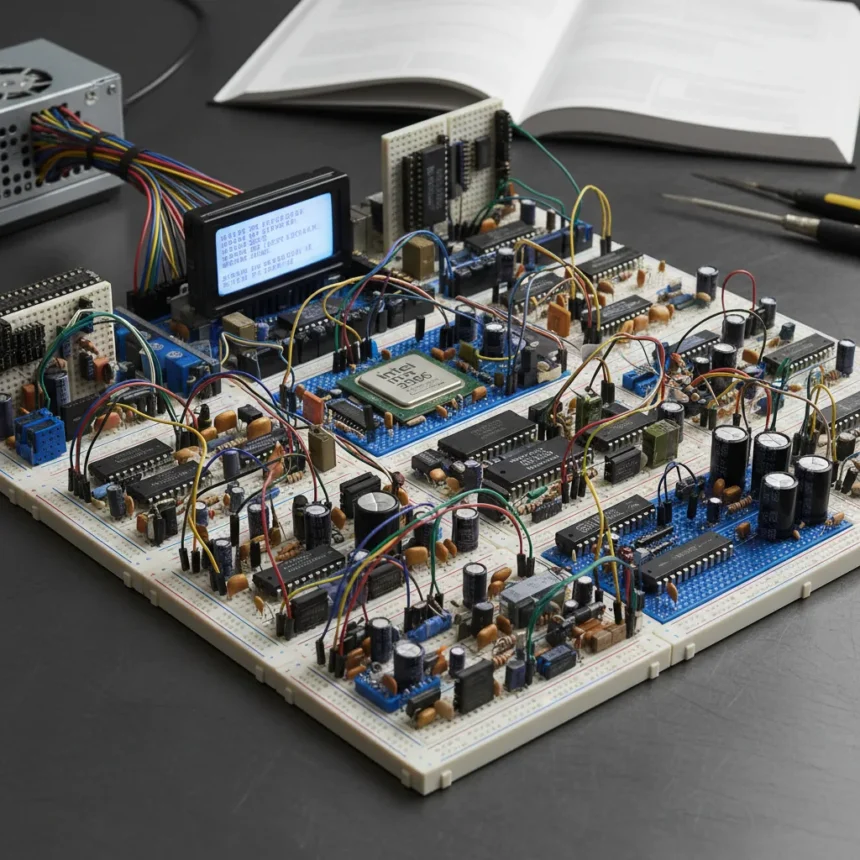
A breadboard-based Intel 386 system is the latest extreme in solderless retro computing, pushing the boundaries of what enthusiasts can build without a traditional motherboard. Breadboarding Labs has announced plans to construct a fully functional 386-based PC using only solderless breadboards, a dramatic escalation from their prior successes with Intel 8088-based PC-XT and PC-AT systems.
Key Takeaways
- Breadboarding Labs is building a breadboard-based Intel 386 system inspired by Compaq’s DeskPro 386 architecture.
- The 80386 CPU has 136 pins, vastly more complex than the 8088’s 40-pin design used in prior builds.
- Project reuses components from earlier PC-XT and PC-AT breadboard builds, including clock controllers, video interfaces, and port logic.
- New additions required include 32-bit RAM support, VGA video, PS/2 input, and a 3.5-inch floppy drive controller.
- Work begins with a custom 386 CPU breadboard adapter to handle the increased pin count and signal complexity.
Why This Breadboard-Based Intel 386 System Matters
The breadboard-based Intel 386 system represents a quantum leap in complexity compared to earlier 8088-based breadboard projects. The 80386 processor features 136 pins versus the 8088’s 40, forcing builders to manage exponentially more signal routing, bus arbitration, and timing constraints on solderless breadboards. This is not theoretical—Breadboarding Labs has already proven the concept works at smaller scales, making this escalation credible rather than speculative.
Retro computing has exploded as a hobby, but most enthusiasts either restore vintage hardware or design custom PCBs. The breadboard approach occupies a strange middle ground: it is slower than PCBs, more fragile than soldered circuits, yet offers complete transparency and modularity that traditional builds cannot match. Every component connection is visible and adjustable, turning the breadboard itself into a teaching tool.
What Makes the 386 Breadboard Project Different From Prior Builds
Breadboarding Labs’ earlier PC-XT and PC-AT systems, both built around the Intel 8088, established proof of concept for the approach. Those builds demonstrated that solderless breadboards could handle the clock generation, bus control, interrupt logic, and basic video output needed for functional retro PCs. The 386 project reuses much of that infrastructure—the clock and bus controller, interrupt controllers, timer logic, and video interfaces all carry forward from the 8088 designs.


The new system demands entirely fresh components for 32-bit memory addressing, a 16-bit ISA bus interface, DMA (direct memory access) logic, variable-speed clock control down to 8 MHz, and VGA graphics support. The 386 also requires PS/2 keyboard and mouse support and a 3.5-inch floppy drive controller, neither of which appeared in the simpler 8088 systems. This is not a minor upgrade—it is an architectural redesign that happens to reuse some proven modules.
Comparative Context: How This Differs From Other 386 Retro Projects
Other engineers have tackled 386 system design, but through different methods. Alexandru Groza built an 80386DX ISA single-board microcomputer using period-correct components sourced from auctions and flea markets, incorporating an OPTi chipset and 2 MB of RAM. Pierre Surply took a modern approach, using an Altera Cyclone IV FPGA to emulate the chipset and bus logic around an 80386SX, adding USB and JTAG debugging for development convenience. Phil’s Computer Lab assembled a 386DX running at 40 MHz with Sound Blaster Pro 2 audio and a Roland MT-32 synthesizer, mixing period components with modern conveniences for DOS gaming.



The breadboard-based Intel 386 system stands apart because it abandons PCBs entirely, embracing solderless construction for maximum modularity and visibility. This makes it slower and more prone to signal integrity issues than any of the above approaches, but it also makes every design decision reversible and every component swappable without desoldering. For education and experimentation, that transparency is invaluable.
What Happens Next: The CPU Adapter Phase
The project is currently in its earliest phase, with work beginning on a breadboard adapter for the 80386 CPU itself. This adapter is the critical first step—it must route all 136 pins into solderless breadboard sockets while maintaining proper signal integrity and power distribution. Once the CPU interface is functional, the team can add the memory bus, bus controller, and interrupt logic, then layer in the more complex subsystems like DMA and variable-speed clock control.
No timeline or completion date has been announced, and the full schematics remain unreleased. The project is ambitious enough that delays would not be surprising—routing 136 CPU pins plus the supporting bus logic, memory controller, video subsystem, and peripheral interfaces on breadboards is a significant undertaking.
Can a Breadboard-Based Intel 386 System Actually Work?
Yes, in theory and increasingly in practice. Breadboarding Labs’ track record with the 8088-based systems proves that the fundamental approach is sound. The 386 is more demanding, but it is not a fundamentally different architecture—it is a 32-bit evolution of the same x86 lineage. Signal integrity is the main risk; breadboards introduce stray capacitance and inductance that can cause timing violations on high-speed buses. At 8 to 16 MHz, the 386 breadboard project should remain within manageable limits, though the team will need careful layout and possibly signal conditioning.



Will This Project Influence Other Retro Builders?
If successful, yes. The breadboard-based Intel 386 system could inspire a wave of similar projects, particularly among educators and hobbyists who value transparency and modularity over performance. The detailed documentation from Breadboarding Labs’ prior builds has already influenced the retro computing community, and a 386 breadboard success would likely spawn clones and variations. However, the project must first reach a functional state—until then, it remains an ambitious plan rather than a proven method.
Is a breadboard-based Intel 386 system actually practical to use?
Practically speaking, no. Breadboards are fragile, prone to loose connections, and limited in speed compared to PCBs or soldered circuits. A breadboard 386 would boot and run simple software, but it would not rival a restored vintage 386 or a modern FPGA-based 386 emulator for reliability or performance. The value lies in learning and experimentation, not in building a daily-use computer.
How much faster is the 386 than the 8088 in these breadboard builds?
The 386 can run at 16 MHz in this breadboard project, while the 8088 systems likely operated in the 4 to 8 MHz range. Raw speed is not the main advantage, though—the 386 brings 32-bit processing, extended memory addressing, and protected mode capabilities that the 8088 lacks entirely.
Why does the 386 breadboard project need VGA support when the 8088 used MDA and CGA?
VGA represents the video standard that dominated the 386 era, making it the natural choice for a system inspired by Compaq’s DeskPro 386. The earlier MDA and CGA video controllers were simpler and lower-bandwidth, suitable for 8088 systems; VGA’s 256-color modes and higher resolution demand more complex logic but deliver the authentic 386-era experience.
The breadboard-based Intel 386 system is a fascinating intersection of nostalgia, engineering ambition, and solderless experimentation. It will not replace PCB-based retro builds or FPGA emulators, but it offers something unique: a fully transparent, modular, hands-on approach to understanding how a 386 actually works. If Breadboarding Labs delivers, the project could become a landmark in hobbyist retro computing and a blueprint for others pursuing extreme solderless builds.
Edited by the All Things Geek team.
Source: Tom's Hardware