





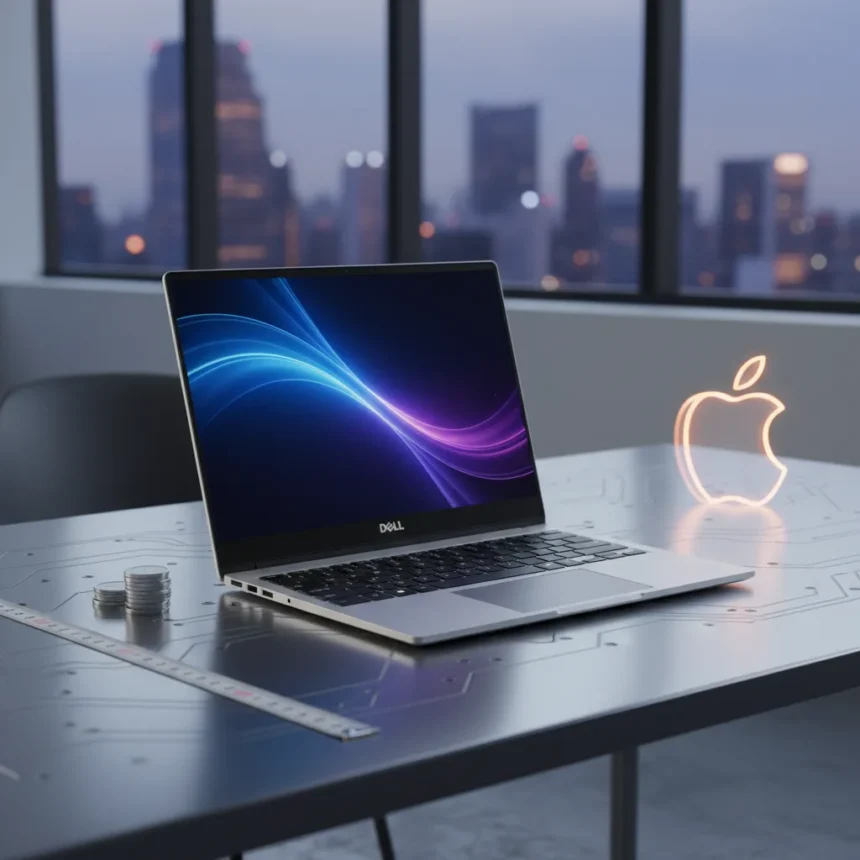
The Dell XPS 13 is a Windows ultrabook made by Dell, redesigned as the thinnest and lightest model in the XPS lineup, and positioned directly against Apple’s MacBook Air as a premium portable laptop. Dell announced the new model as available today, with coverage from Tom’s Hardware confirming a starting price of $999. The redesign is significant enough that Tom’s Guide framed it as a potential MacBook Neo challenger — bold language, but not entirely without basis.
Key Takeaways
- The new Dell XPS 13 measures 0.55 inches thick and weighs 2.59 pounds, making it Dell’s slimmest XPS to date.
- Dell achieved the thinner chassis by using a miniaturised motherboard design rather than a conventional layout.
- The XPS 13 uses Intel’s 12th Gen U-series chips, which are less powerful but more efficient than the P-series used in the XPS 13 Plus.
- A redesigned XPS 13 2-in-1 is also coming later in the summer as part of the same refresh.
- Tom’s Hardware confirms the new XPS 13 starts at $999 and is available now.
What makes the Dell XPS 13 redesign worth paying attention to?
The Dell XPS 13 redesign centres on a genuinely miniaturised motherboard that allows Dell to push the chassis to just 0.55 inches thick and keep the weight at 2.59 pounds. That is not a minor spec tweak — it represents a fundamental rethink of how the internals are arranged. For a Windows ultrabook to match MacBook Air dimensions, the engineering has to be serious.
Dell made a deliberate trade-off to get there. The new XPS 13 uses Intel’s 12th Gen U-series chips rather than the more powerful P-series found in the XPS 13 Plus. The U-series runs at a lower wattage, which means less heat, a thinner cooling solution, and ultimately a slimmer machine. Whether that trade-off suits you depends entirely on what you’re doing with the laptop.
Dell XPS 13 vs MacBook Air: how does the competition actually stack up?
The Dell XPS 13 is being compared to Apple’s MacBook Air because the dimensions and weight class are directly comparable, and Dell is clearly targeting buyers who want MacBook-level portability without committing to Apple’s ecosystem. At 0.55 inches thin and 2.59 pounds, the XPS 13 sits in the same physical territory as the MacBook Air, which has long defined what a premium thin-and-light laptop should feel like.


The XPS 13 Plus, Dell’s higher-powered sibling, started at $1,199 in spring 2022 and used a 12th Gen Intel Core chip rated for 28W — compared with 15W on the standard XPS 13 at that time. The Plus offered more performance but came with design compromises that drew criticism, including choices that echoed some of the less-loved decisions Apple made and then reversed on its own MacBook Pro line. The standard XPS 13 avoids most of those controversies by keeping the design cleaner and the priorities clearer.
Apple’s MacBook Air remains the benchmark for what a mainstream ultrabook should deliver: excellent battery life, a fanless design, and tight software-hardware integration. The XPS 13 can match it on portability metrics, but Windows users know that software optimisation rarely reaches the same level of polish. That gap is real, even if the hardware specs look comparable on paper.



Is the Dell XPS 13 the right ultrabook for most buyers?
For anyone who needs a Windows machine and wants the most portable option Dell makes, the new XPS 13 is the clearest answer in the current lineup. The 0.55-inch chassis and sub-2.6-pound weight make it genuinely easy to carry daily, and the miniaturised motherboard design shows Dell is thinking seriously about competing with Apple on physical form factor rather than just spec sheets.
The U-series chip choice will disappoint buyers who want to run demanding workloads. If you need sustained performance for video editing, heavy multitasking, or running local AI tools, the lower wattage ceiling of the U-series will become noticeable. The XPS 13 Plus exists for those users, though it starts higher and brings its own compromises. For productivity, travel, and everyday use, the standard XPS 13 makes more sense for most people.
Dell also confirmed that a redesigned XPS 13 2-in-1 is coming later in the summer as part of the same product refresh. Buyers who want touchscreen flexibility or a tablet mode should wait to see what that model offers before committing to the clamshell version.
How much does the new Dell XPS 13 cost?
Tom’s Hardware confirms the new Dell XPS 13 starts at $999 and is available now. Note that some coverage has referenced a lower entry price, but the $999 figure is the one corroborated by hardware-focused announcement coverage. Dell’s XPS line has historically offered multiple configurations, so higher-spec variants will cost more.



How does the Dell XPS 13 compare to the XPS 13 Plus?
The XPS 13 Plus uses a more powerful 12th Gen Intel chip rated for 28W versus the 15W U-series in the standard XPS 13, and it launched at $1,199 in spring 2022. The Plus delivers more sustained performance but is thicker and heavier as a result. For most users who prioritise portability over raw power, the standard XPS 13 is the better fit.
Is the Dell XPS 13 a genuine MacBook Air alternative?
On portability metrics alone, yes. At 0.55 inches thick and 2.59 pounds, the Dell XPS 13 matches the MacBook Air’s physical profile closely enough to belong in the same conversation. The real question is whether Windows on this hardware delivers the same day-to-day experience as macOS on Apple Silicon — and that gap is harder to close with a spec sheet than with actual software optimisation.
The Dell XPS 13 is a serious ultrabook that earns its place in the premium laptop market. Dell has done the hard engineering work to get the chassis this thin, made a sensible chip choice for the target audience, and priced it to compete. It won’t convert committed Mac users, but for Windows buyers who want the most portable XPS money can buy, this is the one to get.
Edited by the All Things Geek team.
Source: Tom's Guide




