





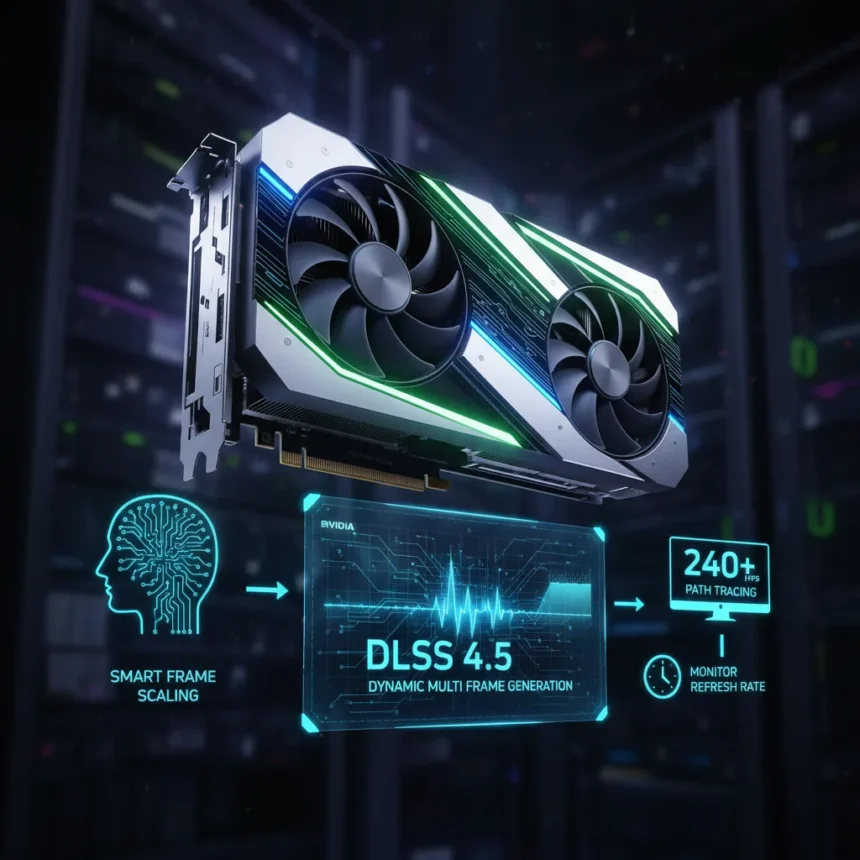
DLSS 4.5 Dynamic Multi Frame Generation is Nvidia’s latest frame-generation system for GeForce RTX 50-series GPUs, launching March 31, 2026, that automatically adjusts frame multipliers to match your monitor’s refresh rate, eliminating the need for manual tuning. The feature functions like an automatic transmission for your GPU, shifting between 4X, 5X, and 6X multipliers on the fly to balance frame rate, image quality, and responsiveness without requiring user intervention.
Key Takeaways
- DLSS 4.5 Dynamic Multi Frame Generation automatically shifts frame multipliers (4X, 5X, 6X) to match display refresh rates like 120Hz, 144Hz, 240Hz, or 360Hz.
- 6X mode generates up to 5 additional frames per natively rendered frame, powered by a second-generation transformer model for improved stability and anti-aliasing.
- On RTX 50-series GPUs, 6X mode boosts 4K path-traced frame rates by up to 35% over 4X, enabling 240+ FPS with path tracing.
- DLSS 4.5 Super Resolution uses a second-gen transformer with 5x more compute than prior versions, rivaling native quality in Performance and Ultra Performance modes.
- Free update available March 31, 2026, via Nvidia app for RTX 50-series; over 250 games already support DLSS 4 Multi Frame Generation.
How DLSS 4.5 Dynamic Multi Frame Generation Works
The core innovation is automatic multiplier shifting. Instead of locking to a fixed frame multiplier, DLSS 4.5 Dynamic Multi Frame Generation detects both your render rate and display refresh rate, then continuously adjusts between 4X, 5X, and 6X modes to hit your monitor’s target Hz without manual tweaking. This means a 240Hz monitor automatically gets different multiplier ratios than a 360Hz display, all without you touching a setting.
Hands-on testing revealed the system works smoothly in practice. The multiplier shifts between modes happen so smoothly that players struggle to notice them even when watching frame statistics. One tester noted the end result is an uninterrupted gaming experience where the transitions feel imperceptible, virtually eliminating any hints of latency. The feature integrates with Nvidia Reflex to keep input lag minimal, a critical consideration when you are generating five extra frames per rendered frame.
The 6X mode represents the biggest leap. It generates five additional synthetic frames for every natively rendered frame, powered by a second-generation transformer model that improves temporal stability, anti-aliasing, and frame pacing over prior versions. On RTX 5090 and RTX 5080 GPUs, this translates to up to 35% higher frame rates in 4K path-traced games compared to 4X mode, making 240+ FPS with full path tracing practical for the first time.


DLSS 4.5 Super Resolution Gets Its Own Upgrade
DLSS 4.5 Dynamic Multi Frame Generation is not the only upgrade shipping March 31. The Super Resolution upscaler also receives a second-generation transformer model, featuring 5x more compute than prior versions and expanded training data. The result is better temporal stability, sharper anti-aliasing, and Performance and Ultra Performance modes that now rival or exceed native image quality.
This matters because frame generation only works if the underlying upscaler is rock-solid. A second-generation transformer handles edge detail, motion, and temporal coherence better than the convolutional neural networks in DLSS 4, which means fewer artifacts when the system is rapidly generating synthetic frames. The improvements are most visible in particle effects, sparks, and fine textures—details that frame generation can easily butcher if the upscaler is weak.


DLSS 4.5 Dynamic Multi Frame Generation vs. DLSS 4
DLSS 4 Multi Frame Generation maxed out at 4X multipliers, generating three additional frames per rendered frame. DLSS 4.5 adds 5X and 6X modes, with 6X delivering one extra frame per render compared to the previous ceiling. The dynamic shifting is entirely new—DLSS 4 required manual selection, forcing players to choose between responsiveness and frame rate.
The path-tracing gains are the real story. Path tracing is computationally expensive, and DLSS 4’s 4X mode struggled to hit high refresh rates in 4K. The 35% frame rate boost from 6X mode in path-traced games like Outer Worlds 2 transforms high-refresh path tracing from a luxury to something achievable on flagship hardware. Combined with the improved Super Resolution upscaler, DLSS 4.5 makes path tracing viable for competitive play, not just eye candy.
Game Support and Timeline
DLSS 4 was Nvidia’s fastest-adopted technology, with over 250 games and applications already using DLSS 4 Multi Frame Generation. DLSS 4.5 Dynamic Multi Frame Generation will be backward compatible with existing DLSS games, rolling out via the Nvidia app on March 31, 2026. The developer plugin for Dynamic MFG and 6X mode arrives in spring 2026, giving studios time to integrate and test before launch.
Several major titles are confirmed for DLSS 4.5 at launch or shortly after, including Pragmata, Resident Evil Requiem, 007 First Light, Control Resonant, and Tides of Annihilation. These range from action shooters to narrative-driven games, suggesting broad adoption across genres rather than niche optimization for frame-gen enthusiasts.



Is DLSS 4.5 Dynamic Multi Frame Generation Worth the Wait?
If you own an RTX 50-series GPU and play demanding titles at high refresh rates, the answer is yes. The automatic multiplier shifting removes friction from frame generation—no more tweaking settings per game or per scene. The 35% frame rate boost in path-traced 4K is substantial, and the improved Super Resolution transformer addresses the artifacts that plagued DLSS 4 upscaling.
For RTX 40-series owners, DLSS 4.5 does not apply. You are stuck with DLSS 4 Multi Frame Generation, which is still excellent but lacks the 6X mode and dynamic shifting. This is a hard limitation of the fifth-generation Tensor Cores on RTX 50-series hardware.
Does DLSS 4.5 Dynamic Multi Frame Generation work on older Nvidia GPUs?
No. DLSS 4.5 Dynamic Multi Frame Generation requires RTX 50-series GPUs (RTX 5090, RTX 5080, and lower models in the series) due to fifth-generation Tensor Core requirements. RTX 40-series and earlier cards are limited to DLSS 4 Multi Frame Generation with up to 4X multipliers.
What is the difference between 4X, 5X, and 6X frame generation?
The multiplier refers to the total number of frames output per natively rendered frame. 4X generates three additional frames (total four), 5X generates four additional frames (total five), and 6X generates five additional frames (total six). DLSS 4.5 Dynamic Multi Frame Generation automatically selects the best multiplier based on your render rate and monitor refresh rate, so you do not need to choose manually.
When does DLSS 4.5 Dynamic Multi Frame Generation launch?
DLSS 4.5 Dynamic Multi Frame Generation rolls out March 31, 2026, via a free Nvidia app update for RTX 50-series GPUs. The developer plugin for integrating the feature into games arrives in spring 2026, with major titles like Resident Evil Requiem and 007 First Light arriving around the same timeframe.
DLSS 4.5 Dynamic Multi Frame Generation solves one of frame generation’s biggest usability problems: the need to manually pick a multiplier. By shifting automatically based on your hardware and display, Nvidia has made frame generation feel less like a technical feature and more like a transparent performance boost. For RTX 50-series owners, that is worth the wait.
This article was written with AI assistance and editorially reviewed.
Source: Tom's Hardware