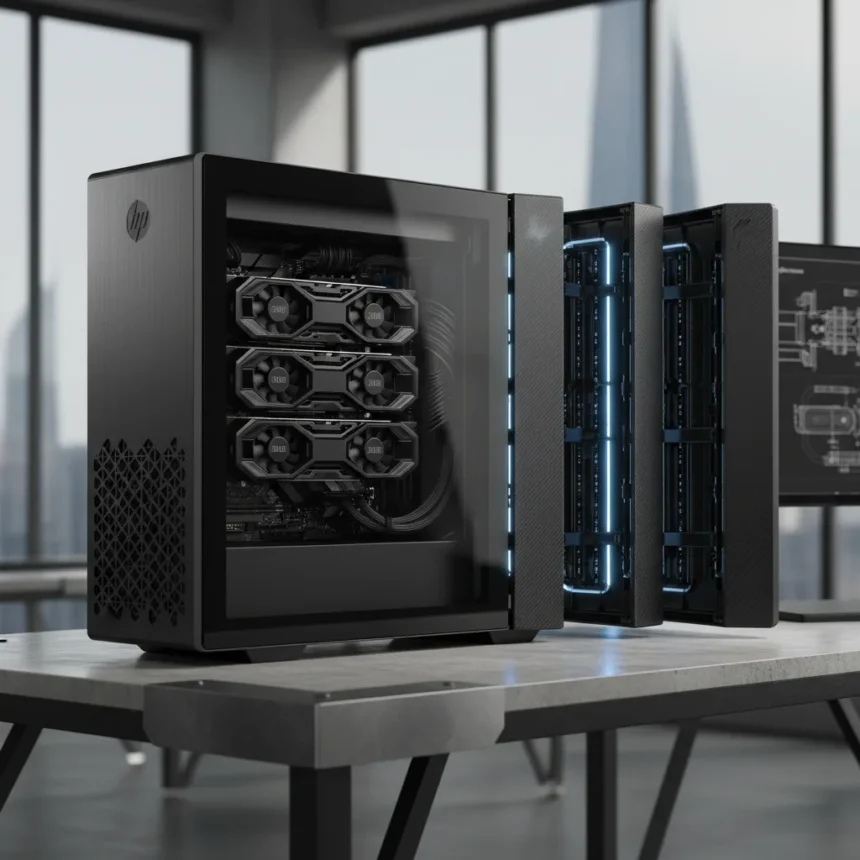
The HP Z8 Fury G6i workstation is a professional tower PC made by HP, announced at HP Imagine 2026 in March 2026, with availability expected on HP.com starting in April 2026 — no pricing has been confirmed yet. Aimed squarely at engineers, VFX artists, and AI researchers who have outgrown conventional workstations, it supports up to four NVIDIA RTX PRO 6000 Blackwell Max-Q Workstation Edition GPUs inside a single chassis. That’s not a spec bump. That’s a statement.
Key Takeaways
- The HP Z8 Fury G6i supports up to four NVIDIA RTX PRO 6000 Blackwell Max-Q GPUs for AI, VFX, and simulation workloads.
- It uses Intel Xeon 600-series processors, up to the Xeon 698X, with 16 DDR5 ECC memory slots.
- The optional HP Max Side Panel expands internal chassis volume by 15% and enables tool-free installation of larger GPUs.
- HP claims up to 5.7x faster rendering in Catia and Siemens NX via HP ZBoost GPU resource sharing, based on initial customer deployments.
- HP describes the Max Side Panel as the industry’s first workstation chassis expander — a claim that has not been independently verified.
What Makes the HP Z8 Fury G6i Workstation Different
The HP Z8 Fury G6i workstation isn’t trying to be the fastest consumer PC on a spec sheet — it’s built for sustained, multi-GPU professional workloads that most desktops can’t touch. Four Nvidia Blackwell GPUs working in concert inside one box is the kind of configuration that previously required a rack-mounted server or a custom build costing a small fortune. HP is packaging that muscle into a tower you can actually put under a desk.
On the CPU side, the machine pairs those GPUs with Intel Xeon 600-series processors, scaling up to the Xeon 698X. Memory headroom is generous: 16 DIMM slots for DDR5 ECC RAM, which matters enormously for simulation and analysis tasks where data integrity is non-negotiable. There are also 10 PCIe slots of varying lanes and speeds, giving integrators real flexibility for custom card configurations. Storage options include a 5.25-inch bay, two internal 3.5-inch bays, and three SATA ports — a layout that reflects the workstation’s role as a long-term production machine, not a device you replace every two years.
The HP Max Side Panel Is the Most Interesting Thing Here
The HP Max Side Panel is the genuinely novel part of this announcement. HP describes it as the industry’s first workstation chassis expander — and while that claim is HP’s own and hasn’t been independently verified, the mechanism itself is hard to dismiss. Press a button, pull off the standard side panel, attach the new one. No tools, no screws, no voided warranties. The expanded panel increases internal volume by 15% compared to the standard configuration, which sounds modest until you consider that GPU clearance is often the limiting factor when upgrading to newer, physically larger cards.


The Max Side Panel also adds more active cooling fans, attached via pins with no cables required. HP says thermal performance is maintained despite the larger volume — a claim that will need real-world validation once the machine ships. The design was reportedly user-inspired, which tracks: anyone who has tried to fit a current-generation GPU into an aging tower chassis knows exactly why this problem needed solving.
How the HP Z8 Fury G6i Compares to Its Predecessor
Against the previous HP Z8 Fury line, the G6i brings meaningful generational upgrades rather than incremental tweaks. The jump to Nvidia Blackwell architecture and Intel Xeon 600-series silicon represents a full platform refresh, not a rebadge. The chassis expander concept is entirely new to the line. What hasn’t changed is HP’s positioning: this is a machine for professionals who bill by the render, not enthusiasts chasing frame rates.


No direct desktop workstation competitors are named in HP’s announcement materials, but the broader context is clear. As AI inference and generative workloads push GPU memory and compute requirements upward at an unprecedented pace, workstations that can’t adapt their physical configuration become obsolete faster. The Max Side Panel is HP’s answer to that problem — a way to extend the useful life of a chassis investment as GPU form factors continue to evolve.
HP ZBoost and Real-World Performance Claims
HP pairs the Z8 Fury G6i with its ZBoost software for GPU resource sharing across AI and rendering workflows. According to HP, initial customer deployments showed up to 5.7x faster rendering in Catia and Siemens NX compared to configurations without ZBoost. Those numbers come from HP’s own deployment data, not independent third-party testing, so treat them as directional rather than definitive. Still, the use cases named — Catia and Siemens NX — are precisely the simulation-heavy applications that workstation buyers in automotive, aerospace, and industrial design actually use.
Is the HP Z8 Fury G6i worth buying for AI workloads?
For professionals running multi-GPU AI inference, large-scale rendering, or complex simulation workloads, the HP Z8 Fury G6i is one of the most capable local compute options announced in 2026. The quad Nvidia Blackwell GPU support and the expandable chassis design address two real pain points in the professional workstation market. Whether the price — unannounced as of March 2026 — justifies the investment over cloud-based alternatives will depend entirely on workload frequency and data sensitivity requirements.
When does the HP Z8 Fury G6i become available?
HP has confirmed availability on HP.com starting in April 2026. Pricing has not been announced and HP says details will be provided closer to the availability date. Regional availability beyond HP.com has not been specified in official materials.



What is the HP Max Side Panel and how does it work?
The HP Max Side Panel is an optional chassis expander for the Z8 Fury G6i that replaces the standard side panel without tools. It increases internal volume by 15%, accommodates larger GPU cards, and adds pin-attached active cooling fans. HP claims it is the first product of its kind in the workstation industry, though that claim is HP’s own and has not been independently verified.
The HP Z8 Fury G6i workstation is a serious machine for serious work — and the Max Side Panel alone makes it worth watching. Whether HP’s performance claims hold up under independent scrutiny, and what the price tag looks like in April 2026, will determine whether this becomes the default choice for multi-GPU professional workloads or just an impressive announcement that didn’t quite land.
Edited by the All Things Geek team.
Source: TechRadar