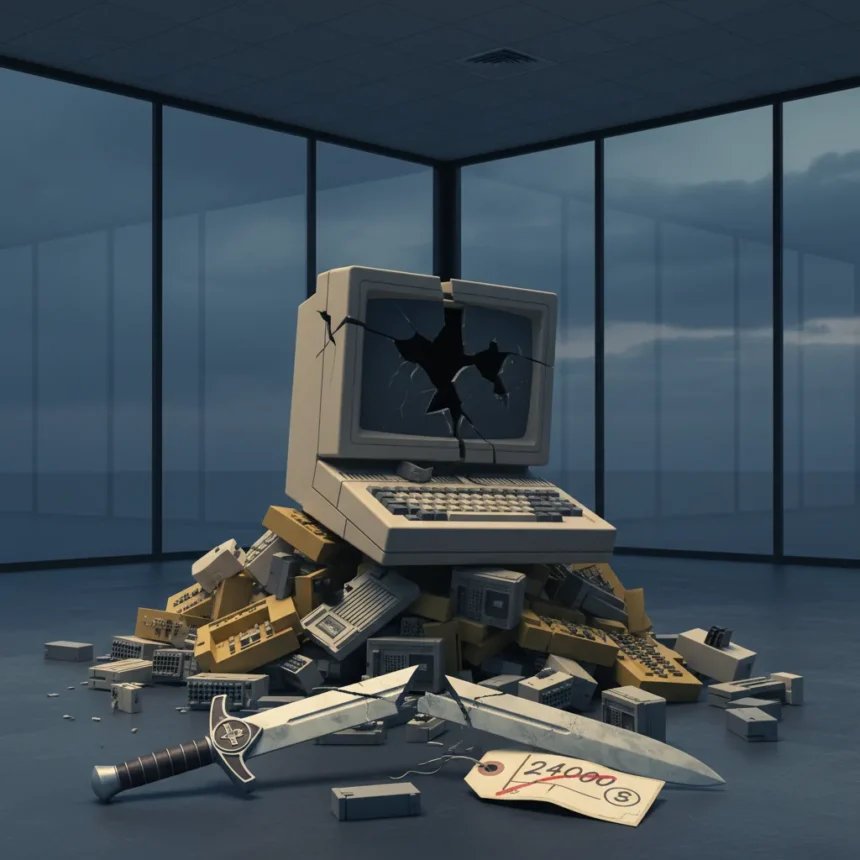
Texas Instruments personal computer price war nearly destroyed one of technology’s most ambitious players. In the early era of home computing, Texas Instruments pursued an aggressive strategy to dominate the personal computer market, but the resulting price war nearly brought the company to the brink of ruin. The company’s experience offers a stark lesson in how corporate ambition can backfire when market dynamics shift faster than strategy can adapt.
Key Takeaways
- Texas Instruments pursued dominance in the early personal computer market through the TI-99/4 microcomputer.
- A brutal price war emerged as competitors like Apple and Epson offered cheaper alternatives.
- The aggressive pricing strategy nearly destroyed Texas Instruments financially.
- IBM-compatible computers eventually captured 83 percent market share by 1996, reshaping the entire industry.
- The episode demonstrates how market competition can destabilize even established technology giants.
How Texas Instruments Entered the Personal Computer Market
Texas Instruments did not stumble into the personal computer business by accident. The company, already dominant in semiconductors and calculators, saw the emerging home computer market as a natural expansion opportunity. The TI-99/4 microcomputer represented this ambition—a machine designed to compete directly against established players and capture significant market share through aggressive positioning.
The broader personal computer market was still forming during this period, with no clear winner and room for multiple competitors. Apple had proven consumer demand existed. IBM was preparing to enter the market. The window appeared open for a well-capitalized company like Texas Instruments to claim a substantial stake. The TI-99/4 was that bet.
The Price War That Triggered Collapse
Texas Instruments ended up in a brutal price war that nearly brought it to the brink. Rival companies such as Apple and Epson entered the scene with lower-priced options in the same era, forcing Texas Instruments into a defensive spiral of price cuts and margin compression. What began as a strategy to dominate through volume turned into a race to the bottom that the company could not win.


Price wars in technology are particularly vicious because they destroy margins without necessarily expanding the market. Competitors match cuts, consumers delay purchases waiting for lower prices, and manufacturers find themselves unable to fund product development or marketing. Texas Instruments faced this exact trap. The company had committed capital and manufacturing capacity to the TI-99/4, but aggressive pricing from rivals meant those investments could not generate profitable returns.
Why Market Dominance Failed
The personal computer market proved far more competitive and fragmented than Texas Instruments anticipated. IBM-compatible computers eventually reached an 83-percent share of the market by 1996, illustrating how competitive market shifts could decisively reshape the entire industry. This consolidation around a single architecture meant that companies betting on proprietary designs—like Texas Instruments—faced an uphill battle.



Texas Instruments was not alone in this miscalculation. Many established technology companies overestimated their ability to dominate emerging categories through size and capital alone. The personal computer market rewarded companies that understood software ecosystems, consumer preferences, and distribution channels—not just manufacturing prowess. Texas Instruments excelled at the latter but lacked the former. By the time the company recognized this gap, the price war had already inflicted severe damage.
The Broader Lesson for Technology Strategy
The Texas Instruments personal computer price war remains a cautionary tale about the limits of aggressive market entry. Entering a new category with the goal of domination often requires deeper understanding of customer needs and competitive dynamics than a company might possess. Underestimating rivals—or overestimating your own advantages—can trigger a destructive spiral that no amount of capital can reverse.
The personal computer market ultimately proved that scale and manufacturing expertise were necessary but insufficient. Companies that survived and thrived—Apple, IBM, and later the clone makers—combined hardware manufacturing with either software control, distribution networks, or both. Texas Instruments had none of these advantages, and the price war exposed that weakness with brutal clarity.
Did Texas Instruments ever recover from the PC market failure?
Texas Instruments exited the personal computer market and refocused on its core semiconductor and calculator businesses, where it remained a major player. The company survived the price war and subsequent withdrawal, but the personal computer adventure represented a significant strategic misstep that cost the company billions in losses and opportunity.



Why did IBM-compatible computers win the PC market?
IBM-compatible computers achieved dominance because they combined open architecture with broad software support and competitive pricing from multiple manufacturers. This ecosystem approach proved more powerful than any single company’s proprietary design. By 1996, IBM-compatible machines controlled 83 percent of the market, making them the de facto standard.
What made the Texas Instruments personal computer price war so destructive?
The Texas Instruments personal computer price war was destructive because competitors could match or undercut prices faster than the company could reduce costs. This forced Texas Instruments into a margin-destroying spiral where lower prices did not translate to market share gains—competitors simply cut their prices too. The company eventually had no choice but to exit the market entirely.
The Texas Instruments personal computer price war stands as a reminder that entering a new market requires more than capital and manufacturing capability. It requires understanding the competitive landscape, customer preferences, and ecosystem dynamics. Texas Instruments had the first ingredient but lacked the others, and the price war exposed that gap with devastating finality. For modern technology companies, the lesson remains clear: dominance through pricing alone is a losing strategy.
Edited by the All Things Geek team.
Source: TechRadar