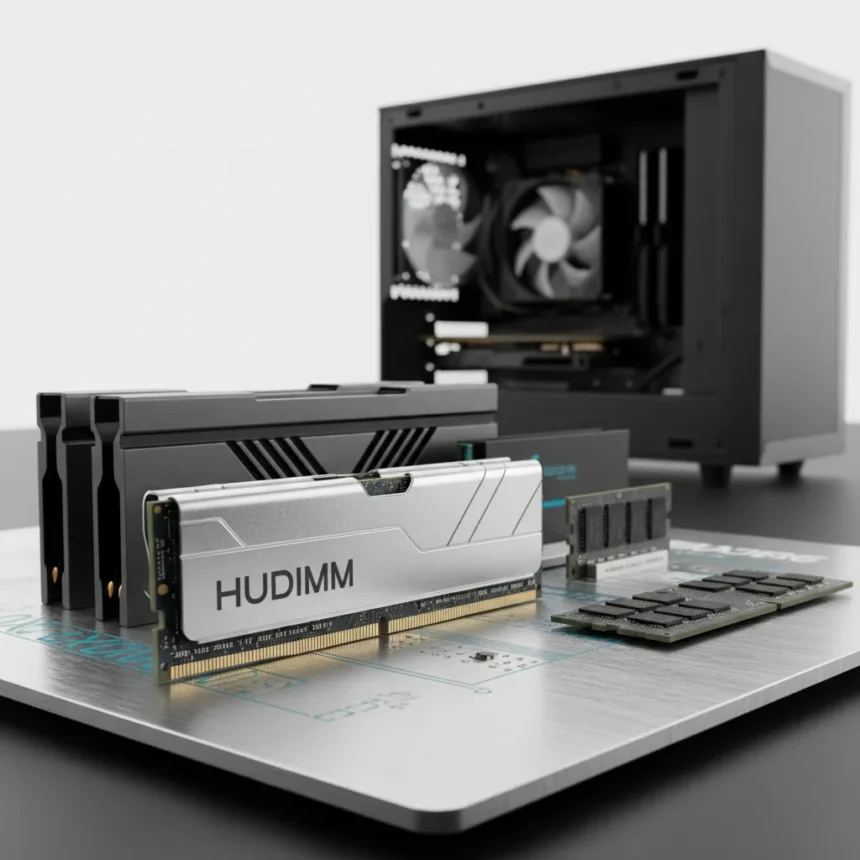
The HUDIMM memory specification is a new budget-focused DDR5 standard designed to lower RAM prices during persistent shortages, using a simplified architecture that cuts both bandwidth and capacity in half compared to standard DDR5 modules. Manufactured by TeamGroup and supported on most LGA 1700 ASRock motherboards, HUDIMM represents the first serious attempt to create an entry-level DDR5 tier that actually works with existing hardware.
Key Takeaways
- HUDIMM uses one 32-bit subchannel per stick versus standard DDR5’s two, reducing required integrated circuits and manufacturing costs
- Compatible with standard DDR5 in mix-and-match configurations on supported ASRock boards, enabling immediate adoption
- Targets budget PC builders during RAM shortages when DDR5 pricing remains elevated
- Reduces both bandwidth and capacity by approximately half compared to standard DDR5 UDIMMs
- Manufactured by TeamGroup with support from motherboard vendors like ASRock
What HUDIMM Memory Specification Actually Changes
Standard DDR5 UDIMMs use two 32-bit subchannels to create a 64-bit data path, requiring a substantial number of integrated circuits to manage that bandwidth. HUDIMM memory specification simplifies this architecture by using just one 32-bit subchannel per stick, cutting the IC count roughly in half. This is not a minor tweak—it fundamentally reduces what the module can do, but that trade-off is the entire point. For budget builds that prioritize cost over raw performance, the performance hit matters less than the price difference.
The specification maintains the same 288-pin connector standard as other DDR5 UDIMMs, meaning HUDIMM modules physically fit into any DDR5 slot. The key advantage is backward compatibility: boards that support HUDIMM can also run standard DDR5 modules, and you can theoretically mix both types on a single system if your motherboard supports it. This is not true of every memory generation transition—DDR4 and DDR5 use different pin configurations specifically to prevent accidental installation—so the cross-compatibility here removes a major friction point for budget upgrades.
HUDIMM Memory Specification vs. Standard DDR5: What You Actually Lose
Halving the subchannels means HUDIMM delivers roughly half the bandwidth of standard DDR5, which sounds dramatic until you consider what budget systems actually do. Productivity work, web browsing, and older gaming titles do not stress memory bandwidth the way content creation or high-refresh competitive gaming does. A system built on HUDIMM will feel slower than one with standard DDR5 in specific workloads, but for the intended audience—budget PC builders during RAM shortages—the price-to-performance trade-off makes sense.


Standard DDR5 UDIMMs provide a 64-bit data path via pins on both sides of the module, while HUDIMM memory specification reduces this to effectively half that throughput. The capacity reduction mirrors the bandwidth cut: you get fewer gigabytes per stick because the module uses fewer memory ICs. This means a budget build with HUDIMM might max out at 32GB total, whereas a standard DDR5 system could reach 96GB or more with the same number of DIMM slots. For most users, 32GB is plenty, but creators and professionals working with large datasets will notice the ceiling.
Why HUDIMM Memory Specification Matters Right Now
DDR5 pricing has remained stubbornly high since the standard’s debut, and supply constraints continue to plague the market. Manufacturers have been reluctant to drop prices aggressively because there is no cheaper tier—you either buy standard DDR5 or you stick with aging DDR4 systems. HUDIMM memory specification fills that gap by offering a legitimate DDR5 option that costs substantially less without requiring a completely different motherboard or CPU.



TeamGroup’s decision to manufacture HUDIMM modules and ASRock’s support on LGA 1700 boards suggests the specification could see broader adoption if other manufacturers follow suit. The timing is crucial: if RAM shortages persist or prices remain elevated through 2025, HUDIMM becomes an attractive option for system integrators and budget-conscious builders who want modern DDR5 compatibility without premium pricing.
Compatibility and Real-World Adoption Hurdles
HUDIMM memory specification works on most LGA 1700 ASRock motherboards, but the question of broader support remains open. Intel and AMD do not mandate HUDIMM support in their platform specifications—it is a vendor choice. If only ASRock commits to it, the addressable market shrinks significantly, and HUDIMM becomes a niche product rather than a market-shifting standard. Motherboard manufacturers from ASUS, Gigabyte, and MSI have not yet announced HUDIMM support, which could limit its reach in the DIY and prebuilt markets.
The mix-and-match compatibility with standard DDR5 is genuinely useful for upgrades, but it also creates a potential support headache. A system running one HUDIMM stick and one standard DDR5 module will operate at the speed and bandwidth of the slower module, which could confuse users who expect performance matching their faster stick. Clear documentation and BIOS labeling become critical for avoiding support tickets and returns.
What About Other DDR5 Variants?
HUDIMM is not the only attempt to expand DDR5’s market reach. CUDIMM (Clocked Unbuffered DIMM) is another DDR5 variant that uses the same 288-pin connector but adds clocking for higher speeds than standard UDIMMs, maintaining full 64-bit bandwidth while enabling faster operation. CUDIMM expected launch later in 2025 targets the opposite end of the market—high-performance systems that want more speed rather than lower cost. For budget builders, HUDIMM is the relevant standard; for enthusiasts chasing frame rates, CUDIMM is the play.



Server-grade RDIMM (Registered DIMM) and the emerging TDIMM standard operate in completely different ecosystems, so they are not direct competitors to HUDIMM memory specification. The real tension is between HUDIMM and standard DDR5 UDIMM—and whether the price difference justifies the bandwidth loss for budget builds.
Should You Wait for HUDIMM or Buy Standard DDR5 Now?
If you are building a budget system in 2025 and can find HUDIMM modules at significantly lower prices than standard DDR5, the specification makes sense—especially if you are not planning to upgrade memory later. The compatibility with ASRock LGA 1700 boards is solid, and the simplification of the memory subsystem reduces costs across the entire platform.
However, if you are shopping on a mainstream platform like ASUS or Gigabyte boards, HUDIMM support may not exist yet, forcing you to choose standard DDR5 anyway. The specification’s real value emerges only if it gains traction beyond TeamGroup and ASRock, which remains uncertain as of now.
Will HUDIMM actually lower DDR5 prices across the market?
HUDIMM memory specification is designed to undercut standard DDR5 pricing, but actual price reductions depend on whether major manufacturers adopt it and whether supply constraints ease. If only TeamGroup produces HUDIMM modules and only ASRock boards support them, the impact on overall market pricing will be minimal. Widespread adoption by Kingston, Corsair, Crucial, and others would be needed to meaningfully shift DDR5 pricing downward.
Can you mix HUDIMM and standard DDR5 on the same board?
Yes, HUDIMM is compatible with standard DDR5 in mix-and-match configurations on supported boards, though the system will operate at the bandwidth and capacity of the slower module. This is useful for incremental upgrades but not ideal for balanced performance.
What motherboards support HUDIMM memory specification?
Most LGA 1700 ASRock motherboards support HUDIMM, but other manufacturers have not yet announced support. Check your motherboard manual or contact the vendor directly before purchasing HUDIMM modules.
HUDIMM memory specification represents a pragmatic response to persistent DDR5 pricing and supply issues, offering budget builders a legitimate path to modern memory without premium costs. Whether it becomes a market standard or remains a niche product depends entirely on manufacturer adoption in the coming months. For now, it is a promising option for ASRock users who prioritize cost over bandwidth—but a gamble for everyone else.
Edited by the All Things Geek team.
Source: Tom's Hardware