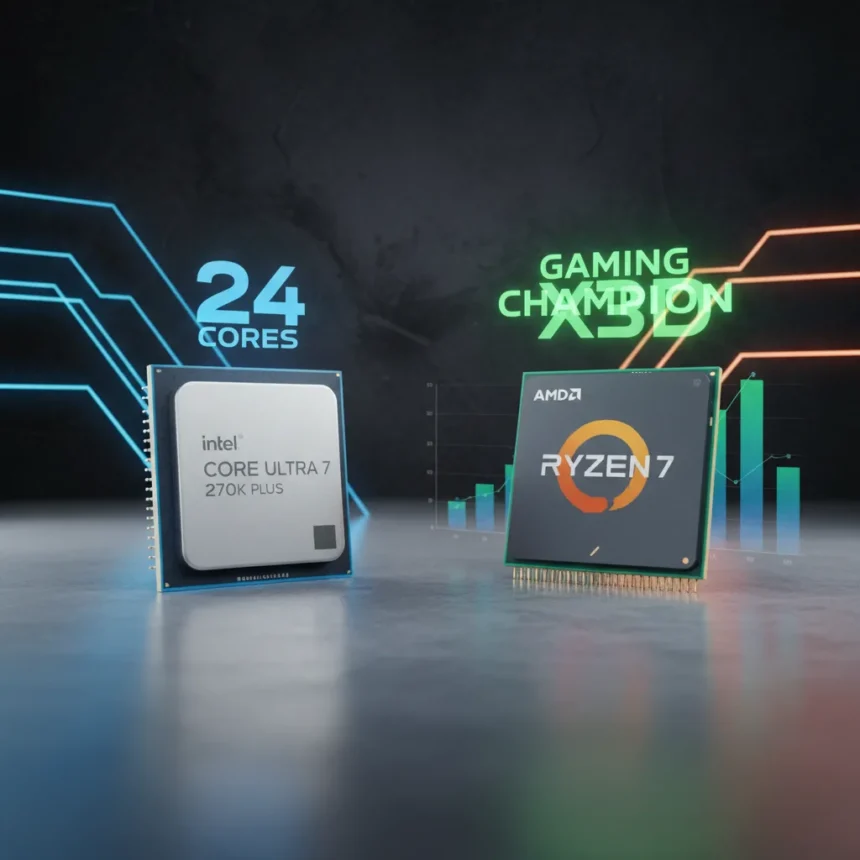
The Intel Core Ultra 7 270K Plus arrives in March 2026 with a radical architectural shift: 24 physical cores and 24 threads designed to challenge AMD’s three-year-old gaming king, the Ryzen 7 7800X3D. On paper, Intel’s massive core count advantage looks devastating. In practice, the story is messier.
Key Takeaways
- Intel Core Ultra 7 270K Plus has 24 cores vs. Ryzen 7 7800X3D’s 8 cores, but gaming performance tells a different story
- Ryzen 7 7800X3D leads in gaming with a 13% performance advantage despite lower core count
- Intel dominates productivity tasks with 32.4% overall performance gain, driven by massive multi-core scaling
- Ryzen 7 7800X3D’s 96 MB L3 cache with 3D V-Cache technology remains the gaming advantage
- Intel’s 3 nm process is more advanced than AMD’s 5 nm, but doesn’t guarantee gaming supremacy
Intel Core Ultra 7 270K Plus Specs vs. Ryzen 7 7800X3D
The Intel Core Ultra 7 270K Plus is a 24-core, 24-thread processor with a base clock of 3.7 GHz and boost up to 5.5 GHz, built on Intel’s advanced 3 nm lithography. It carries 192 KB of L1 cache per core, 3 MB of L2 cache per core, and 36 MB of shared L3 cache, with a 125 W TDP. The Ryzen 7 7800X3D, released in January 2023, uses just 8 cores and 16 threads at 4.4 GHz base and 5 GHz boost on AMD’s 5 nm process, but packs a massive 96 MB of L3 cache thanks to 3D V-Cache stacking. AMD’s chip runs at 120 W TDP, slightly more efficient than Intel’s solution.
The architectural gap is staggering: Intel has 200% more cores, 50% more threads, and a three-year recency advantage with more advanced lithography. Yet raw specs rarely tell the gaming story. The Ryzen 7 7800X3D’s 60 MB advantage in L3 cache—plus the 3D V-Cache technology that stacks cache vertically—creates a memory hierarchy optimized for gaming workloads that brute-core-count approaches struggle to match.
Gaming Performance: Does Intel Finally Win?
No. The Ryzen 7 7800X3D still leads gaming performance with roughly a 13% advantage in frame rates across diverse titles. This isn’t a marginal win—it’s the kind of consistent lead that justifies the X3D branding. Testing across 23 games at CPU-heavy scenarios (Cities Skylines II, Counter-Strike 2, Cyberpunk 2077, S.T.A.L.K.E.R. 2, and others) shows AMD’s cache architecture simply extracts more gaming performance from fewer cores.


The Intel Core Ultra 7 270K Plus does win specific comparisons against other chips. It beats the Ryzen 9 9700X by 30% in 1% lows in certain games and shows advantages in Baldur’s Gate 3 with 12% better 1% lows at medium settings. But these victories against other processors don’t translate to beating the 7800X3D in head-to-head gaming. The 7800X3D remains the gaming CPU to beat, and Intel’s new flagship hasn’t managed it.
Productivity and Multi-Core Dominance
Where Intel Core Ultra 7 270K Plus crushes the competition is pure multi-threaded workload performance. The processor delivers a 32.4% overall performance advantage over the Ryzen 7 7800X3D, driven entirely by its massive core advantage. In Blender rendering, Intel shows 121% faster performance than the Ryzen 9 9700X at 285 samples per minute, and demonstrates 62% faster compression speeds. This is where the 24-core architecture earns its place in high-end workstations.



For content creators, video editors, 3D modelers, and software developers, the Intel Core Ultra 7 270K Plus is the obvious choice. The Ryzen 7 7800X3D was never designed for these workloads—it’s a gaming chip first, productivity chip second. Intel’s new processor inverts that priority entirely. The question isn’t whether Intel wins productivity; it’s whether the gaming audience cares.
User Ratings and Real-World Adoption
User ratings reveal a critical gap: the Ryzen 7 7800X3D has 4.4 stars across 413 user ratings, while the Intel Core Ultra 7 270K Plus has 4.9 stars from just 26 ratings. The Intel chip’s higher score likely reflects early-adopter enthusiasm and a smaller, more tech-savvy sample size. AMD’s rating comes from three years of real-world use across diverse customer bases. By this measure, the Ryzen 7 7800X3D has earned its reputation through sustained reliability and performance.
The low rating count for Intel’s processor is itself telling: it’s brand new, expensive, and positioned at a niche intersection of gaming and productivity. Most gamers won’t need 24 cores. Most productivity users won’t prioritize gaming performance. The Intel Core Ultra 7 270K Plus is a chip searching for its audience.
Which CPU Should You Buy?
Buy the Ryzen 7 7800X3D if you’re a gamer. Its 13% gaming advantage, proven track record, and lower TDP make it the right choice for 1440p and 4K gaming rigs. The three-year-old architecture still outperforms Intel’s newest flagship in the one metric gamers actually care about: frames per second.



Buy the Intel Core Ultra 7 270K Plus if you’re a content creator, programmer, or engineer who also wants to game. The 32.4% productivity advantage is real and measurable. You’ll sacrifice some gaming performance, but you’ll gain the kind of multi-core throughput that shaves hours off render times and compiles. This is a professional’s chip with gaming capability, not the reverse.
The Ryzen 7 7800X3D remains the better pure gaming CPU. Intel’s answer isn’t to beat AMD at its own game—it’s to redefine what a high-end CPU should be. Whether that redefinition matters depends entirely on your workload.
Can Intel’s 24 cores overcome AMD’s 3D V-Cache?
Not in gaming. The Ryzen 7 7800X3D’s 96 MB L3 cache with 3D V-Cache stacking is specifically engineered for gaming memory patterns. Intel’s larger core count excels at parallel workloads like rendering, encoding, and compilation, but gaming remains a cache-sensitive, single-threaded-heavy workload where core count matters less than memory hierarchy.
Is the Intel Core Ultra 7 270K Plus worth the upgrade?
That depends on what you’re upgrading from. If you own a Ryzen 7 7800X3D and game primarily, don’t upgrade—you’ll lose gaming performance. If you’re upgrading from a previous-generation Intel chip or a productivity-focused Ryzen, the 24 cores and advanced 3 nm lithography deliver measurable gains in non-gaming tasks.
What’s the TDP difference between these CPUs?
The Ryzen 7 7800X3D runs at 120 W TDP while the Intel Core Ultra 7 270K Plus is rated at 125 W. Both are reasonable power draws for their class, though AMD’s efficiency advantage is marginal—roughly 4% lower power consumption despite dramatically fewer cores.
The Intel Core Ultra 7 270K Plus doesn’t dethrone the Ryzen 7 7800X3D as gaming’s best CPU. What it does is offer a legitimate alternative for users who value productivity alongside gaming. AMD still owns the gaming crown, but Intel has finally built a chip that makes you think twice about the tradeoff.
Where to Buy
Intel Core Ultra 7 270K Plus | AMD Ryzen 7 7800X3D
Edited by the All Things Geek team.
Source: Tom's Hardware