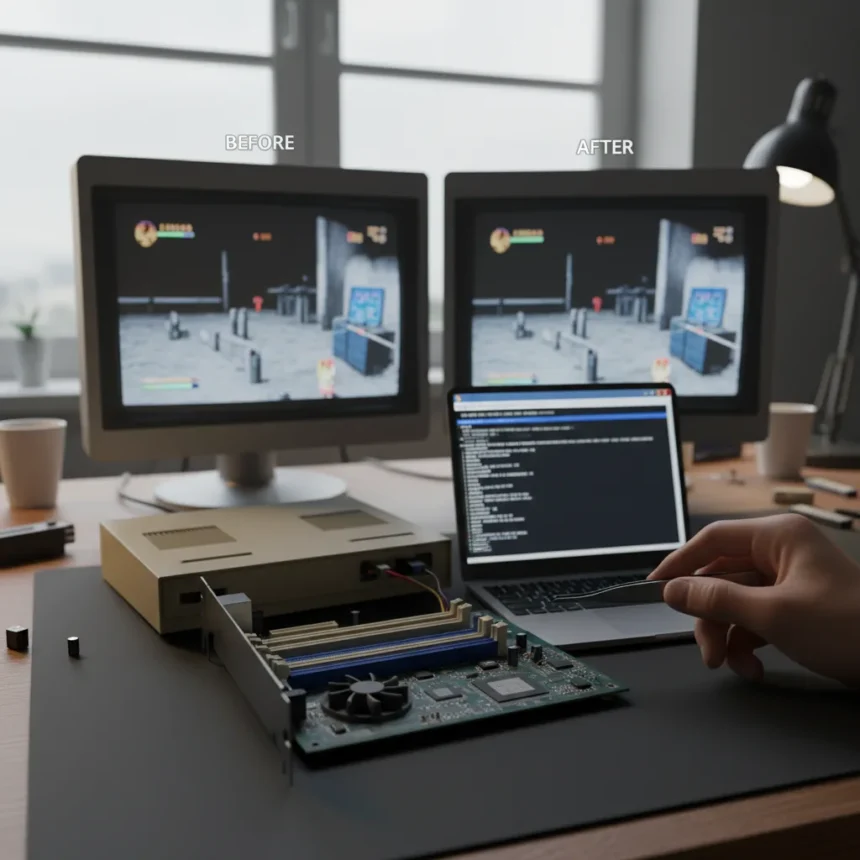
A decades-old brightness problem affecting S3 graphics cards has finally been solved through a simple VBIOS modification that disables an obsolete hardware feature. The S3 graphics card black levels issue stems from a pedestal bit—a legacy component designed for composite television output that has no purpose on modern CRT or LCD displays. By patching the VBIOS to set this bit to zero on boot, enthusiasts can permanently restore proper black levels to cards like the Trio 3D, Trio64, and ViRGE, eliminating the washed-out appearance that has plagued these boards for three decades.
Key Takeaways
- S3 graphics card black levels were artificially elevated by a hardware pedestal bit intended for 1980s composite TV compatibility.
- The pedestal bit raises the brightness floor of the video signal, washing out deep blacks especially visible on boot screens.
- A VBIOS patch setting the pedestal bit to zero permanently fixes the issue on affected cards.
- Multi-GPU setups pairing S3 cards with 3dfx Voodoo II suffer inconsistent brightness due to this hardware quirk.
- S3 published detailed datasheets documenting the pedestal bit, enabling the fix without reverse-engineering.
The Pedestal Bit: A TV Legacy That Outlived Its Purpose
The pedestal bit was an intentional hardware feature, not a design flaw. S3 engineers included it to ease scanline detection on composite video outputs—a standard for 1980s television integration that became irrelevant the moment these cards entered computer-only environments. The bit artificially raises the black level of the video signal, pushing what should be pure black (zero volts) into a gray midtone. On CRT boot screens, this manifests as a muddy, washed-out background where text should pop against a crisp black backdrop.
The problem worsens in 3D gaming scenarios, particularly in multi-GPU configurations. When an S3 card runs alongside a 3dfx Voodoo II accelerator, the brightness mismatch becomes visually jarring—one card outputs properly crushed blacks while the other renders everything with an unintended gray veil. For retro gaming enthusiasts restoring these systems to their original glory, this inconsistency destroys immersion and makes side-by-side comparisons with period-correct hardware nearly impossible.
How the VBIOS Patch Restores S3 Graphics Card Black Levels
The fix is elegantly simple: modify the VBIOS to set the pedestal bit to zero during the boot sequence, and the issue vanishes permanently. S3 provided comprehensive datasheets specifying exactly how to address the pedestal bit, meaning no guesswork or reverse-engineering was required—the manufacturer essentially handed enthusiasts the solution decades ago. An enthusiast known as Bits und Bolts demonstrated the fix on a salvaged S3 Trio 3D 2X card, proving that even e-waste hardware could be resurrected with a straightforward binary edit.


The VBIOS patch approach offers a critical advantage over hardware workarounds. S3 had published alternative solutions involving resistor pairs to trim positive voltage or diode-transistor circuits for negative pulse correction, but these required physical soldering and component-level modification. A software patch, by contrast, requires only a text editor and a programmer capable of writing the modified BIOS back to the card’s ROM. For collectors and retro enthusiasts, this means fixing dozens of cards without risk of solder damage or component failure.
S3 ViRGE: The Card That Needed More Than a Black Level Fix
While the pedestal bit hack solves the brightness problem, it does not address the S3 ViRGE’s other notorious shortcomings. The ViRGE earned a reputation as a 3D decelerator rather than accelerator, plagued by driver glitches, timing issues, and graphical artifacts that made it perform worse than contemporaries despite its ambitious architecture. Even doubling onboard RAM to 4MB provided only marginal improvements in specific titles and failed to solve the fundamental 3D rendering problems.



This context matters for understanding why the pedestal bit fix, while genuinely useful, represents only a partial restoration of these cards’ usability. The black level correction makes 2D output crisp and proper for DOS-era software and boot sequences, but it does not resurrect the ViRGE’s broken 3D performance. A collector restoring a Trio 3D or Trio64 will see dramatic visual improvement; a ViRGE owner will see proper blacks but still contend with the card’s well-documented 3D limitations.
Why This Matters for Retro Computing Today
The pedestal bit fix represents a rare victory in retro hardware restoration: a clean, documented solution to a three-decade-old problem that affects a specific class of hardware. Unlike many vintage computer issues that require obscure driver tweaks, BIOS lottery luck, or component-level repairs, this fix is reproducible, permanent, and rooted in published technical documentation. For enthusiasts running period-correct gaming setups or maintaining collections of 1990s graphics cards, the ability to restore proper black levels transforms the visual experience from washed-out and compromised to authentic and sharp.
The broader lesson is that many retro hardware quirks were not inevitable design failures but deliberate engineering choices made for contexts that no longer exist. The pedestal bit solved a real problem in 1990—composite video integration—but became a liability in 2026. Identifying these obsolete features and neutralizing them through firmware patches or BIOS hacks unlocks the full potential of aging hardware that might otherwise be dismissed as defective or unusable.
Can I apply this fix to any S3 graphics card?
The pedestal bit issue affects AGP-era S3 cards including the Trio 3D, Trio64, and ViRGE. Not all S3 cards suffer the problem equally, and some later models may have addressed the issue in hardware. Consult the specific card’s datasheet and BIOS structure before attempting a patch; the fix requires identifying the correct VBIOS offset for the pedestal bit on your particular model.



Is this fix permanent or does it reset on restart?
The VBIOS patch is permanent because it modifies the card’s firmware itself. Once written to the card’s ROM, the patched BIOS executes automatically on every boot, setting the pedestal bit to zero without requiring any software intervention or driver changes.
How does the S3 graphics card black levels issue compare to other vintage GPU problems?
Unlike driver compatibility issues or memory errors that plague retro hardware, the pedestal bit problem is purely a firmware configuration issue with a documented, reversible solution. Most vintage GPU problems require either driver hunting, BIOS lottery, or accepting compromised functionality; the S3 pedestal bit fix is rare in that it offers a clean, technical resolution rooted in published manufacturer documentation.
The S3 graphics card black levels fix proves that even the most stubborn retro hardware problems can yield to methodical investigation and access to original technical documentation. For collectors and enthusiasts, this VBIOS hack transforms a 30-year-old aesthetic compromise into a non-issue, restoring these cards to their intended visual quality and making them genuinely usable again alongside modern displays and period-correct systems.
Edited by the All Things Geek team.
Source: Tom's Hardware