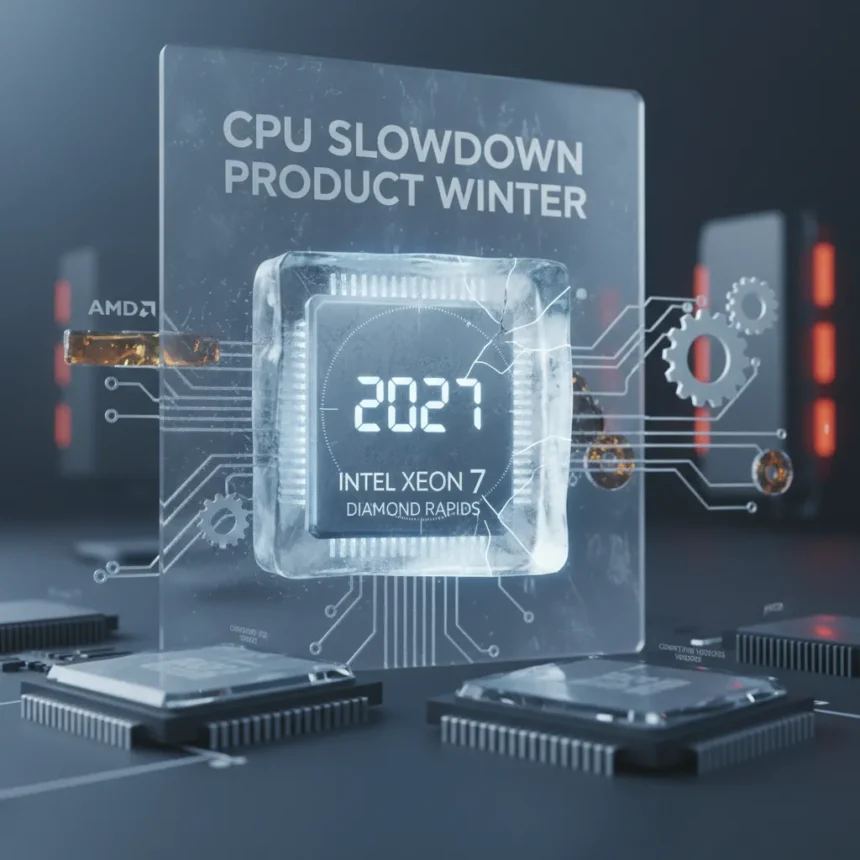
Intel Xeon 7 Diamond Rapids, the company’s next flagship server processor, has been delayed to 2027 from an originally planned late-2025 launch, according to a new leak from Jaykihn. This slip represents a significant setback for Intel’s server roadmap and signals deeper problems rippling across the semiconductor industry as a whole.
Key Takeaways
- Intel Xeon 7 Diamond Rapids delayed from late 2025 to 2027, per leaker Jaykihn.
- Clearwater Forest, the E-core-only successor to Sierra Forest, targets first half of 2026.
- Coral Rapids family planned for 2028 but launch can reportedly be accelerated.
- AMD Zen 6 (Olympic Ridge) and Intel Nova Lake also delayed to CES 2027 amid industry turmoil.
- Broader market faces potential Product Winter slowdown in CPU advancement cycles.
Why Intel Xeon 7 Diamond Rapids Matters Right Now
Server CPU roadmaps matter because they determine which enterprises can upgrade their data center infrastructure and when. A two-year delay for Intel Xeon 7 Diamond Rapids is not a minor slip—it fundamentally reshapes purchasing decisions for hyperscalers, cloud providers, and on-premise data center operators worldwide. Companies already running aging Xeon processors now face a longer wait for meaningful performance jumps, potentially forcing them to reconsider AMD alternatives or stretch current hardware lifecycles beyond planned refresh cycles.
The delay also exposes a troubling pattern. Intel Nova Lake desktop CPUs have been pushed to 2027, with initial variants possibly arriving in Q4 2026. AMD’s Zen 6 (Olympic Ridge) lineup is also reportedly delayed to CES 2027. When both leading x86 vendors shift major product families into the same window, the industry is signaling something deeper than routine engineering hiccups. This convergence suggests a potential Product Winter—a prolonged slowdown in the cadence of meaningful CPU advancement.
Intel Xeon 7 Diamond Rapids Timeline and What Comes Before
Intel Xeon 7 Diamond Rapids will not arrive alone. Clearwater Forest, the E-core-only successor to the current Sierra Forest lineup, is scheduled for the first half of 2026. This intermediate step allows Intel to maintain some momentum in the server space while Diamond Rapids undergoes final engineering. Coral Rapids, the generation after Diamond Rapids, is planned for 2028 but reportedly can be accelerated if needed—though no official confirmation exists on whether that acceleration will actually occur.


The staggered roadmap reveals Intel’s strategy: keep the server channel supplied with incremental upgrades while buying time for Diamond Rapids to reach production readiness. But it also raises a question: if Coral Rapids can be accelerated, why not Diamond Rapids? The leak does not clarify whether acceleration is technically possible, commercially feasible, or simply a contingency plan. For data center customers, this ambiguity is frustrating. A 2027 launch for Intel Xeon 7 Diamond Rapids means enterprises must plan infrastructure investments around a moving target.
Industry Turmoil and the Broader CPU Slowdown
Intel Xeon 7 Diamond Rapids is not delayed in isolation. The entire semiconductor industry is experiencing what analysts are describing as next-gen chips rocked by industry turmoil. AMD’s Zen 6 and Intel’s Nova Lake are both converging on CES 2027, suggesting that fundamental manufacturing, design, or market challenges are affecting multiple vendors simultaneously.



This is unusual. Historically, Intel and AMD stagger major launches to avoid direct collisions. A synchronized delay suggests either shared supply chain bottlenecks, manufacturing yield challenges at advanced nodes, or a collective reassessment of market demand. Data center growth has slowed from pandemic peaks, and AI accelerator demand, while strong, cannot single-handedly drive CPU refresh cycles. The result is a potential Product Winter where meaningful CPU advancements slow to a crawl, and customers stretch existing hardware lifecycles longer than they would prefer.
What This Means for Intel’s Competitive Position
AMD’s EPYC lineup currently holds significant share in cloud and hyperscaler environments. A delay to Intel Xeon 7 Diamond Rapids until 2027 gives AMD additional runway to consolidate that advantage. By the time Diamond Rapids launches, AMD will have had years to refine Zen 6 and establish deeper ecosystem relationships. Intel’s server business, already under pressure, faces the risk of permanent customer migration if the gap stretches too long.
That said, Clearwater Forest arriving in H1 2026 provides a holding action. An E-core-only design signals Intel’s commitment to power efficiency and cost-per-core metrics, which matter in cloud environments. But without confirmation of Clearwater Forest’s performance characteristics or pricing, it remains unclear whether this intermediate product can meaningfully compete with AMD’s offerings or simply delays the inevitable reckoning until Diamond Rapids finally arrives.
Should You Believe the Leak?
Jaykihn has established credibility in the leaker community, but Intel has not officially confirmed these timelines. The company rarely comments on unannounced products, so official denial is unlikely even if the leak is inaccurate. However, the convergence of multiple delay reports across Intel Nova Lake, AMD Zen 6, and now Intel Xeon 7 Diamond Rapids suggests the underlying delays are real, even if exact dates remain fluid. Leaks often contain timing errors of quarters, not years, so treating 2027 as a plausible window rather than a guaranteed date is prudent.



When will Intel Xeon 7 Diamond Rapids launch?
According to the latest leak from Jaykihn, Intel Xeon 7 Diamond Rapids is now targeted for 2027, a significant delay from the originally planned late-2025 window. This timeline is unconfirmed by Intel and based on leaked information, so actual launch dates could shift. Clearwater Forest, the interim E-core-only product, is scheduled for H1 2026.
How does Intel Xeon 7 Diamond Rapids compare to AMD Zen 6?
Both Intel Xeon 7 Diamond Rapids and AMD Zen 6 (Olympic Ridge) are now reportedly delayed to CES 2027, converging on the same launch window. Direct performance comparisons are premature since neither product has been announced officially. However, AMD’s current EPYC lineup already holds significant market share in cloud and hyperscaler environments, giving it a head start in customer relationships and ecosystem maturity by the time both next-gen products arrive.
Why is the CPU industry facing delays?
Multiple sources attribute the broader delay pattern to industry turmoil and potential Product Winter conditions. Slowing data center growth post-pandemic, manufacturing challenges at advanced nodes, and a collective market reassessment are likely contributing factors. When both Intel and AMD shift major launches into 2027, it signals systemic industry challenges rather than isolated engineering issues at either vendor.
Intel Xeon 7 Diamond Rapids represents more than a single product delay—it reflects an industry in transition. Two-year slips are not routine, and when they occur alongside competitor delays and talk of Product Winter, they signal that the comfortable cadence of annual CPU improvements has broken down. For data center operators, this means longer planning horizons, tougher purchasing decisions, and pressure to maximize value from current-generation hardware. Intel needs Diamond Rapids to land successfully in 2027, because the longer the wait, the more entrenched AMD becomes in the server market.
Edited by the All Things Geek team.
Source: Tom's Hardware