





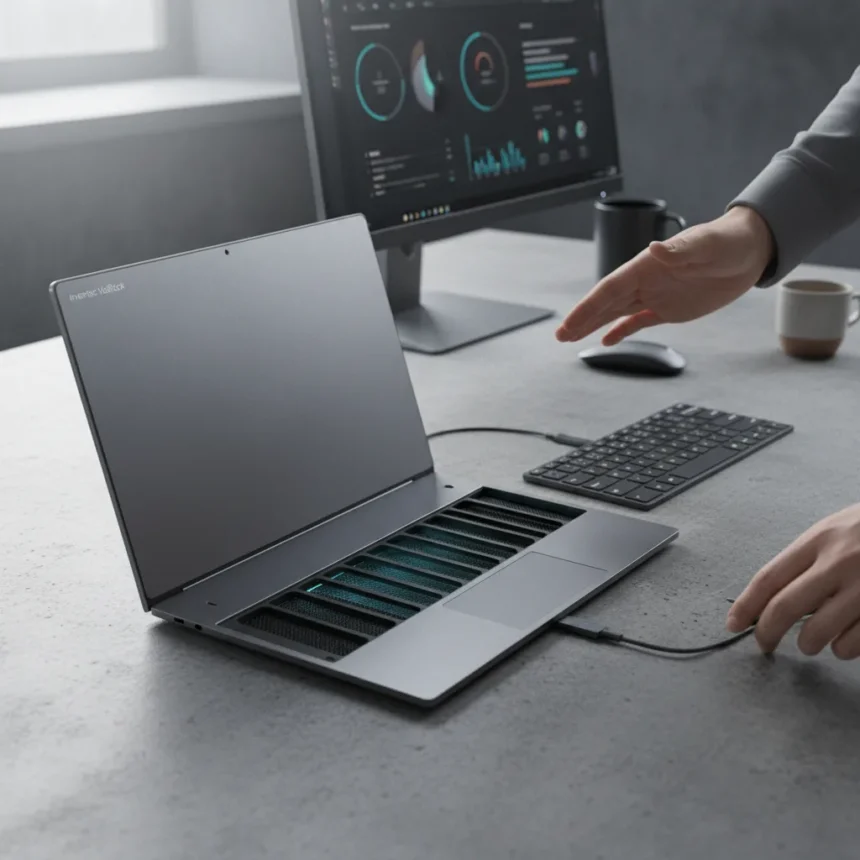
The Inventec VeilBook removable keyboard is a 14-inch ultra-thin concept laptop under 1 cm thick that solves a problem you probably don’t have. Manufactured by Inventec Corporation in Taipei, the device features a detachable keyboard that slides forward to cover the touchpad and palm rest, exposing cooling vents underneath. The design won the iF Design Award 2026, but clever engineering and actual necessity are two different things.
Key Takeaways
- VeilBook is under 10 mm thick with a sliding keyboard that exposes cooling fans when stowed.
- Keyboard repositions in seconds to enable touchpad use when needed.
- Targets hybrid workers and mobile professionals in Asia and North America.
- No pricing or confirmed launch date; described as a prototype concept.
- Solves thermal throttling in ultra-thin designs but introduces new user friction.
How the Inventec VeilBook Removable Keyboard Actually Works
The core mechanic is straightforward: slide the keyboard forward to cover the touchpad, freeing space underneath for cooling fans and vents to improve airflow. When you need to use the trackpad, slide the keyboard back, which takes a few seconds. The touchpad doubles as a shortcut surface for workflows when exposed, adding a secondary function to justify the extra step. Inventec pairs this with behavior-linked power management that scales power draw based on usage states—lower energy consumption when the keyboard is stowed and input drops.
On paper, this rethinks the fundamental trade-off between slim design and sustained performance. Traditional ultra-thin laptops cram fans under fixed keyboards, choking airflow and forcing thermal throttling under demanding workloads. VeilBook’s sliding mechanism theoretically prevents that bottleneck. But the design introduces a usability cost: every time you switch from typing to pointing, you perform an extra gesture. For hybrid workers who toggle between keyboard and trackpad constantly, that friction compounds throughout the day.
Why Ultra-Thin Laptops Have a Real Cooling Problem
Slim devices like recent MacBook Pro models prioritize weight and portability, but they sacrifice thermal headroom. Fans can only pull air through constrained spaces, and when processors demand peak performance, they throttle to avoid overheating. VeilBook targets this exact pain point—professionals who need sustained performance in a mobile form factor. The removable keyboard exposes vents that would otherwise sit blocked under a traditional keyboard deck, allowing unobstructed airflow when the system is under load but input is paused.


The catch is that most hybrid work doesn’t involve the kind of sustained, processor-intensive tasks that trigger thermal throttling. Video editing, 3D rendering, and machine learning inference are exceptions, not the norm. For email, spreadsheets, web browsing, and document work, a slim laptop’s thermal management is rarely the limiting factor. VeilBook solves a genuine problem for a narrow slice of users, not the hybrid workforce broadly.
Inventec VeilBook Removable Keyboard vs. Traditional Slim Laptops
Traditional ultra-thin laptops accept the thermal trade-off as a given—they cool as well as they can within fixed constraints. VeilBook rejects that premise by making the keyboard a movable component. The comparison reveals the design’s strength and weakness simultaneously. A MacBook Pro M5 Pro delivers consistent performance in a sealed, elegant form factor. VeilBook trades elegance for thermal flexibility, requiring users to manually reconfigure the device to unlock cooling benefits.



Neither approach is objectively superior. Traditional designs prioritize simplicity and consistency; VeilBook prioritizes performance headroom at the cost of an extra interaction step. For users who value set-and-forget simplicity, the traditional approach wins. For professionals who regularly hit thermal limits and don’t mind an extra gesture, VeilBook’s flexibility becomes valuable.
Is the Inventec VeilBook Removable Keyboard Worth Waiting For?
The device exists as a concept prototype with no confirmed pricing, availability, or launch timeline. Inventec targets Asia and North America as initial regions, but details on actual market release remain vague. The design is undeniably inventive—it won a prestigious iF Design Award for rethinking the relationship between keyboard placement and thermal performance. But innovation in design competitions doesn’t always translate to market success.
The real question is whether consumers will embrace a laptop that requires manual reconfiguration to reach its thermal potential. Competitive alternatives already deliver sustained performance in thin packages through improved materials, smarter power management, and better fan engineering. VeilBook’s removable keyboard is one answer to the cooling problem, but it’s not the only one, and it introduces new friction that other solutions avoid.
Will the removable keyboard actually stay in place during travel?
The research brief does not specify the keyboard’s attachment mechanism or how securely it locks in place during transport. This is a critical durability question that remains unanswered in available information about the concept.



Does the Inventec VeilBook removable keyboard work with external displays?
No details are available about external display support, docking, or how the keyboard repositioning interacts with peripheral connectivity. The brief focuses on the cooling mechanism and mobile use cases but does not address desktop workflows with external monitors.
What’s the actual weight and battery life of the VeilBook?
Specific weight and battery specifications are not disclosed in available sources. The design emphasizes ultra-thin form factor under 1 cm and portability for hybrid workers, but numerical specs remain proprietary or unpublished.
The Inventec VeilBook removable keyboard is a clever design solution looking for a market problem. It addresses a real thermal challenge in ultra-thin laptops, but only for users who regularly push their hardware to its limits. For the broader hybrid workforce, the added interaction step and mechanical complexity may outweigh the cooling benefits. Until Inventec releases pricing and availability details, the VeilBook remains what it is today—an award-winning concept that proves innovation in laptop design is still possible, even if the market isn’t yet ready to adopt it.
Edited by the All Things Geek team.
Source: TechRadar




