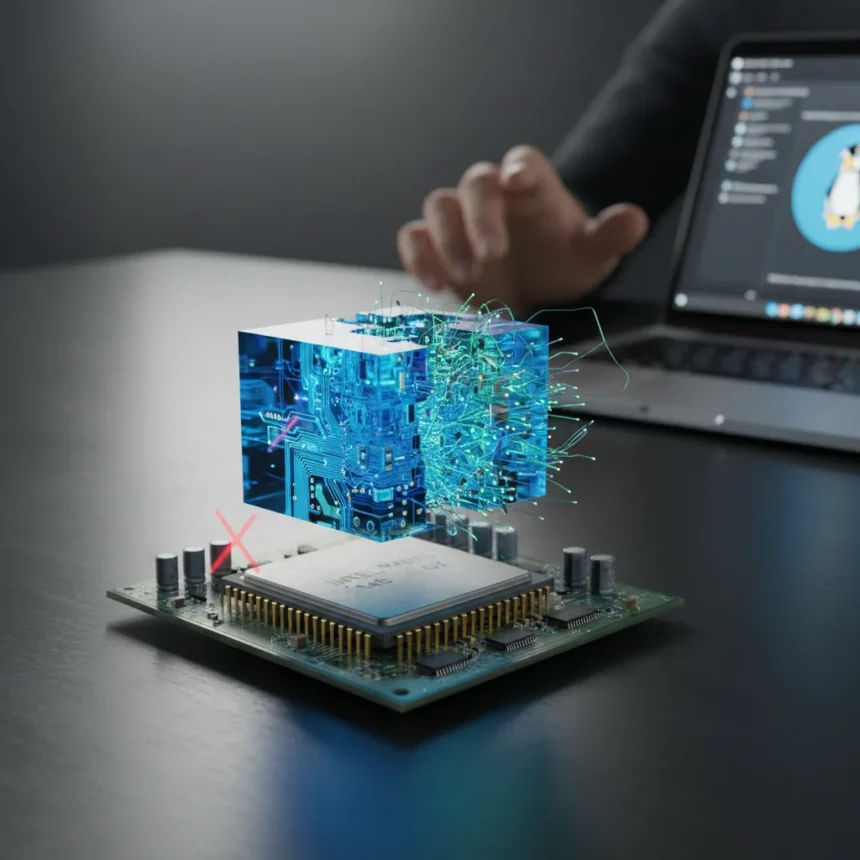
The Linux kernel is finally saying goodbye to the Intel 486 CPU, a processor first released in 1989 that has lingered in the codebase for 37 years. Linus Torvalds, the Linux creator, has made clear his frustration: there is simply no reason to keep supporting ancient hardware that nobody runs anymore. The decision marks a major cleanup effort, removing over 14,000 lines of legacy code and touching 80 files across the kernel.
Key Takeaways
- Intel 486 CPU support removal begins with patches queued for Linux 7.1, expected in 2026.
- Linus Torvalds stated there is ‘zero real reason’ to continue supporting the 37-year-old processor.
- The cleanup removes CONFIG_M486, CONFIG_M486SX, and CONFIG_MELAN build options entirely.
- Over 14,000 lines of legacy code, including math-emu floating-point emulation, will be deleted.
- No modern Linux distribution currently supports 486 CPUs, making removal a practical inevitability.
Why Linux Is Finally Dropping Intel 486 CPU Support
The Intel 486 CPU support removal has been a long time coming. Torvalds has advocated for dropping 486 support since at least 2022, but the effort gained concrete momentum in April 2025 when kernel maintainer Ingo Molnár posted an RFC (request for comments) patch series. The patches raise the minimum supported x86-32 CPU requirement to processors with Time Stamp Counter (TSC) and CMPXCHG8B (CX8) instruction support—capabilities the 486 lacks. Torvalds’ position is blunt: ‘I really get the feeling that it’s time to leave i486 support behind. There’s zero real reason for anybody to waste one second of development effort on this kind of issue’.
From a practical standpoint, the 486 has been obsolete for decades. No mainstream Linux distribution ships with 486 support enabled anymore. Microsoft dropped official i486 support with Windows 98 and Windows NT 4.0, leaving the processor stranded in the embedded and hobbyist space. Continuing to maintain kernel code for hardware nobody deploys in production is a drag on development velocity—code that could be optimized, refactored, or used for new features instead gets spent maintaining 37-year-old compatibility quirks.
The Scope of the Cleanup Effort
The patches queued for Linux 7.1 eliminate three Kconfig build options: CONFIG_M486, CONFIG_M486SX, and CONFIG_MELAN. This removes the ability to build kernel images specifically for i486-class hardware, including some early Pentium variants. The changes also strip out the math-emu software floating-point emulation library, which was essential for the 486SX—the last Intel system shipped without an integrated floating-point unit (FPU). Developers working on the 486 relied on a math coprocessor emulator to perform floating-point calculations, a workaround that modern processors render completely unnecessary.


This is not the first time Linux has abandoned an ancient architecture. The kernel dropped Intel 386 support in 2012, marking a similar watershed moment where the burden of maintaining obsolete code finally outweighed any nostalgic or edge-case benefit. The 486 removal follows the same logic: if you need to run Linux on 486 hardware, older kernel versions remain available. Users can continue using software built for those releases indefinitely. But the mainline kernel development effort should focus on processors people actually use.
What About Retro Computing and Alternatives?
The removal of Intel 486 CPU support does not mean the end of Linux on vintage hardware. Retro computing enthusiasts have alternatives. NetBSD, another Unix-style open-source operating system, continues to support older architectures and remains a viable option for 486-based systems. Additionally, the open-source community has demonstrated continued interest in 486 hardware—a recent custom open-source 486 motherboard passed Linux, DOS, and Doom compatibility tests, proving that people are still building and tinkering with this era of silicon.



The broader Linux kernel still maintains support for other obscure and ancient architectures—Qualcomm Hexagon and HP PA-RISC, for example, remain in the codebase. But the decision to drop 486 support reflects a pragmatic boundary: some architectures have enough modern use or active community interest to justify maintenance burden. The 486 crossed that threshold into pure legacy territory.
When Will Intel 486 Support Actually Disappear?
The patches removing Intel 486 CPU support have been accepted into the ‘tip’ branch, which feeds into the mainline Linux kernel. The formal removal is expected to land in Linux 7.1, anticipated for 2026. Until then, current kernel versions and earlier releases continue to support the 486. Users relying on 486 hardware can pin to older kernel versions and remain stable indefinitely—open-source software does not disappear when support ends.
Does this affect modern Linux users?
No. Modern Linux distributions have not supported 486 CPUs for years. Your current system, whether running Ubuntu, Fedora, or any other mainstream distribution, already requires a much newer processor. This change formalizes what is already true in practice: the 486 is no longer part of the Linux ecosystem.
Can I still run Linux on a 486 after this change?
Yes. Older kernel versions that include 486 support remain available indefinitely. Retro computing enthusiasts can continue using those releases. Alternatively, NetBSD and other Unix-like systems offer ongoing support for 486 hardware if you want to explore different operating systems.



Why did it take 37 years to drop 486 support?
Backward compatibility is a core Linux principle, and removing support for old hardware was a low priority when there were more pressing development goals. But as codebases grow, the maintenance burden of legacy code becomes harder to justify. Linus Torvalds’ decision to finally draw the line reflects the practical reality that 486 support was consuming developer effort with zero real-world benefit.
The removal of Intel 486 CPU support is not a dramatic shift—it is a formality acknowledging a reality that has existed for years. No one is running production Linux on 486 hardware. The kernel’s decision to stop pretending otherwise clears away dead code and lets developers focus on architectures people actually use. For retro enthusiasts, the door remains open: older kernels work fine, and alternatives like NetBSD continue the torch. For everyone else, this change is invisible. Linux moves forward.
Edited by the All Things Geek team.
Source: TechRadar