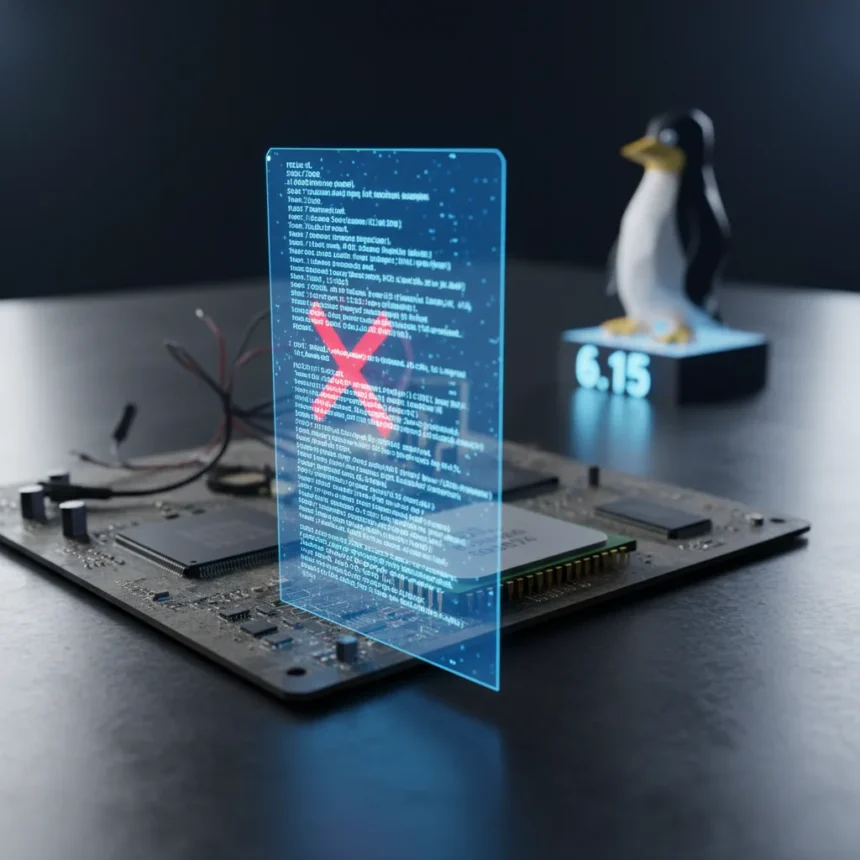
Linux kernel developers are removing Intel 486 CPU support, marking the end of a 37-year era for one of computing’s most iconic processors. Kernel 6.15, expected in late May or early June 2025, will eliminate support for the Intel 80486 (i486) and early 586-class chips, including IDT WinChip, AMD Elan, AMD 5×86, and Cyrix variants. Linus Torvalds has stated there is zero real reason to continue maintaining code for hardware so old that virtually no one is actually running modern Linux on it.
Key Takeaways
- Linux kernel 6.15 drops Intel 486 and early 586 processor support, requiring TSC and CMPXCHG8B instruction support
- Patch removes approximately 15,000 lines of code across 80 files, eliminating floating-point unit emulation
- Last major CPU support removal was i386 in 2012, making this the first significant architecture drop in 13 years
- Discussions about dropping 486 support date back to 2022, reflecting years of developer consensus
- Modern Linux distributions already require 64-bit hardware, effectively sidelining 486 and Pentium users
Why Linux Developers Are Finally Dropping 486 Support
The decision to remove Intel 486 CPU support stems from a simple reality: nobody is using it. Kernel veteran Ingo Molnar authored the patch that eliminates support for processors lacking the Time Stamp Counter (TSC) register and CMPXCHG8B instruction, requirements that pre-Pentium chips cannot meet. The user base running modern Linux kernels on 486 or early 586 hardware has shrunk to such insignificance that no developer bothers testing whether the kernel actually works on these systems. When code breaks and nobody notices, there is no practical reason to maintain it.
Torvalds’ position reflects a hardline pragmatism: legacy support becomes a burden when it serves no real user. The patch removes not just old CPU detection code but also software emulation for floating-point units that older chips lacked, freeing developers from maintaining workarounds for hardware that predates the modern era. This is not sentimental. It is resource allocation.
The Scale of Code Removal and Developer Burden
Ingo Molnar’s patch deletes approximately 15,000 lines of code spread across 80 different files. That is not trivial housekeeping—it represents years of accumulated compatibility layers, conditional compilation directives, and edge-case handling that collectively slowed kernel development and increased maintenance complexity. Every new feature, every security patch, every optimization had to account for 486-era constraints that modern systems never encounter.


The removal of CMPXCHG8B emulation alone eliminates a significant source of architectural debt. Modern CPUs have had this instruction for decades, making the software fallback a relic that only added complexity without serving contemporary hardware. Developers can now write cleaner, faster code without worrying about ancient instruction sets.
Intel 486 CPU Support vs. Modern Architecture Requirements
The Intel 486, released in 1989, becomes incompatible with Linux starting in kernel 6.15. The original Pentium (P5, released in 1993) becomes the new minimum supported x86 architecture. This represents a meaningful generational leap: Pentium introduced features like TSC and CMPXCHG8B that the 486 lacked, creating a hard architectural boundary.



Most major Linux distributions have already moved to 64-bit-only support, effectively rendering 486 and early 32-bit Pentium systems obsolete from a practical standpoint. Users attempting to run kernel 6.15 on 486 hardware will simply find it incompatible—no graceful fallback, no legacy mode. The ecosystem has already voted with its feet.
Historical Context: The 13-Year Gap Since i386 Removal
The last significant CPU architecture drop occurred in 2012, when Linux removed i386 support entirely. That was 13 years ago. The decision to remove 486 support now reflects both the maturation of the kernel codebase and the reality that hardware from the 1980s no longer justifies maintenance effort. Discussions about dropping 486 support have circulated since 2022, giving developers and maintainers years to prepare.
Each removal of legacy support marks a point where the kernel community collectively decides that backward compatibility no longer serves the greater good. The 486 drop is not controversial because there are no vocal advocates for keeping it. The user base is so small that the decision is essentially uncontroversial—a quiet sunset rather than a contentious debate.
What This Means for Users Running Older Hardware
Users with 486 or early 586 systems will be locked to older kernel versions, which continue to receive security patches only if they are part of a long-term support (LTS) branch. Running a modern kernel 6.15 on such hardware simply will not be possible. For the vast majority of users, this change is invisible—they upgraded to modern hardware years ago.



However, enthusiasts maintaining retro systems or industrial equipment using 486-era processors will need to plan accordingly. Older kernel versions remain available and functional, but the cutting edge of Linux development will leave them behind. This is the natural lifecycle of technology: support eventually ends, and users move forward or accept stagnation.
Will older kernels still support 486 processors?
Yes. Older kernel versions, particularly long-term support branches, will continue to support 486 processors. Users can remain on kernel 5.x or earlier versions indefinitely, though they will miss out on newer features and security updates over time. The removal applies only to kernel 6.15 and future versions.
Why did it take so long to drop 486 support?
Linux prioritizes backward compatibility, and removing support for any architecture requires developer consensus and sufficient justification. The 486 had a small but persistent user base, and some developers may have maintained the code out of principle. Only when the maintenance burden clearly outweighed the benefit did the community move forward with removal.
Could 486 support return to Linux in the future?
Unlikely. Once an architecture is removed and the code is deleted, reintroducing it would require rewriting all the compatibility layers from scratch. The kernel community would need a compelling reason—a sudden surge in 486 usage, which is not happening. The removal is effectively permanent.
The Linux kernel dropping Intel 486 support is not a dramatic event, but it is a symbolic one. It marks the end of an era when a processor from 1989 could still run modern software. The 486 was legendary—the chip that made personal computing affordable and powerful. But 36 years later, keeping it compatible with latest Linux kernels serves no one. Sometimes the most pragmatic decision is to let the past stay in the past.
Edited by the All Things Geek team.
Source: Tom's Hardware