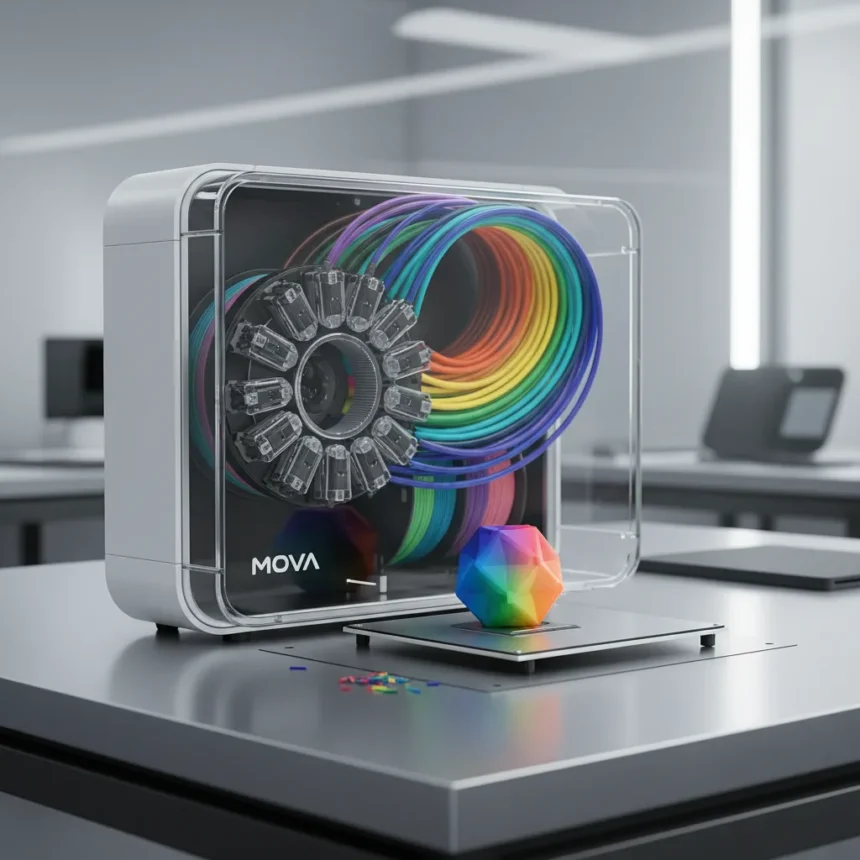
The MOVA AtomForm Palette 300 is a 12-nozzle 3D printer designed for multi-color and multi-material printing, unveiled at CES 2026 with a list price of $2,199 and early Q2 2026 availability. It marks AtomForm’s first commercial printer and promises to cut filament waste dramatically compared to traditional color-printing approaches.
Key Takeaways
- 12-nozzle OmniElement system swaps colors automatically without purge waste, supporting up to 36 colors and 12 materials per print
- FOC step-servo motors and closed-loop feedback eliminate missed steps; build volume is 300×300×300 mm
- Requires up to 6 RFD-6 filament units with built-in drying up to 85°C and automated air venting
- Early supporter price: $999 with $50 refundable deposit; full 36-color setup cost remains undefined
- Ships early Q2 2026; smaller overall footprint than Bambu Lab H2C despite similar build volumes
How the Palette 300 Actually Works
The Palette 300’s defining feature is its OmniElement nozzle swapping system—a revolver-style carousel that holds 12 nozzles and automatically rotates to the next one when a color or material change is needed. This approach eliminates the purge waste that plagues traditional multi-material printers, which typically discard filament to clear old colors before switching. The printer calculates nozzle center deviations automatically and compensates within milliseconds, maintaining ±0.02 mm accuracy.
The accompanying ReadyPrint feeding system prepares the next filament in advance, enabling seamless transitions with far less purging than competing systems. Stanford professor Berry Katz noted the environmental angle: less waste translates directly to less money spent on filament. That efficiency claim is central to AtomForm’s pitch, though independent verification of the 90% waste reduction claim is limited.
Speed specs match the competition—up to 800 mm/s print speed and 20,000-25,000 mm/s² acceleration—but the real question is whether multi-material nozzle changes slow things down in practice. The machine uses FOC (Field Oriented Control) step-servo motors with closed-loop feedback, eliminating missed steps that plague open-loop designs. A steel X-axis rail and high-strength frame handle vibration, while four cameras and pressure sensors monitor print quality in real time via the AutoForm App.


The Filament Management Ecosystem
The Palette 300 doesn’t stand alone. It works with up to six RFD-6 filament units, each holding six spools with built-in drying up to 85°C, auto-rotate drying, temperature and humidity detection, and automated air venting. This ecosystem approach mirrors Bambu Lab’s AMS and Creality’s CFS, but the integration here is tighter—filament prep happens automatically while printing progresses.
The nozzle temperature reaches 350°C, the heated bed climbs to 110°C, and the chamber can warm to 65°C, supporting materials from PLA and PETG through PC, PPA, and engineering-grade filaments. The textured PEI build plate comes standard. A pre-print system check confirms a clear chamber and correct build plate positioning, reducing failed starts.



MOVA AtomForm Palette 300 vs. Bambu Lab H2C
The Palette 300’s closest competitor is the Bambu Lab H2C, which uses the Vortek nozzle system and has a slightly larger build volume (330×320×325 mm versus 300×300×300 mm). However, the Palette 300’s OmniElement carousel is more compact than Vortek’s architecture, giving the AtomForm machine a smaller overall footprint despite comparable print chambers. The H2C excels in speed-focused workflows, but the Palette 300 targets users who prioritize color flexibility and waste reduction over raw velocity.
Speed-focused machines from both Bambu Lab and Creality match the Palette 300’s 800 mm/s capability, but questions linger about whether multi-material nozzle swaps actually preserve that pace in complex prints. The Palette 300 trades some theoretical speed for the convenience of automatic nozzle changes—useful when a nozzle clogs, as YouTuber Robbie Burch pointed out during the launch event.
Pricing and the Early Supporter Play
List price is $2,199, but AtomForm is offering an early supporter deal: a $50 refundable deposit locks in a $999 VIP price, with the printer and filament housing estimated at roughly $2,000 combined. The full cost of a complete 36-color setup remains undefined, a notable gap for buyers planning their investment.
Availability starts early Q2 2026, making this AtomForm’s first commercial printer to ship. The deposit mechanism is straightforward—no promo codes or bundle tricks, just a time-limited price advantage for early commitments.



Should You Pre-Order the Palette 300?
The Palette 300 appeals to prosumers and small shops that print multi-color models regularly and care about filament waste. YouTubers Jerry Gomes and Robbie Burch listed it as their top pick during the launch panel, citing its practical benefits. The OmniElement system genuinely solves a real problem—color switching without purge waste—and the closed-loop motors eliminate a frustration point in open-loop designs.
The catch: promotional claims about 90% waste reduction and 50% faster swaps lack independent verification. The undefined cost of a full 36-color setup makes budgeting difficult. And while the compact footprint is attractive, the ecosystem requires up to six RFD-6 filament units, which will add cost and desk space.
Can the Palette 300 handle engineering-grade materials?
Yes. The nozzle reaches 350°C and the heated bed climbs to 110°C, supporting PC, PPA, and other engineering-grade filaments alongside standard plastics. The chamber heating to 65°C helps with material adhesion and reduces warping for demanding prints.
What’s included in the box?
The package contains the main unit, power cable, starter filament spool, basic toolset (nozzle cleaner and spatula), quick-start guide, and warranty card. The RFD-6 filament units are sold separately.
How does nozzle swapping work when one clogs?
The Palette 300 can automatically swap to a fresh nozzle from the carousel if one becomes clogged, saving the print and eliminating downtime. This is a practical advantage over single-nozzle machines, where a clog means starting over.
The Palette 300 arrives at a moment when multi-color 3D printing is becoming mainstream but still inefficient. MOVA AtomForm’s 12-nozzle carousel solves the waste problem elegantly, and the closed-loop motors address a real pain point. The price is reasonable for the feature set, and the early supporter discount makes entry cheaper. What remains to be seen is whether the waste reduction claims hold up in independent testing and whether the ecosystem cost—multiple RFD-6 units plus the printer itself—justifies the efficiency gains. If you print multi-color models regularly and hate throwing away purge waste, the Palette 300 is worth the pre-order deposit. If you’re a speed chaser or casual single-color user, stick with faster machines from Bambu Lab or Creality.
Where to Buy
Make it New: A History of Silicon Valley Design
Edited by the All Things Geek team.
Source: Tom's Hardware