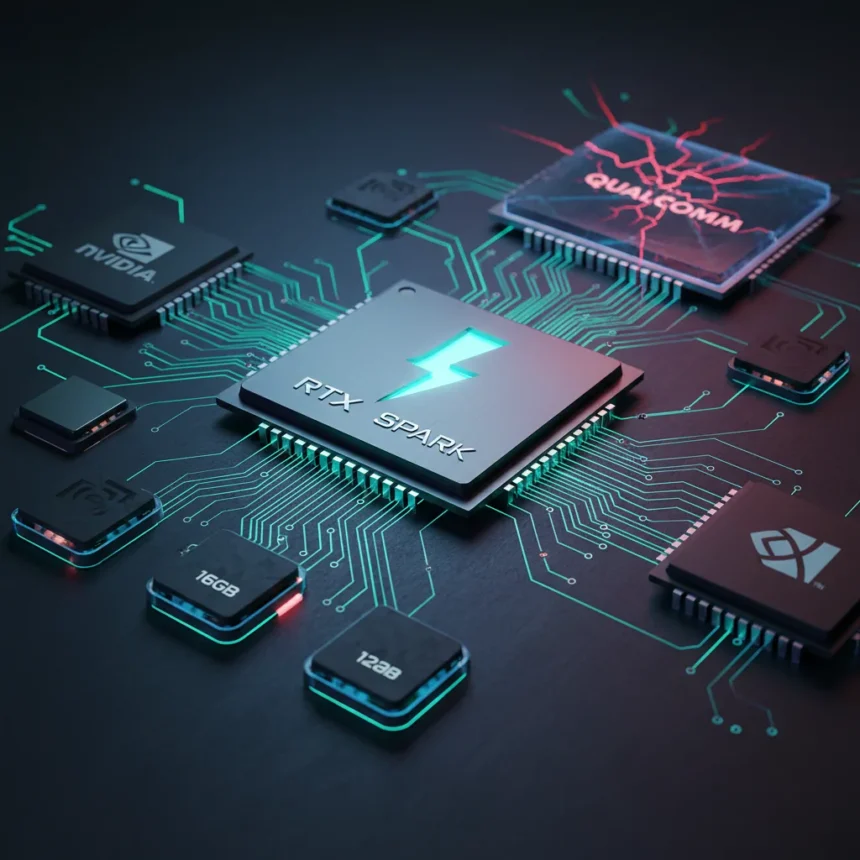
Nvidia RTX Spark Arm PC is not just an AI platform—it is a direct challenge to Qualcomm’s near-monopoly on Windows-on-Arm devices. The company announced a family of products designed to target multiple price points, from budget-conscious buyers to high-end gamers, spanning configurations from 16GB to 128GB of unified memory. This marks a significant shift in an industry where Qualcomm’s Snapdragon processors have dominated for years.
Key Takeaways
- Nvidia RTX Spark Arm PC family targets AI agents, developers, and gamers across multiple price points.
- The flagship N1X superchip includes up to 20 Grace CPU cores and 6144 RTX Blackwell GPU cores with 128GB unified LPDDR5x memory.
- RTX Spark relies on Microsoft’s Prism emulator for x86 compatibility on Windows-on-Arm, similar to existing Qualcomm solutions.
- Nvidia claims GPU-bound workloads see minimal emulation overhead, with performance potentially matching or exceeding RTX 5070 in certain scenarios.
- Native Arm game ports and Prism-optimized updates are already in development from game studios.
Why Nvidia is Entering the Arm Windows Market
For years, Qualcomm controlled the Arm PC space almost entirely. The company’s Snapdragon processors powered virtually every Windows-on-Arm device on the market. Nvidia’s entry signals that the market is finally worth competing for seriously. The RTX Spark targets three distinct audiences: AI researchers and software developers who need efficient compute, gamers seeking portable high-performance systems, and general users wanting cheaper alternatives to traditional Intel and AMD laptops.
The timing matters. Windows-on-Arm adoption has been gradual but steady, with Microsoft improving Prism emulation and developers showing renewed interest in native Arm support. Nvidia’s GPU expertise gives it a credible angle—the company can promise gaming performance that Qualcomm, historically weaker in graphics, has struggled to deliver convincingly.
Nvidia RTX Spark Arm PC Performance Expectations
Nvidia has been careful with its performance claims, acknowledging that results depend heavily on workload type. For GPU-bound applications and games, the company argues emulation overhead is negligible. In those scenarios, RTX Spark can match or exceed an RTX 5070. For compute-heavy portions of applications, Nvidia similarly expects minimal emulation impact.


This conditional framing is important. Nvidia is not claiming universal superiority over discrete GPUs—only that in specific workload categories, the Arm approach holds its own. Games that rely on heavy shader work or ray tracing, where the GPU does most of the lifting, should perform well. Applications that depend on frequent CPU-x86 instruction translation will face steeper penalties.
The family approach also matters for realistic positioning. By offering configurations from 16GB to 128GB of memory, Nvidia can serve different price tiers without making overblown promises about competing directly with high-end RTX 5090 systems.



How RTX Spark Compares to Qualcomm’s Snapdragon
Qualcomm’s response to Nvidia’s entry has been diplomatic—the company publicly welcomed the competition, framing it as validation of the Arm PC category. Yet the two platforms differ significantly. Qualcomm’s Snapdragon processors prioritize power efficiency and general computing, with modest GPU capabilities. Nvidia’s RTX Spark flips that balance, emphasizing GPU performance and AI compute at the expense of power efficiency.
Both rely on the same Windows-on-Arm software stack and Prism emulation for legacy x86 apps. Neither has a fundamental software advantage. The real distinction lies in GPU architecture: Nvidia’s RTX Blackwell cores are purpose-built for gaming and AI workloads, while Snapdragon’s Adreno GPUs target mobile-first efficiency. For developers and gamers, RTX Spark’s graphics prowess is the key differentiator.
Qualcomm may still hold advantages in battery life and thermal efficiency, areas where Snapdragon’s conservative design excels. But those strengths matter less to the audiences Nvidia is targeting—developers want raw compute power, gamers want framerates, and AI researchers need GPU throughput.
The Emerging Arm Gaming Ecosystem
RTX Spark’s credibility as a gaming platform depends on software support. The good news: developers are taking Arm seriously. Studios are reportedly creating native Arm game ports and Prism-optimized updates specifically for RTX Spark. This is a departure from the early Windows-on-Arm era, when most games relied entirely on emulation.



Native ports mean better performance and more predictable behavior. Prism-optimized updates mean developers have tuned their x86 code for faster emulation translation. Together, these approaches suggest the software ecosystem is maturing beyond pure emulation toward hybrid native-and-translated support.
Still, Arm gaming remains niche. Most AAA titles will not receive native Arm ports immediately. RTX Spark will depend on Prism’s translation quality for the vast majority of games. Nvidia’s claim that GPU-bound workloads suffer minimal emulation overhead is credible—the GPU does the heavy lifting—but CPU-intensive games or those with complex physics may face stuttering or frame drops.
What This Means for the Broader Arm PC Market
Nvidia’s entry validates the Arm PC category but also raises the stakes. Qualcomm can no longer assume dominance by default. The company will need to improve GPU performance, lower prices, or both. Microsoft, meanwhile, benefits from increased competition driving innovation and software investment. More vendors pursuing Arm PCs means more incentive for game studios and app developers to optimize for the platform.
The real winner could be consumers. If Nvidia and Qualcomm compete aggressively on price and performance, Arm PC buyers will have genuine choices. That was never true before.
Does RTX Spark guarantee good gaming performance?
Not universally. Nvidia claims GPU-bound workloads perform well, but CPU-heavy games or those relying on x86-specific optimizations may see emulation slowdowns. Performance varies by game and workload type.
How does RTX Spark compare to buying an RTX 5070 laptop?
RTX Spark targets different price points and use cases. Nvidia suggests GPU-bound performance can match an RTX 5070, but RTX Spark systems will likely cost less and offer better battery life due to Arm efficiency. However, discrete GPU laptops offer more predictable compatibility with existing x86 software.
Will game developers support RTX Spark?
Yes, but selectively. Developers are already creating native Arm ports and Prism-optimized updates for RTX Spark. However, not every game will receive native support—most will rely on Prism emulation initially.
Nvidia RTX Spark Arm PC represents a genuine market shift. Qualcomm’s welcome speech was diplomatic, but the company now faces real competition in a space it has owned unchallenged. For gamers and developers, that competition is overdue. Whether RTX Spark delivers on its promises depends on software maturity and real-world performance testing, but the platform’s ambition is clear: make Arm PCs competitive for gaming, not just efficiency.
Edited by the All Things Geek team.
Source: TechRadar