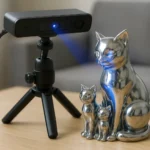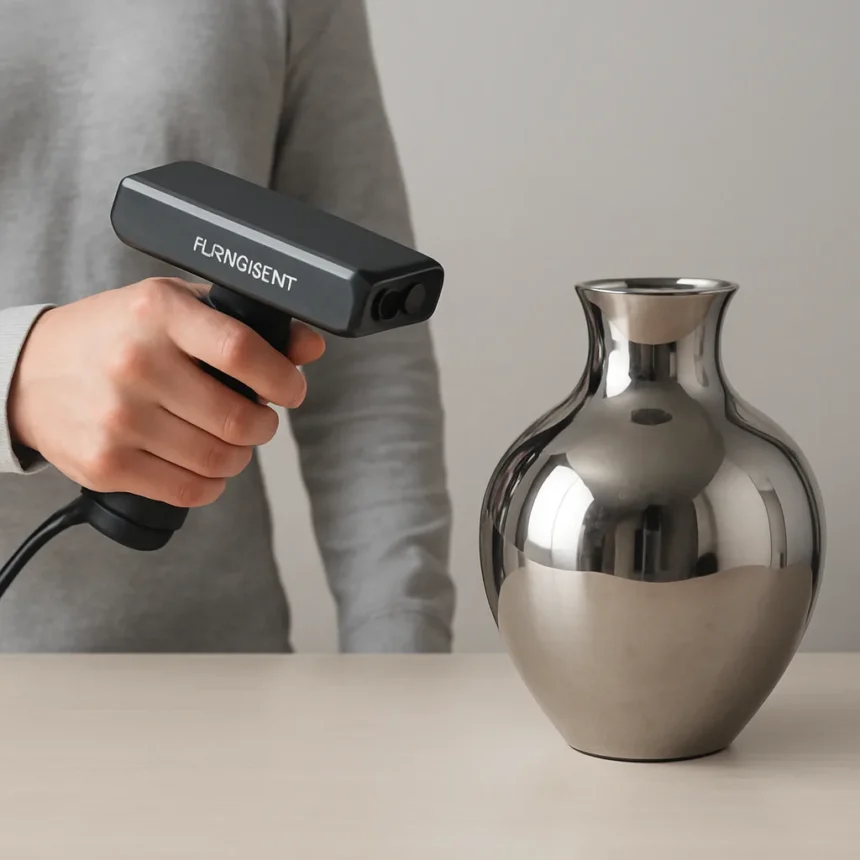
The Revopoint INSPIRE 2 is a portable handheld 3D scanner made by Revopoint, launched recently and available globally through the Revopoint official site and retailers including 3D Prima. It weighs just 190g and introduces a dual-mode hybrid system combining Infrared Structured Light with 11 Parallel Infrared Laser Lines — a combination that its predecessor never offered. The central claim is bold: scan highly reflective, shiny, or dark surfaces without reaching for scanning spray. That is a promise worth testing hard.
What Makes the Revopoint INSPIRE 2 Different From Its Predecessor
The original INSPIRE was a capable entry-level scanner, but it had real limitations. Single-frame accuracy sat at 0.2 mm, the minimum scan volume was 50 × 50 × 50 mm, and outdoor scanning was essentially off the table. The INSPIRE 2 addresses all three of those weaknesses in one hardware revision. Accuracy improves to 0.05 mm — a 75% improvement — while the minimum scan volume drops to 20 × 20 × 20 mm, opening the door to small-detail work that the original could not reliably capture.
The addition of 11 parallel infrared laser lines is the architectural change that matters most. Structured-light-only scanners flood a surface with a projected pattern and read the distortion — but highly reflective surfaces bounce that light unpredictably, causing holes and noise in the resulting mesh. Laser lines behave differently, cutting through glare rather than being defeated by it. This is why the INSPIRE 2 can handle shiny chrome-plated objects in laser mode without any surface preparation. That is not a small convenience; for makers and prototypers who scan metal parts, jewellery components, or polished enclosures, it removes a genuinely annoying step from the workflow.
Revopoint INSPIRE 2 Scanning Performance: Speed and Detail
The INSPIRE 2 runs at up to 18 frames per second in Full-field Structured Light mode. Switch to Multi-line Laser mode and that figure jumps dramatically — up to 90 fps on GPU-capable hardware, or 40 fps on CPU alone. For a scanner in this weight class, those are competitive numbers. The capture area is 30% larger than the original INSPIRE, and surface detail improves by a similar margin.


Optical zoom at 1.5x and 2x gives additional flexibility when working across mixed-geometry surfaces — useful when a single object combines both fine engraving and broad flat planes. The RGB camera resolves at 1280 × 800, supporting full colour capture when you need texture alongside geometry. Outdoor usability extends up to 20,000 lux, which covers most daylight conditions and makes location scanning genuinely practical rather than theoretical.
Tracking deserves a note of precision here. In Structured Light mode, the scanner supports Feature, Marker, and Global Marker tracking — giving you flexibility on low-texture surfaces. In Laser mode, only Marker and Global Marker tracking are available. That is not a dealbreaker, but it is the kind of detail that matters when you are mid-session on a featureless curved object and wondering why tracking keeps dropping.



How the Revopoint INSPIRE 2 Compares to Other Revopoint Scanners
Stacking the INSPIRE 2 against the broader Revopoint lineup reveals where it sits. The POP series uses blue-laser technology and achieves higher raw point rates — the POP 3 reaches 1,700,000 points per second — which gives it an edge in dense geometry capture. The INSPIRE 2’s infrared approach, however, handles outdoor light and reflective surfaces more reliably than blue-laser alternatives, making it the better choice for real-world maker environments rather than controlled studio setups.
Against structured-light-only scanners at a similar price point, the hybrid system is a clear differentiator. Any scanner that relies solely on projected patterns will struggle with chrome, polished aluminium, or wet-look paint without spray. The INSPIRE 2 sidesteps that problem entirely in laser mode, putting it in a different practical category for anyone whose work involves shiny materials.
Is the Revopoint INSPIRE 2 worth buying for reflective object scanning?
For makers, product designers, and 3D printing enthusiasts who regularly scan metal parts, polished enclosures, or jewellery, the INSPIRE 2 makes a strong case. The spray-free laser mode removes a step that was always a friction point, and the 0.05 mm accuracy is genuinely useful for parts that need to fit together after printing. If your work is exclusively low-texture matte objects in a controlled indoor environment, the original INSPIRE or a structured-light alternative may still serve you adequately at lower cost.
Does the INSPIRE 2 need scanning spray on shiny surfaces?
No. In Multi-line Laser mode, the Revopoint INSPIRE 2 is designed to scan shiny, reflective, and dark surfaces without scanning spray. Structured Light mode may still struggle with highly specular surfaces, so switching to laser mode is the recommended approach for chrome or polished metal objects.



What is the minimum object size the INSPIRE 2 can scan?
The minimum scan volume is 20 × 20 × 20 mm, down from 50 × 50 × 50 mm on the original INSPIRE. This makes the INSPIRE 2 suitable for small components, jewellery, and fine-detail work that the predecessor could not reliably capture.
The Revopoint INSPIRE 2 is not a perfect scanner — no scanner at this price tier is — but it solves a real problem that its predecessor left open. The hybrid infrared system earns its place by making reflective-surface scanning practical without spray, and the accuracy and minimum-volume improvements are meaningful upgrades rather than marketing increments. For makers who have been frustrated by structured-light limitations on shiny objects, this is the scanner that changes the workflow.
Where to Buy
Edited by the All Things Geek team.
Source: Creativebloq