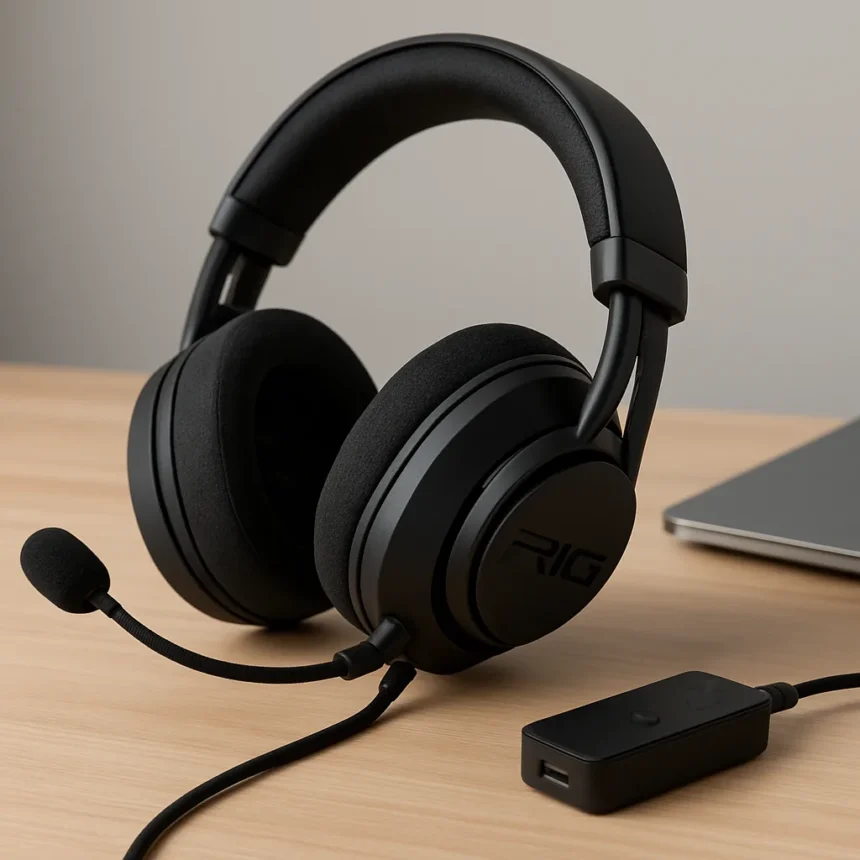
The RIG R5 Max HD gaming headset is a wired PC and console headset made by RIG Gaming, featuring GrapheneQ™ drivers developed with ORA and a bundled USB-C DAC dongle that unlocks 32-bit/384 kHz hi-res audio playback. It is positioned as a direct challenge to premium audiophile gaming headsets at roughly half their asking price, though an exact retail price has not been officially confirmed at the time of writing. For competitive PC gamers who have been priced out of true hi-res audio hardware, this announcement deserves serious attention.
What Makes the RIG R5 Max HD Gaming Headset Different
The headline feature here is not the headset itself but the combination of the headset and its included R5 USB-C DAC. That dongle supports 32-bit/384 kHz resolution for headphone output and 24-bit/192 kHz for the microphone input — figures that sit comfortably in audiophile territory and well above what most gaming headsets even attempt. The GrapheneQ™ drivers, co-developed with ORA, deliver a frequency response of 20 Hz to 40 kHz with less than 0.3% harmonic distortion, which is a notably tight distortion figure for a gaming product.
Connecting via USB-C also unlocks Dolby Atmos for headphones on PC, which is a meaningful addition for spatial audio without requiring a separate software subscription or additional hardware. The 6 mm broadcast-grade microphone covers a 50 Hz to 15 kHz frequency range, though based on experience with the related R5 Spear Pro HS, sensitivity can run high enough to pick up PC fans and mechanical keyboards when gain is boosted. That is a known trade-off with sensitive microphones and worth flagging for streamers who work in noisy environments.
How the RIG R5 Max HD Stacks Up Against the Competition
RIG’s own positioning is blunt: the R5 Max HD costs roughly half what comparable audiophile gaming headsets charge. Without a confirmed retail price, that claim cannot be fully stress-tested, but the related R5 Spear Pro HS has already demonstrated that RIG can compete with significantly more expensive hardware on sound reproduction. Stream Tech Reviews found the R5 Spear Pro HS capable of challenging the Logitech G Pro X 2 and Astro A50 Gen 5 in detail and separation for footsteps, reloads, and critical in-game sound cues. Both of those are flagship-tier headsets with flagship-tier prices.



Against Sony’s own PlayStation headsets, Gaming Nexus noted that the R5 Spear Pro sounded noticeably clearer and outperformed Sony’s own units on Tempest 3D AudioTech. That is a credible data point for console players considering the R5 Max HD, which shares the same core driver philosophy. The one area where RIG concedes ground is in mid-range detail and positional cues compared to competitors like the Atlas 200, which edges ahead in those specific areas despite the R5 delivering stronger sub-bass.
RIG R5 Max HD Gaming Headset PC Setup: Getting the Most From the DAC
The USB-C DAC is only as useful as the setup behind it, and getting the full benefit requires a few deliberate steps. In Windows sound settings, set the R5 Max as the default audio output device and select RIG DAC in the output tab. From there, adjust the sample rate to the maximum 32-bit/384 kHz for headphone output. Under the input tab, select the headset microphone and set the sample rate to its maximum of 24-bit/192 kHz. Once the USB-C DAC is connected and configured correctly, Dolby Atmos for headphones activates automatically on PC, adding a layer of 3D spatial processing that is particularly useful in competitive shooters where directional audio is a tactical advantage.



Who Should Actually Buy This Headset
The RIG R5 Max HD gaming headset is built for a specific type of player: someone who takes audio seriously as a competitive tool, games primarily on PC, and does not want to spend flagship money to get flagship-adjacent sound quality. The GrapheneQ™ driver technology and sub-0.3% harmonic distortion are not marketing noise — they reflect a genuine engineering commitment to low-distortion, wide-frequency reproduction that most gaming headsets do not bother with.
That said, this is a wired-only solution. There is no wireless option here, which is a deliberate trade-off for audio quality and latency. Players who prioritise freedom of movement over sonic precision will find the wired format limiting. Similarly, streamers or content creators sharing a space with loud peripherals should factor in the microphone’s high sensitivity before committing. For pure competitive gaming on PC, though, the value proposition is compelling — assuming the final retail price lives up to the half-price claim.
Is the RIG R5 Max HD compatible with PlayStation?
The broader RIG R5 family, including the R5 Spear Pro HS, carries PlayStation licensing and is optimised for Sony’s Tempest 3D AudioTech. The R5 Max HD shares the same platform focus on PC and console, though buyers should confirm PlayStation compatibility specifics at point of purchase, as DAC functionality may vary by platform.
What does GrapheneQ mean in a gaming headset?
GrapheneQ™ is a driver technology developed by ORA that uses graphene-composite materials to achieve a wider frequency response and lower harmonic distortion than traditional dynamic drivers. In the R5 Max HD, this translates to a 20 Hz to 40 kHz frequency range and less than 0.3% THD, which reduces the coloration and distortion that can muddy competitive audio cues like footsteps and reload sounds.



How does the RIG R5 Max HD microphone perform for streaming?
The 6 mm broadcast-grade microphone covers 50 Hz to 15 kHz and is sensitive enough for clear voice capture. However, that same sensitivity becomes a liability in louder environments — Stream Tech Reviews noted the R5 family’s microphone picks up PC fans and keyboards when gain is increased. Streamers in acoustically treated spaces will be fine; those in typical home setups should consider a noise gate in their audio software.
The RIG R5 Max HD gaming headset arrives at a moment when the audiophile gaming market has been dominated by expensive, wireless-first flagships that bundle features many competitive players do not need. By pairing serious driver technology with a hi-res DAC dongle and keeping the price aggressive, RIG is making a direct argument that wired, precision-focused audio should not require a premium budget. If the retail price holds to the half-the-competition promise, this could be the most disruptive value play in gaming audio this year.
This article was written with AI assistance and editorially reviewed.
Source: TechRadar