





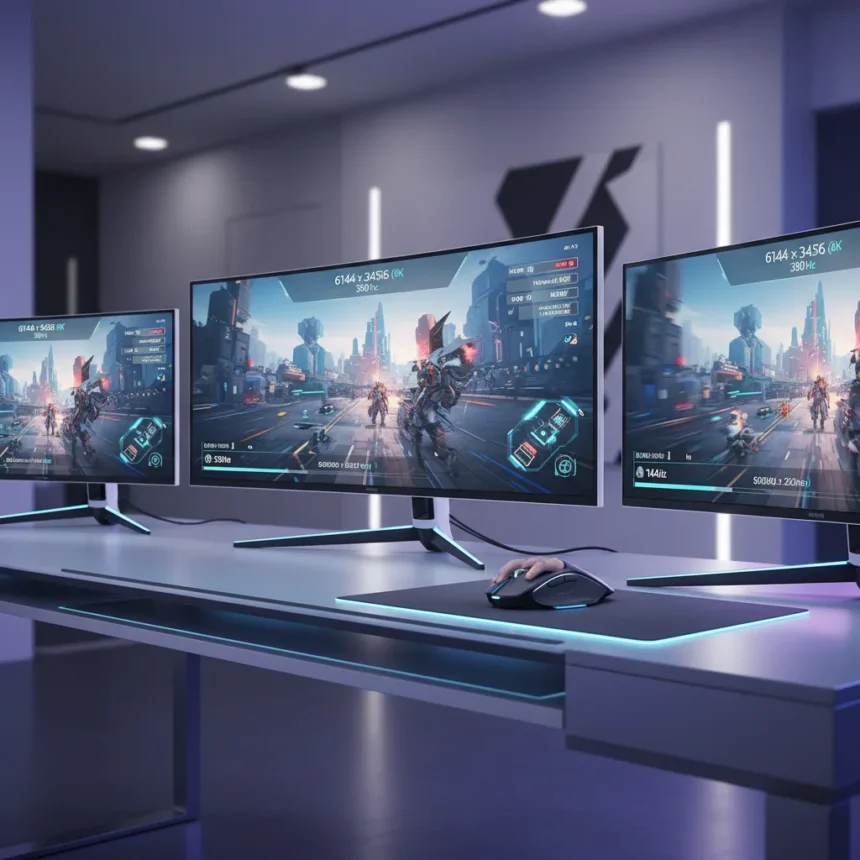
Samsung’s 2026 Odyssey gaming monitors are pushing ultra-high resolution into territory most gamers have never seriously considered. The lineup includes what Samsung claims is the industry’s first 6K gaming monitor, alongside 5K and 4K OLED models in sizes from 27 to 32 inches, with refresh rates reaching 330 Hz in certain modes. But the question looming over this launch is whether pixel density at these levels actually serves competitive gaming, or if Samsung is chasing a specification arms race that leaves practical gaming performance behind.
Key Takeaways
- Samsung’s Odyssey G8 (G80HS) is a 32-inch 6K IPS monitor with 224 PPI pixel density and 165 Hz native refresh rate.
- The G80HS supports Dual Mode, allowing 330 Hz refresh rate when resolution drops to 3K, a less aggressive compromise than typical 1080p/720p dual-mode monitors.
- The 27-inch 5K Odyssey model delivers 218 PPI and starts at $949.99 in the US, while the 32-inch 6K model costs $1,600.
- A 27-inch Odyssey OLED 4K model with 240 Hz refresh rate is also available at $1,099.99, offering an alternative for those prioritizing response time.
- The 2026 lineup signals Samsung’s bet that ultra-high-resolution gaming will appeal to a broader audience beyond professional content creators.
What Makes the Samsung Odyssey Gaming Monitors Stand Out
The 32-inch Odyssey G8 (G80HS) is the centerpiece of this launch. It combines a native 6144 x 3456 resolution across a 32-inch IPS LCD panel with a 165 Hz refresh rate at full resolution. That pixel density—224 PPI—puts it in territory typically reserved for professional monitors. But here’s where Samsung’s engineering choice becomes interesting: instead of dropping to 1080p or 720p when you want higher refresh rates, the Dual Mode reduces resolution to 3K while pushing refresh rate to 330 Hz. That’s a gentler compromise than the aggressive downgrades competitors often use, though it still requires accepting a resolution cut to achieve the headline refresh rate.
The 27-inch 5K model delivers similar pixel density logic at 218 PPI, fitting Samsung’s strategy of treating pixel density—not raw resolution—as the primary selling point. Both displays support DisplayPort 2.1 (UHBR 13.5) and HDMI 2.1, which matters because older connection standards would bottleneck these resolutions anyway.
The Dual-Mode Compromise: Resolution or Refresh Rate
Gaming monitors have traditionally forced a choice: high resolution or high refresh rate. Most dual-mode monitors solve this by dropping to 1080p or 720p when you want 240 Hz or above. Samsung’s approach—dropping only to 3K—is more forgiving for gamers who value image clarity, but it still requires accepting a resolution trade-off. The real question is whether 3K at 330 Hz is a meaningful gaming advantage, or whether most players would stick with 6K at 165 Hz anyway.


This tension exposes the fundamental design conflict in these monitors. Competitive shooters and fast-paced games benefit from 240 Hz and above. But at those refresh rates, the 6K resolution becomes almost irrelevant—your graphics card would struggle to maintain frame rates that high at native resolution. For slower-paced games, creative work, or content creation, the 6K resolution shines, but 165 Hz is overkill. The Dual Mode tries to bridge both worlds, but it does so imperfectly, forcing gamers to choose which compromise they prefer.
Pricing and the OLED Alternative
Samsung’s US store lists the 27-inch 5K Odyssey G8 (G80HF) at $949.99. The 32-inch 6K model commands $1,600. For comparison, Samsung also offers a 27-inch Odyssey OLED G8 (G80SH) with 4K resolution and 240 Hz refresh rate at $1,099.99. That OLED model is worth considering—it sacrifices the ultra-high resolution but delivers the faster refresh rate and OLED’s superior contrast and color accuracy, which many gamers prioritize over pixel density.



The pricing strategy reveals Samsung’s target audience: not budget-conscious gamers, but high-end enthusiasts and content creators willing to pay premium prices for specification leadership. At these price points, the monitors compete less with other gaming displays and more with professional-grade content creation monitors from companies like LG and Dell.
Is Ultra-High Resolution Gaming a Real Need?
The 2026 Odyssey lineup raises an uncomfortable question: does anyone actually need 6K resolution for gaming? The answer depends entirely on use case. Professional streamers, video editors, and 3D artists will find genuine value in the pixel density and color accuracy. Competitive gamers chasing sub-100-millisecond response times will find the high refresh rates more appealing than the resolution. Casual gamers will likely find both excessive.
Where these monitors make the most sense is in hybrid workflows—a streamer who plays games and edits content simultaneously, or a designer who needs a monitor for both professional work and gaming breaks. For those users, the Odyssey G8 6K model’s ability to deliver both high resolution and respectable refresh rates (via Dual Mode) is genuinely useful. For everyone else, they’re a specification showcase rather than a practical necessity.
How Do Samsung’s 6K and 5K Odyssey Monitors Compare to Alternatives?
Samsung positions the 6K G80HS as the industry’s first 6K gaming monitor. The competitive landscape for ultra-high-resolution gaming monitors is thin—most manufacturers have focused on 4K at high refresh rates rather than pushing resolution beyond that. This gives Samsung a temporary specification advantage, though it’s unclear whether the market will reward it. The OLED model in the lineup, positioned at a lower price point, may actually be the more popular choice among gamers who value response time and contrast over raw pixel count.



FAQ
What is the native refresh rate of the Samsung Odyssey G8 6K monitor?
The 32-inch Odyssey G8 (G80HS) has a native refresh rate of 165 Hz at full 6K resolution. The 330 Hz refresh rate is only available in Dual Mode at reduced 3K resolution.
How much does the 27-inch 5K Samsung Odyssey monitor cost?
The 27-inch Odyssey G8 (G80HF) 5K gaming monitor is priced at $949.99 in the US. The 32-inch 6K model costs $1,600, while the 27-inch OLED 4K alternative is $1,099.99.
Should I buy the 6K Odyssey monitor or the OLED version?
Choose the 6K model if you need ultra-high pixel density for content creation or professional work alongside gaming. Choose the OLED model if gaming performance and image quality (contrast, color accuracy) matter more than resolution—it’s also $500 cheaper and offers a faster 240 Hz refresh rate.
Samsung’s 2026 Odyssey lineup represents a bet that ultra-high-resolution gaming will eventually become mainstream. Whether that bet pays off depends on whether GPU manufacturers can deliver the graphics power to drive these resolutions at competitive refresh rates. For now, the monitors exist in a specification sweet spot that serves hybrid creators better than pure gamers, making them a niche product in a market still dominated by 4K 144 Hz displays.
Edited by the All Things Geek team.
Source: Tom's Hardware




