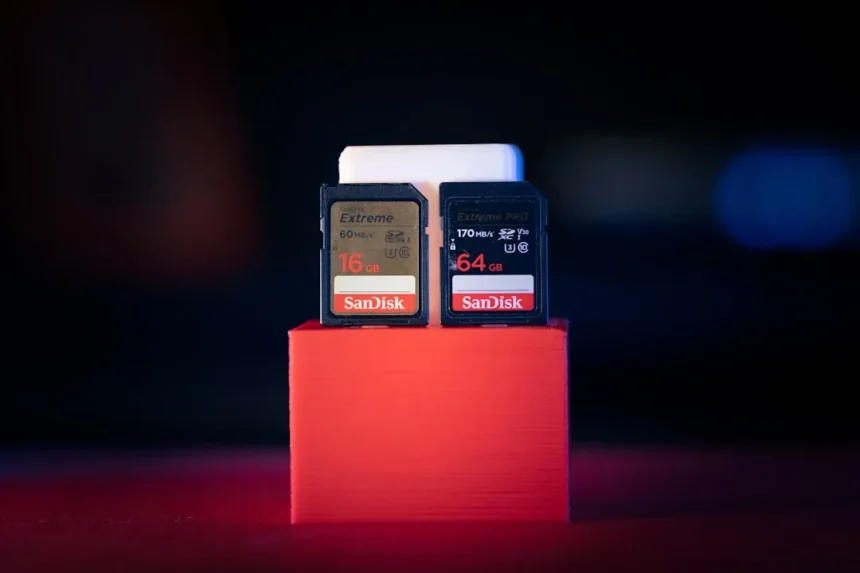
The SanDisk 2TB Extreme Pro SD card has arrived at a staggering $2,000, marking a milestone in high-capacity professional storage—but also raising serious questions about value. At $1 per gigabyte, this UHS-II card promises over 300 MB/s sequential read and write speeds, yet costs more than four times as much per gigabyte as faster microSD Express alternatives. For camera operators, filmmakers, and data archivists, the question is not whether this card exists, but whether anyone should actually buy it.
Key Takeaways
- SanDisk 2TB Extreme Pro SD card priced at $2,000, or $1 per GB
- Promises over 300 MB/s read and write speeds via UHS-II interface
- Real-world tested speeds reach 293 MB/s read, 268 MB/s write on comparable models
- Requires UHS-II compatible reader; standard UHS-I readers cap at ~100 MB/s
- A $299 2TB Extreme Pro UHS-I alternative offers 250 MB/s read, 150 MB/s write
What Makes the SanDisk 2TB Extreme Pro SD Card Different
The SanDisk 2TB Extreme Pro SD card is an SDXC card rated for UHS-II, the faster interface standard that doubles theoretical maximum speed to 312 MB/s compared to UHS-I’s 156 MB/s. The card carries a V90 Video Speed Class rating, guaranteeing a minimum sustained write speed of 90 MB/s—essential for high-bitrate 4K and 8K video capture without dropped frames. This matters for professionals shooting on high-end DSLRs and mirrorless cameras that demand reliable burst performance and consistent file recording.
The headline spec—over 300 MB/s—sits at the upper edge of what UHS-II can deliver. Real-world testing of comparable SanDisk Extreme Pro UHS-II V90 models shows read speeds near 293 MB/s and write speeds around 268 MB/s, slightly below the advertised ceiling. That gap between claimed and tested performance is typical for memory cards, where sequential benchmarks rarely match marketing claims under real-world workloads.
The Price-Per-Gigabyte Problem
At $1 per GB, the SanDisk 2TB Extreme Pro SD card is genuinely expensive. To put this in perspective, a comparable 2TB Extreme Pro UHS-I model—slower but still capable—sells for around $299, or roughly 15 cents per gigabyte. The UHS-II premium costs you roughly six times more per gigabyte for the speed boost. Even more damaging is the comparison to microSD Express cards, which deliver faster performance at a quarter of the price per gigabyte [summary]. If raw speed matters more than the SD form factor, microSD Express becomes the obvious choice.


The real audience for this card is narrow: professionals who need both massive capacity in a single SD card and the UHS-II speed guarantee, without access to microSD Express alternatives or willing to accept their smaller capacity limits. Cinematographers archiving 4K RAW footage, wedding photographers shooting extended bursts, and sports shooters covering multi-hour events might justify the cost. For everyone else, the $299 UHS-I variant or external SSD storage makes more financial sense.
Speed Claims vs. Real-World Performance
SanDisk rates the Extreme Pro UHS-II line at 300 MB/s read and 260 MB/s write, but tested results on the V90 variant show 293 MB/s read and 268 MB/s write. Lower-capacity UHS-II models tested at 245 MB/s read and 193 MB/s write, revealing how compressible data and file fragmentation affect real throughput. The UHS-I Extreme Pro variants max out around 191.8 MB/s read and 133.1 MB/s write in testing, despite 200/140 MB/s ratings.



Here is the catch: you need a UHS-II compatible reader to access these speeds. Standard UHS-I readers, which are far more common and cheaper, bottleneck the card to roughly 100 MB/s—negating the entire speed advantage. The SanDisk QuickFlow reader, a UHS-II compatible accessory, costs around $45 but has drawn criticism for build quality issues, with users reporting cards getting stuck inside the reader. This hidden cost—both financial and logistical—matters when evaluating whether the 2TB card’s speed premium is real.
Capacity That Solves a Real Problem
Two terabytes in a single SD card is genuinely useful for specific workflows. A 2TB Extreme Pro can store approximately 47,368 24-megapixel RAW photos or over 2,800 minutes of 4K UHD video, eliminating the need to swap cards during long shoots. For wedding and event photographers, this single-card capacity reduces the risk of losing an entire day’s work to a card failure, and it simplifies file management on set.
That said, capacity alone does not justify the price. External SSDs offer terabytes of storage at a fraction of the cost and with faster transfer speeds once offloaded. The 2TB Extreme Pro SD card makes sense only if you absolutely need the storage to live inside your camera body during shooting, not as a backup or archive solution.
SanDisk 2TB Extreme Pro SD Card vs. Alternatives
The obvious competitor is the $299 2TB Extreme Pro UHS-I model, which trades speed for affordability. It delivers 250 MB/s read and 150 MB/s write—still plenty for 4K video and high-speed bursts—without requiring a specialized reader. For most professionals, the UHS-I variant is the smarter buy. Faster alternatives like microSD Express cards outpace the 2TB SD card on speed but sacrifice capacity and compatibility with older camera systems. Lexar’s UHS-II offerings, such as the 2000x line, achieve comparable speeds to SanDisk but do not yet offer 2TB capacity, leaving SanDisk with a monopoly on extreme capacity in the SD form factor.



Should You Buy the SanDisk 2TB Extreme Pro SD Card?
Buy it if you shoot 4K RAW video on a professional cinema or mirrorless camera, need to archive multiple terabytes on a single card during multi-day shoots, and have a UHS-II reader already in your workflow. Buy it if your insurance or client contracts require you to minimize the number of physical storage devices on set. Otherwise, the $299 UHS-I variant or an external SSD is the smarter choice. The 2TB capacity is genuinely useful, but the UHS-II speed premium does not justify a 600% price increase for most workflows.
Does the SanDisk 2TB card work with older cameras?
Yes, it is backward compatible with any camera that accepts SDXC cards. However, older cameras with UHS-I or standard SD interfaces will not access the UHS-II speed advantage—you will see write speeds capped around 100 MB/s, negating the premium you paid. Check your camera’s specifications before buying.
What is the difference between UHS-I and UHS-II?
UHS-II doubles the theoretical maximum speed to 312 MB/s compared to UHS-I’s 156 MB/s, and requires additional pins on the card and reader. UHS-II cards work in UHS-I readers, but at UHS-I speeds. You need a UHS-II reader to unlock the full speed advantage, and those readers are less common and more expensive than standard SD readers.
Is the 2TB Extreme Pro worth it over the UHS-I version?
Not for most users. The UHS-II model costs six times more per gigabyte while delivering roughly 40% faster speeds. Unless you regularly shoot 4K RAW or need every extra megabyte per second for professional work, the $299 UHS-I variant delivers better value and avoids the reader compatibility headache.
The SanDisk 2TB Extreme Pro SD card is a technical achievement and a genuine solution for a narrow set of professionals. But it is also a cautionary tale about capacity premium pricing in an era when external storage has become faster, cheaper, and more reliable. If you fit the specific use case—high-capacity professional video or photography requiring on-camera storage—go in with eyes open about the reader requirements and speed-per-dollar tradeoff. For everyone else, save your money.
Where to Buy
costing a staggering $1,999.99 on Amazon
Edited by the All Things Geek team.
Source: Tom's Hardware