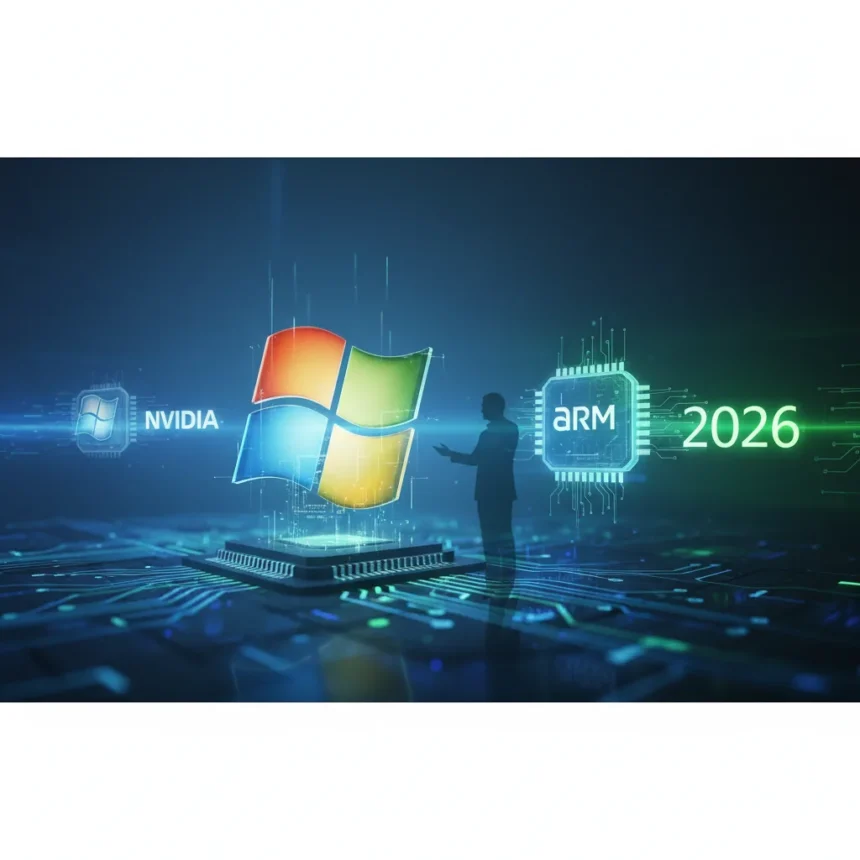
Windows on ARM has failed before. Steven Sinofsky, a Microsoft veteran, recently revisited that failure by unearthing a nostalgic Windows Phone video showing the first time Windows ran on Nvidia Tegra ARM hardware back in 2010. The question he raises cuts to the heart of the current industry push: will history repeat itself, or can Windows on ARM finally break through in 2026?
Key Takeaways
- Steven Sinofsky highlighted a 2010 Tegra demo showing early Windows on ARM experimentation.
- The original demo used the desktop compositor, indicating a technical prototype rather than consumer product.
- Nvidia and ARM are making a renewed push into Windows, sparking comparisons to the failed 2010 effort.
- The 2026 timeline suggests industry confidence in a potential breakthrough moment.
- Historical context matters: understanding why 2010 failed is essential to evaluating current momentum.
The 2010 Tegra Moment That Never Became
Sixteen years ago, Nvidia and ARM had a moment. The Tegra hardware platform could run Windows, and someone at Microsoft captured it on an old school Windows Phone video. The demo showed the desktop compositor working, which meant Windows’ graphical rendering engine was functional on ARM architecture. Yet despite the technical proof of concept, Windows on ARM never became the future of computing. The experiment faded. Devices didn’t ship. The consumer market remained dominated by x86 Intel and AMD processors.
Why did it fail? The research brief doesn’t specify the technical or market reasons, but the historical silence speaks volumes. A working demo that never reaches consumers suggests deeper problems: driver support, software compatibility, OEM reluctance, or simply that the business case didn’t exist. Whatever the cause, the lesson was clear: Windows on ARM was possible, but possible wasn’t enough.
Nvidia and ARM’s Latest Windows Push
Today, the industry is talking about Windows on ARM again. Nvidia and ARM are making what appears to be a serious thrust into the Windows ecosystem. This isn’t a theoretical exercise or a one-off demo. The framing of Sinofsky’s commentary suggests genuine momentum behind the effort. The question he poses—will history repeat itself in 2026?—implies that 2026 is being positioned as a potential inflection point, a year when Windows on ARM might finally transition from prototype to product.


What has changed since 2010? The research brief doesn’t detail the technical improvements or market conditions that might make 2026 different. But the fact that a Microsoft veteran is revisiting the 2010 failure to contextualize the current push suggests that stakeholders believe something is fundamentally different this time. Whether that’s true remains the open question.
Why History Repeating Matters
Sinofsky’s nostalgic video isn’t just a curiosity. It’s a warning and a benchmark. If Windows on ARM reaches consumers in 2026, it will represent a 16-year journey from prototype to product. If it doesn’t, the pattern will have repeated: another cycle of promise, demo, silence. For consumers, the stakes are real. ARM-based Windows devices could mean better battery life, lower heat, and different performance profiles. For the industry, it’s about whether the x86 monopoly in Windows computing can finally be broken.


The comparison between 2010 and 2026 is implicit but powerful. A working demo in 2010 proved the concept was viable. If viability alone isn’t enough to drive adoption, then 2026 will need something more: compelling devices, broad driver support, killer applications, and OEM commitment. The fact that Sinofsky is asking the question publicly suggests these pieces are still in motion.
Is Windows on ARM Finally Ready for Consumers?
The evidence available doesn’t confirm that Windows on ARM is ready for launch in 2026. Sinofsky’s commentary frames the timeline as a question, not a guarantee. What is clear is that Nvidia and ARM believe the moment is right to push harder, and that belief is worth paying attention to. The industry has tried this before and failed. Trying again suggests either new confidence or new desperation—and the difference matters.
What Happened to Windows on ARM After 2010?
The research brief does not specify what happened to the Tegra demo or why it never became a shipping product. The video survives as a historical artifact, evidence that the technology worked. The absence of follow-up products suggests that technical feasibility and business viability diverged, a common pattern in computing history.
Could Windows on ARM Succeed in 2026?
Success requires more than a working prototype. It requires OEM support, software ecosystem maturity, and consumer demand. Sinofsky’s question implies that 2026 is being tested as the year these conditions might finally align. Whether they do will determine whether Windows on ARM becomes a genuine alternative to x86 or another footnote in computing history.


The Tegra video is a time capsule. It proves that Windows on ARM was possible in 2010. The real question is whether 2026 will finally prove it’s inevitable.
Edited by the All Things Geek team.
Source: Windows Central