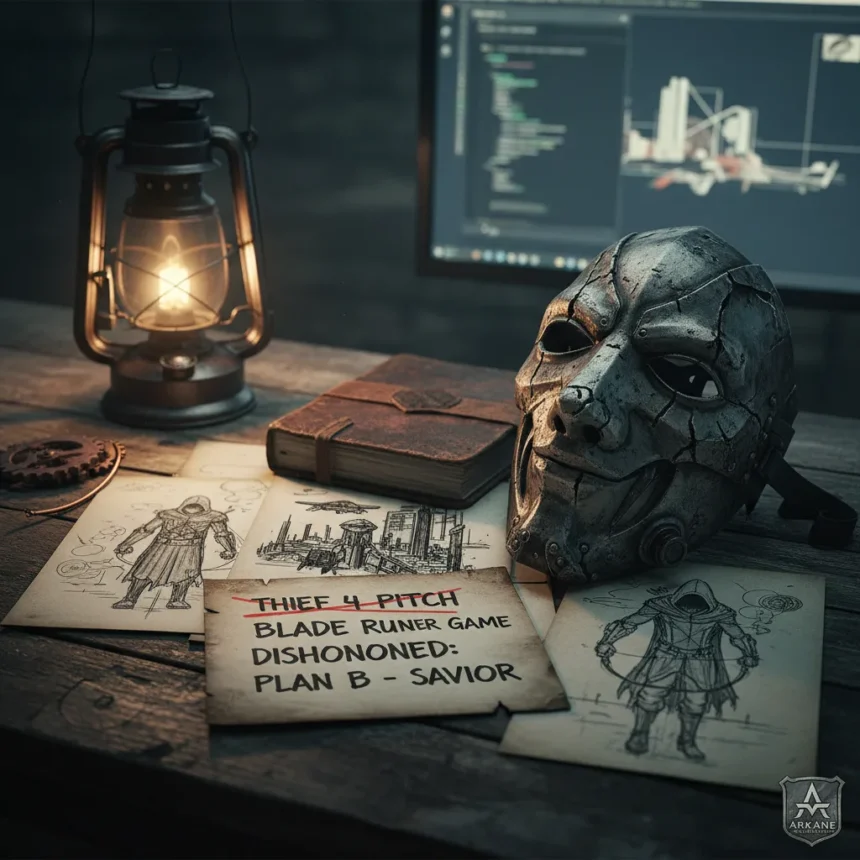
Arkane Studios co-directors Raphael Colantonio and Harvey Smith have revealed that Arkane Studios Dishonored almost never happened—the studio was supposed to develop either Thief 4 or a Blade Runner adaptation instead. The revelation sheds light on how one of gaming’s most influential immersive sims came into existence through a combination of failed licensing deals and last-minute creative pivoting.
Key Takeaways
- Arkane Studios nearly made Thief 4 before Bethesda redirected them toward Dishonored.
- The studio also pitched a Blade Runner game that fell through before Dishonored development began.
- Arkane was in severe financial distress when Bethesda approved the original IP concept.
- Harvey Smith described the two IP offers as “bags of catnip”—both equally exciting to the studio.
- Bethesda ultimately told Arkane to keep their original concept and call it Dishonored.
How Thief 4 Nearly Became Arkane’s Next Project
Before Dishonored entered development, Bethesda approached Arkane with an opportunity to pitch a sequel to the legendary Thief franchise. Colantonio explained the situation directly: “Before we did Dishonored, we were supposed to either do Thief or Bladerunner”. The studio crafted what Smith described as “an amazing pitch for Thief, which would have been Thief 4”. For developers who had grown up inspired by the original stealth classics, this was an opportunity that aligned perfectly with their creative vision. Arkane had spent years mastering the immersive sim formula, and a return to the Thief universe would have felt like a natural evolution of that expertise. But the deal never materialized. Bethesda was attempting to secure the rights to the IP itself, and when those negotiations stalled, the Thief 4 project evaporated before development could begin.
Blade Runner Followed—Then That Failed Too
Just as the Thief opportunity closed, another legendary science fiction property came into play. Arkane was offered the chance to develop a Blade Runner game, another franchise that held deep significance for the studio’s leadership. Smith captured the excitement—and the impossible choice—with a vivid metaphor: “Which is basically like coming to two cats and saying, ‘We have a big bag of catnip here on the one side. We have another bag of catnip here. Which one do you want? You want both?’ We were both so excited”. Smith elaborated on the magnitude of the opportunity: “Bladerunner and Thief, like two of our favorite things of all time”. Yet this second chance at a beloved IP also collapsed. The licensing agreements fell apart, leaving Arkane without either project and facing an uncertain future.
Arkane Studios Dishonored Emerged From Crisis
The stakes were far higher than creative disappointment. Colantonio revealed the studio’s precarious position: “We were in a in a such a dire situation business-wise and they came up not only to save us, but also to bring, frankly, the IP that I would have liked to work on the most”. With both Thief 4 and the Blade Runner project dead, Arkane faced potential shutdown. The studio had proven its technical and creative chops with previous projects, but without a major franchise attachment or fresh funding, survival looked uncertain. Bethesda’s solution was unconventional: rather than shelving Arkane or forcing them into work-for-hire mediocrity, the publisher told them to keep developing their original concept. An unnamed Bethesda representative reportedly said: “Ah, it’s okay—keep what you’re doing and, uh, and call it Dishonored”. That decision transformed Arkane’s trajectory. The studio took its immersive sim expertise, its passion for systemic design, and its love of first-person stealth mechanics, and channeled them into an original property that would become a defining work of the genre.


Why This Story Matters for Game Development
The Arkane Studios Dishonored origin story illustrates a fundamental tension in modern game publishing. Major studios often chase established intellectual property because it offers perceived safety—a recognizable brand, an existing fanbase, a clearer path to profitability. Yet some of the medium’s most innovative work has emerged when that strategy fails and developers are forced to innovate within constraints. Arkane’s near-misses with Thief 4 and Blade Runner were crushing in the moment, but they forced the studio to trust its own vision. The result was a game that influenced stealth design, immersive sim architecture, and player agency across the industry. Neither Smith nor Colantonio has suggested that a Thief 4 or Blade Runner game under Arkane would have been inferior—but Dishonored’s existence proved that sometimes the best creative outcome comes not from securing the IP you want, but from being forced to build something entirely new.
Did Arkane Studios ever make a Thief game after Dishonored?
No. Arkane never developed a Thief game after the failed pitch to Bethesda. The studio went on to create the Dishonored series and other original projects, but the Thief franchise remained out of reach. The IP rights and development opportunities never aligned with Arkane’s availability or interests again.


What happened to the Blade Runner game Arkane pitched?
The Blade Runner project never moved forward. Like the Thief 4 pitch, the licensing deal fell through before Arkane could begin development. The studio pivoted entirely to Dishonored instead, and no Blade Runner game from Arkane was ever produced.
How did Dishonored become successful if it was a fallback project?
Dishonored succeeded because Arkane applied the same level of expertise and passion to an original IP that it would have brought to Thief or Blade Runner. The studio’s mastery of immersive sim design, systemic gameplay, and player agency translated directly into a game that resonated with critics and players worldwide. Sometimes the best creative work emerges not from the most obvious choices, but from developers forced to prove themselves on their own terms.
The Arkane Studios Dishonored story is a reminder that creative success is rarely a straight line. Two beloved franchises slipped away, a studio faced existential crisis, and from that pressure emerged a game that defined a genre. Smith and Colantonio got neither the Thief revival nor the Blade Runner adaptation they dreamed of—but what they built instead became far more influential. That is not a compromise; it is a triumph.
Edited by the All Things Geek team.


Source: TechRadar