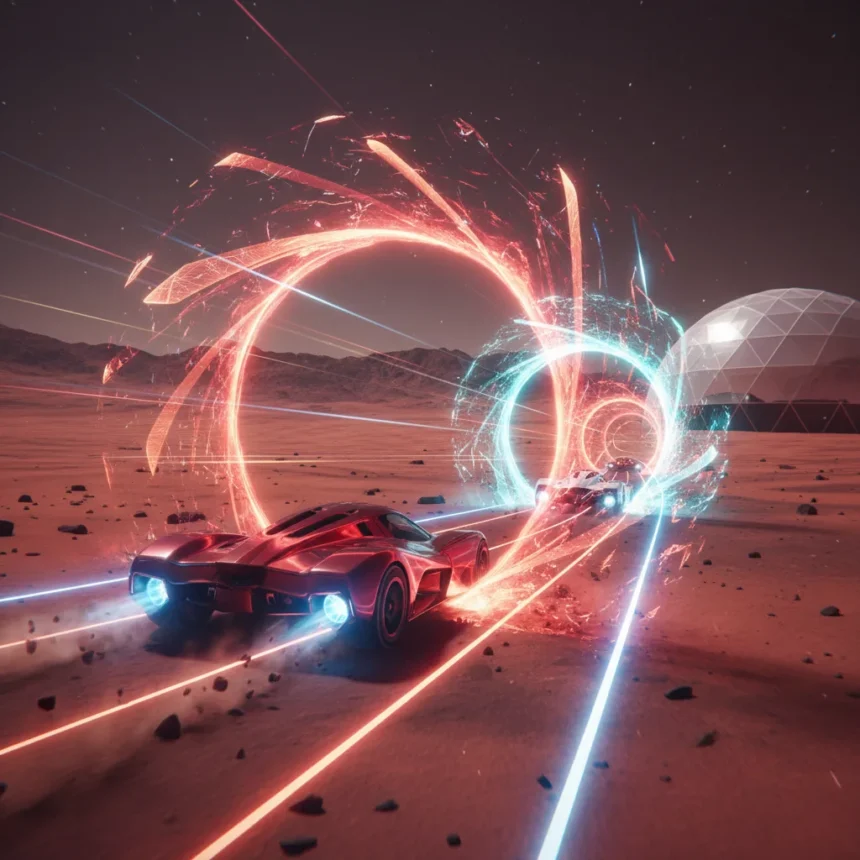
Cars on Mars portal effects have become the standout achievement of a solo indie developer’s sci-fi racing game, combining physics-defying portal mechanics with Martian environments in ways that evoke comparisons to Valve’s Portal. The game allows cars to enter portals for high-speed transitions that bend space-time, preserving momentum across impossible geometry and creating racing lines that feel genuinely innovative rather than gimmicky.
Key Takeaways
- Cars on Mars features advanced portal effects that create visually stunning, physics-defying gameplay mechanics.
- Solo indie developer built the game single-handedly, demonstrating accessible tech innovation in modern game development.
- Portal mechanics integrate smoothly with high-speed racing, allowing momentum preservation across non-Euclidean geometry.
- Visual effects include realistic portal distortions that rival AAA-quality productions.
- Game draws inspiration from Portal’s puzzle-based portal gun concept but applies it to arcade racing instead.
What Makes Cars on Mars Portal Effects Stand Out
The Cars on Mars portal effects distinguish themselves through realistic distortions and momentum preservation that transforms racing fundamentals. Rather than treating portals as a cosmetic layer, the developer integrated them as core mechanics that reshape track design and player strategy. When a car enters a portal, it doesn’t simply teleport—the game renders the space-time bend visually, maintaining the vehicle’s velocity and direction through non-Euclidean geometry that feels both impossible and physics-accurate.
This approach separates Cars on Mars from traditional sci-fi racers. Most racing games treat visual effects as ornamental, but here the portal system fundamentally changes how players navigate courses. The Martian setting provides thematic coherence, positioning the portals as futuristic technology rather than magical anomalies. The result feels intentional and immersive rather than borrowed from another genre.
Cars on Mars Portal Effects vs. Competitors
Portal (2007) pioneered portal-based gameplay through puzzle-solving, but Cars on Mars applies that same mind-bending spatial logic to racing. Distance, a sci-fi horror racer from 2018, also explores psychedelic effects and high-speed arcade racing with Workshop support, yet focuses on survival and atmosphere over portal mechanics specifically. Redout delivers exhilarating sci-fi racing with career mode and multiplayer for up to 12 players across 25 tracks, but does not integrate space-bending portal systems as core gameplay.


What separates Cars on Mars is its singular focus: a solo developer built an entire game around portal effects without the budget or team of AAA studios. This constraint becomes a strength. The portal system isn’t one feature among many—it’s the foundation of every race, every track, every moment of gameplay. Competitors offer breadth; Cars on Mars offers depth in a single, refined mechanic.
Why Portal Mechanics Matter in Racing Games
Portal mechanics force players to think in three dimensions rather than two. Traditional racing games reward memorization and reflexes on fixed tracks. Cars on Mars portal effects demand spatial reasoning—understanding how a portal connects distant points, how momentum transfers through impossible angles, how the track itself becomes non-linear. This cognitive shift appeals to players who loved Portal’s puzzle design but craved speed and competition instead of isolation and contemplation.

The forced-perspective gameplay emerging in titles like upcoming mind-melting games demonstrates growing player appetite for spatial innovation. Cars on Mars taps into that appetite by making portal navigation not optional but essential. Every lap becomes a puzzle race, where understanding portal geometry grants competitive advantage.
Technical Achievement on a Solo Developer Budget
A single developer creating portal effects that rival AAA productions represents a genuine industry milestone. This achievement reflects broader democratization in game development—modern engines, asset libraries, and community resources have lowered barriers to complex visual effects. The developer didn’t need a team of 50 engineers and unlimited budgets to render convincing space-time distortions.
This matters beyond Cars on Mars itself. It signals that indie developers can now compete on visual fidelity in genres traditionally dominated by well-funded studios. Portal effects, once a flagship AAA feature, are now accessible to solo creators willing to master the technical and artistic challenges. For the broader gaming industry, this democratization pushes established publishers to innovate further or risk irrelevance.
Is Cars on Mars worth playing for portal effects alone?
If you loved Portal’s spatial puzzles and want that logic applied to high-speed racing, Cars on Mars delivers exactly that experience. The portal effects are not window dressing—they fundamentally reshape how you approach each race. For players seeking innovative mechanics over established franchises, the game justifies attention based on its core system.

How do Cars on Mars portal effects compare to Distance?
Distance emphasizes psychedelic horror atmosphere and arcade racing with Workshop support, while Cars on Mars focuses specifically on portal mechanics as the primary gameplay driver. Both are sci-fi racers, but Cars on Mars commits entirely to space-bending portals, whereas Distance uses visual effects more broadly to create mood and tension.
Can a solo developer’s portal effects really match AAA quality?
Cars on Mars proves the answer is yes—at least in scope and ambition. Modern game engines provide the technical foundation; artistic vision and technical skill matter more than team size. The developer’s focused approach to portal effects, rather than spreading resources across multiple systems, allowed for AAA-level refinement in a single mechanic.
Cars on Mars demonstrates that innovation in gaming no longer requires massive budgets or sprawling teams. A solo developer with a clear vision and mastery of modern tools can create visual and mechanical achievements that rival established studios. The game’s portal effects aren’t impressive because they come from an indie creator—they’re impressive because they’re genuinely innovative, regardless of who built them. For racing game enthusiasts and players seeking genuinely novel mechanics, Cars on Mars portal effects represent the kind of boundary-pushing design that justifies the indie gaming renaissance.
Edited by the All Things Geek team.
Source: Creativebloq