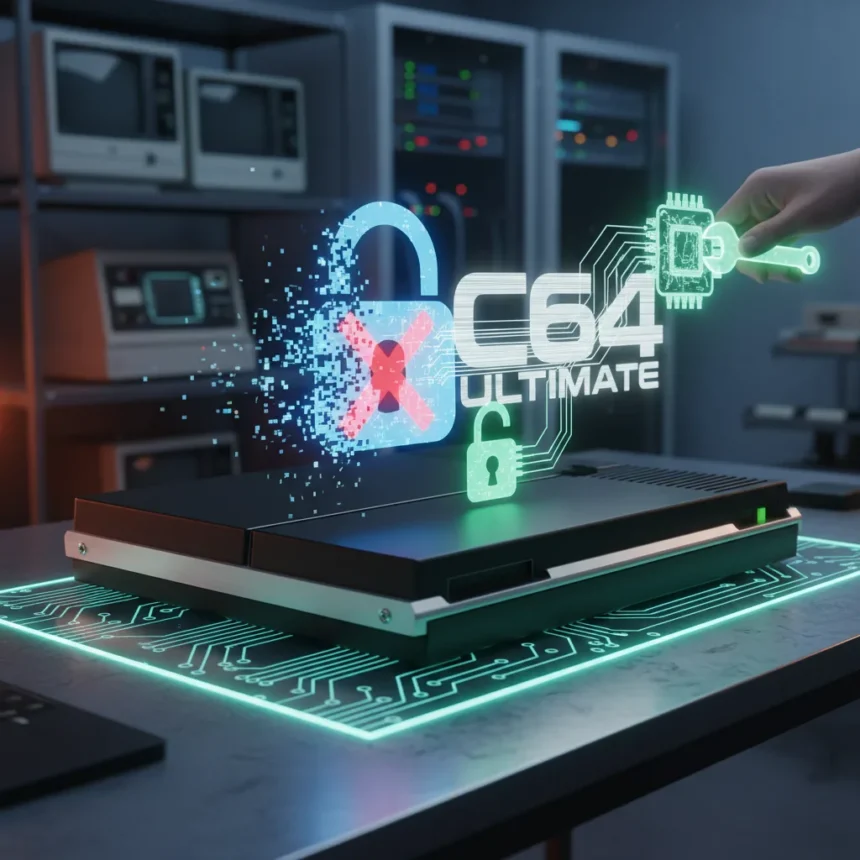
The C64 Ultimate firmware lockdown saga just took a dramatic turn. Commodore announced on April 24, 2026, that it would reverse its controversial plan to prevent third-party FPGA firmware installations on the C64 Ultimate, a move that will likely satisfy modding enthusiasts while still protecting the company from costly support burdens.
Key Takeaways
- Commodore reverses firmware 1.1 lockdown but refuses free support or replacements for bricked modded units.
- Initial lockdown aimed to prevent hardware damage from incompatible third-party firmware like Gideon’s Ultimate64.
- Community backlash cited open-source FPGA tradition and user freedom concerns.
- Hardware roadmap divergence creates real incompatibility risks between Commodore and custom builds.
- Users retain freedom to tinker but bear full financial risk of modifications.
Why Commodore Originally Wanted to Lock Down the C64 Ultimate
Commodore’s initial firmware 1.1 update, which added USB mouse support and music detect mode for RGB lighting, came with a controversial restriction: the company planned to prevent non-Commodore FPGA-level firmware builds from being installed on the hardware. The reasoning was practical, not petty. Commodore cited real cases of non-functioning units resulting from third-party firmware installations, calling the support burden unsustainable when hardware failures stem from modifications outside their control.
The company had a legitimate technical concern. Commodore’s hardware roadmap includes board revisions and component changes that third-party firmware like Gideon’s Ultimate64 has no reason to address, since that firmware was built for a different product entirely. As systems diverge over time, incompatibility risks increase exponentially. A user installing outdated or incompatible custom firmware could easily brick their device, then expect Commodore to fix it at no cost—a scenario that would drain resources and set a dangerous precedent.
Yet the lockdown announcement split the retro computing community sharply. Some supported the restriction as a necessary safeguard against bricking and support chaos. Others saw it as fundamentally anti-tinkering and contrary to the open-source FPGA spirit exemplified by projects like MiSTer cores, where custom firmware is not just allowed but celebrated.

The Community Backlash and Commodore’s Reversal
The backlash was swift and vocal. Retro gaming enthusiasts viewed the lockdown as a betrayal of the tinkering ethos that defined the original Commodore 64 scene. Commodore, sensing the damage to its brand reputation, began exploring alternatives. The company acknowledged it was “still considering alternative approaches and evaluating which path best balances user freedom with user protection,” and it explicitly welcomed user input on the decision.
By late April 2026, Commodore made its move. The company reversed course, allowing third-party firmware installations to proceed without technical restrictions. This reversal preserves user freedom for modding while shifting the entire risk profile: users who install custom firmware and brick their devices will receive no free support, no replacements, and no sympathy from Commodore.

It is a clever compromise. Commodore gets out of the support trap by making clear that modding voids the implicit warranty on firmware-related failures. Users get the freedom they demanded. The company avoids the PR disaster of being seen as anti-modding. Everyone walks away with something, though the burden of technical competence now rests entirely on the modder.
What This Means for Retro FPGA Enthusiasts
The C64 Ultimate firmware lockdown reversal matters because it sets a precedent for how companies should handle open-source hardware communities. Rather than locking down hardware to prevent user error, Commodore chose transparency and clear liability boundaries. Users can modify their devices freely, but they do so knowing that Commodore will not bail them out if something goes wrong.
This approach respects the agency of advanced users while protecting the company from being held hostage by support costs. It also acknowledges that the FPGA retro computing space thrives on customization—locking it down would have been like banning overclocking on gaming PCs or custom ROMs on vintage consoles. The community would have found workarounds, and Commodore would have looked like the villain.
The decision also implicitly admits that Commodore’s hardware roadmap and third-party firmware like Gideon’s Ultimate64 will continue to diverge. Rather than trying to force compatibility through lockdown, the company is accepting that users who choose custom firmware are making an informed choice to leave official support behind.

Is the C64 Ultimate still worth buying after the firmware reversal?
Yes, especially if you want a modern Commodore 64 that works out of the box with official firmware. The C64 Ultimate with Commodore’s firmware is stable and feature-complete. The reversal simply means you have the option to experiment with third-party builds if you are technically confident enough to handle the risks.
Can you install third-party firmware on the C64 Ultimate without voiding your warranty?
You can install it without technical barriers, but Commodore will not provide free support or replacements if the installation bricks your unit. The warranty effectively becomes void for firmware-related failures once you modify the device.
How does the C64 Ultimate compare to other retro FPGA devices?
Unlike MiSTer-based systems, which are explicitly designed around open-source customization from day one, the C64 Ultimate is a commercial product with a defined hardware roadmap. The difference is architectural: MiSTer cores are community-maintained and expect ongoing hardware diversity, while Commodore maintains a single official firmware path. Both approaches have merit—one prioritizes user freedom, the other prioritizes stability and support.
Commodore’s reversal on the C64 Ultimate firmware lockdown shows that companies can protect themselves from support chaos without becoming the enemy of modders. By accepting that advanced users will tinker and clearly stating the consequences, Commodore avoided a PR disaster while maintaining the boundaries it needs to operate sustainably. The retro FPGA community keeps its freedom. Commodore keeps its sanity. That is a win worth celebrating.
Edited by the All Things Geek team.
Source: Tom's Hardware