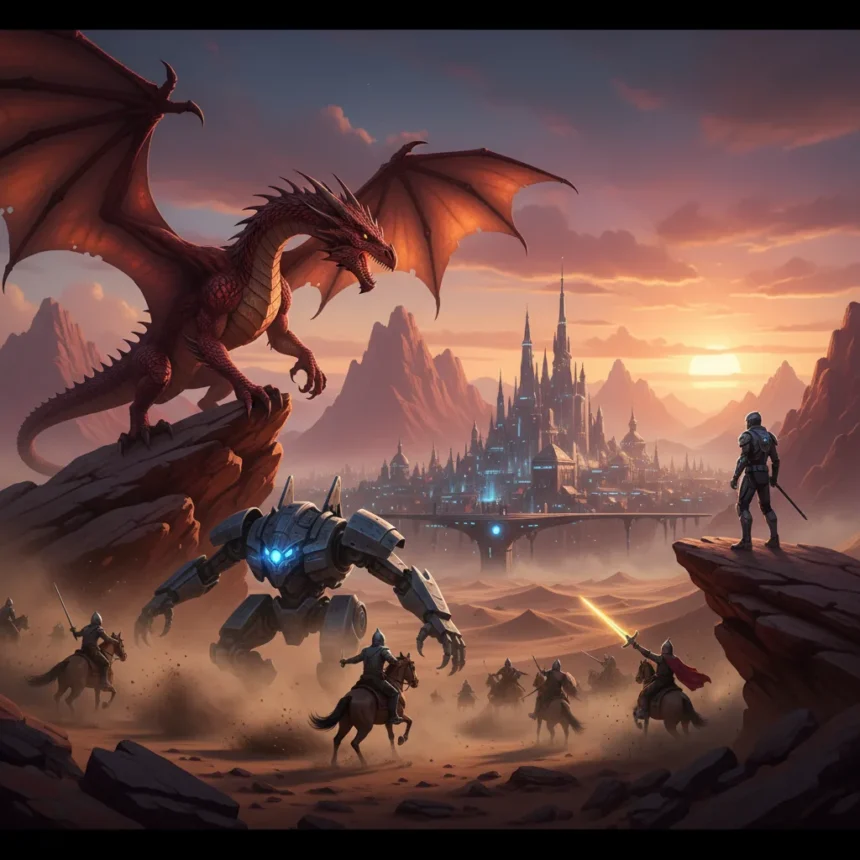
Crimson Desert is an overwhelming action-adventure RPG developed by Pearl Abyss, launching March 19 as the studio’s first single-player title since its flagship Black Desert MMORPG. You play as Kliff, a swordsman navigating the war-torn continent of Pywel, and what unfolds is less a traditional RPG and more a fighting game wrapped inside an open world. The ambition is staggering. The execution is messy.
Key Takeaways
- Crimson Desert features skill-based combat with no level scaling—undergeared players genuinely die to high-level enemies.
- Multiple playable characters offer distinct combat styles: quick swordsman, female claymore fighter with pistol, tank with arm cannon.
- Vertical exploration uses grappling hooks, gliding, triple jumps, and rideable dragons and mechs for traversal.
- Massive feature set includes base building, farming, archery contests, arm wrestling, fishing, and theft mechanics with bounty systems.
- Boss defeats reward unique equipment with signature abilities you can incorporate into your own combat style.
Combat That Demands Real Skill
Crimson Desert’s combat is fast, brutal, and utterly unforgiving. This is not a game where stats alone carry you through difficult encounters. Instead, the system rewards observation and timing. When you defeat a boss—say, a knight with a devastating kick—you absorb that move into your own repertoire. Future encounters with similar enemies become easier because you have learned their language. This is fighting-game design masquerading as an RPG.
Weapons span sword and shield, greatswords, spears, axes, and ranged options, each with distinct combo chains. Fast R1 strikes chain into slower R2 power attacks; Circle and Triangle buttons trigger grapples and throws that feel like WWE-style suplexes. Parrying on perfect timing opens enemy windows. Blocking holds L1; drop it to fight without lock-on and gain full 360-degree freedom. Elemental infusions—fire, freeze, stun, lightning—layer onto attacks, and the magic palms system lets you click each stick to trigger spells from each hand, chaining them into triple jumps that escalate damage from basic to flashy. The depth is staggering, but the learning curve is a wall. You will die repeatedly before the systems click.
Unlike Souls games, Crimson Desert emphasizes speed over stamina management. You respawn close to failure points, and manual saving is available, removing some friction. Yet the skill requirement remains punishing. High-level areas will flatten undergeared players, forcing you into a genuine exploration loop: enter an area, get demolished, retreat to the open world, gather gear and skills, return stronger, retry.


A World That Refuses to Hold Your Hand
The seamless open world of Pywel is massive and layered with systems. Dynamic day-night cycles, changing weather, and faction control create a living environment. You can build a base, gather resources, craft equipment, dispatch comrades to missions, and engage in dozens of side activities. Archery contests, arm wrestling, horse racing and taming, gambling, fist fighting, pickpocketing, cooking, fishing, hunting, and farming are all present. Reading books grants skills. Stealing from cities triggers bounties and guard chases. The world feels dense with purpose.
Vertical traversal separates Crimson Desert from typical open-world games. Grappling hooks swing and pull you forward; gliding covers distance; the magic palms system chains triple jumps for mobility and damage. Late-game you ride dragons and pilot a missile-firing mech. These are not cosmetic additions—they fundamentally reshape how you navigate the world. A mountain that blocks your path at level one becomes a puzzle to solve through skill-based climbing and jumping.


Yet the feature density becomes a liability. Base building, resource gathering, crafting, and faction systems compete for attention. Newcomers will feel lost. Crimson Desert demands time investment before its systems cohere into a cohesive experience. This is not a pick-up-and-play game.
Multiple Characters, Multiple Learning Curves
Beyond Kliff, Crimson Desert offers multiple playable characters, each with unique combat techniques and weaponry. A quick female fighter wields a massive claymore and flintlock pistol. A strong male tank carries an arm cannon (Barret-like) and large axe. Each character feels distinct enough to warrant replaying content, but switching characters means relearning combat fundamentals. For players seeking variety, this is a feature. For those overwhelmed by depth, it is another barrier.
Comparison to Traditional Action RPGs
Crimson Desert occupies a strange space between fighting games and open-world RPGs. Unlike games such as The Witcher 3, where character level gates progression, Crimson Desert respects player skill over stat inflation. You can tackle high-level areas early if you master combat mechanics. This creates genuine danger and reward, but it also means the game punishes button-mashing. Traditional action RPGs like Dark Souls emphasize deliberate, methodical combat; Crimson Desert prioritizes speed and combo chaining, blending fighting-game fluidity with open-world exploration.
Is Crimson Desert Worth Your Time?
Crimson Desert is unquestionably ambitious. Pearl Abyss has packed dragons, mechs, base building, farming, and dozens of side activities into a single cohesive world. The combat is fluid and rewarding once it clicks. The vertical exploration is genuinely inventive. But the feature density and skill-based difficulty create a steep entry barrier. This is a game for players who relish learning systems, dying repeatedly, and investing dozens of hours before mastery arrives. Casual players will bounce off within the first few hours.


What makes Crimson Desert different from Black Desert?
Crimson Desert is a single-player open-world action-adventure, while Black Desert is an MMORPG focused on grinding and multiplayer content. Crimson Desert emphasizes skill-based combat and exploration over gear acquisition, though both games share Pearl Abyss’ visual polish and feature density.
Do you need to play Black Desert to understand Crimson Desert’s story?
Crimson Desert was originally conceived as a prequel to Black Desert but now stands as a standalone experience. No prior Black Desert knowledge is required, though lore connections may exist for series fans.
How does Crimson Desert handle difficulty progression?
Crimson Desert uses skill-based combat with no traditional level scaling. Enemies in high-level areas will defeat undergeared players, forcing you to improve gear and learn combat patterns rather than grinding levels. This creates genuine exploration loops where you must return stronger after initial defeats.
Crimson Desert is a statement of intent from Pearl Abyss: they can build sprawling, ambitious worlds with mechanical depth. Whether that ambition serves the player experience is another question entirely. For hardcore action RPG fans willing to embrace a steep learning curve, Crimson Desert delivers a genuinely fresh experience. For everyone else, the overwhelming feature set and punishing combat may prove more frustrating than fun.
Where to Buy
Edited by the All Things Geek team.
Source: Tom's Guide