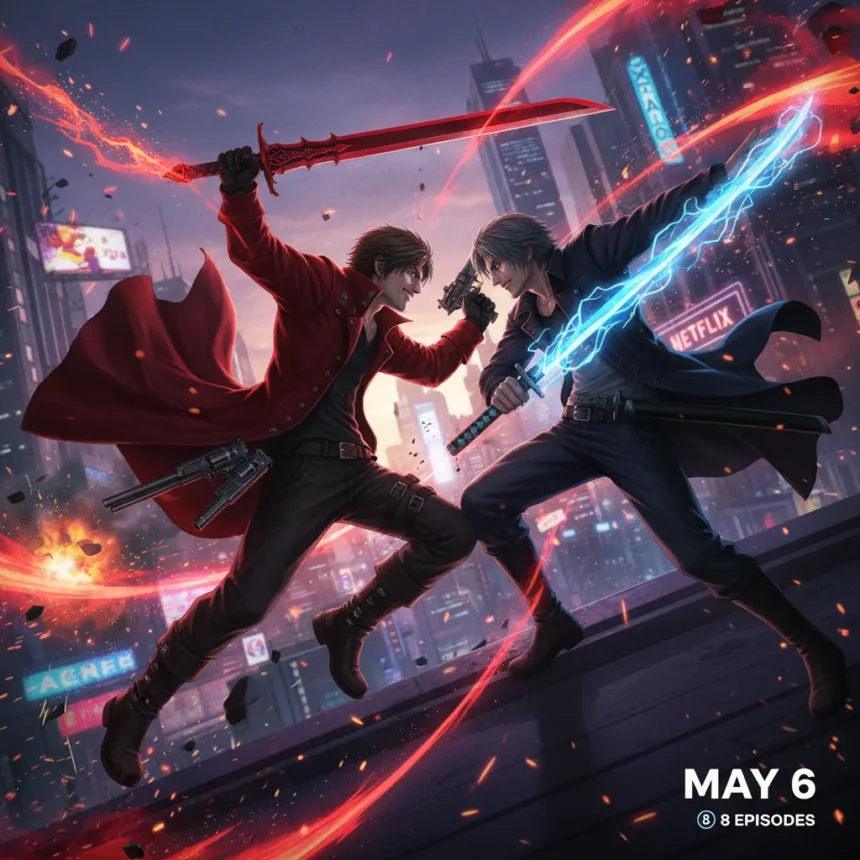
Devil May Cry season 2 just landed on Netflix on May 6, 2026, and it wastes no time delivering the sibling showdown fans demanded after season 1’s cliffhanger. All eight episodes dropped at once, each running 25-30 minutes of pure stylized chaos featuring Dante and his twin brother Vergil locked in an explosive rivalry that mirrors the tension of the original video game series.
Key Takeaways
- Devil May Cry season 2 features 8 episodes released simultaneously on Netflix May 6, 2026.
- Johnny Yong Bosch returns as Dante; Brian Hanford takes over voice duties for Vergil.
- Studio Mir and director Adi Shankar deliver game-faithful action with Devil Trigger transformations and Yamato sword combat.
- The season holds a 92% audience score on Rotten Tomatoes and hit Netflix’s global top 10 within 24 hours.
- Messier pacing than season 1, but the campy tone and over-the-top fights remain binge-worthy.
What Makes Devil May Cry Season 2 Stand Out
Devil May Cry season 2 doesn’t pretend to be prestige television, and that’s its greatest strength. Studio Mir, the animation house behind The Legend of Vox Machina and Dota: Dragon’s Blood, leans into the franchise’s signature excess—ridiculous one-liners, impossible acrobatic sword moves, and a visual style that feels ripped directly from the games. Director Adi Shankar, who produced Castlevania, cranked the sibling rivalry between Dante and Vergil to deliberately absurd levels, treating their conflict like a video game boss fight stretched across eight episodes.
The animation captures what made Devil May Cry 3 through 5 so rewarding to play: fluid, high-energy combat sequences featuring Dante’s Devil Trigger transformation, his Royalguard and Trickster combat styles, and Vergil’s devastating Judgment Cut attacks with his iconic Yamato katana. If you’ve played the games, you’ll recognize the move sets instantly. If you haven’t, the fights are simply gorgeous to watch—each clash between brothers feels earned and devastating, not just filler between plot beats.
How Devil May Cry Season 2 Compares to Season 1
Season 1, which released April 3, 2025, introduced Dante as a cocky demon hunter protecting Red Grave City from supernatural threats. Season 2 picks up the momentum but shifts focus squarely onto the Dante-Vergil dynamic. Where season 1 felt like a solid foundation, season 2 is messier—the pacing stumbles in later episodes, and the plot occasionally sacrifices coherence for spectacle. But that messiness is almost intentional, matching the chaotic energy of the games themselves rather than imposing a conventional three-act narrative.


Compared to other Netflix anime adaptations like Arcane, Devil May Cry season 2 moves faster and leans harder into humor and action over emotional depth. It’s less interested in making you cry than making you cheer when Dante pulls off an impossible combo. That’s not a weakness—it’s a different choice, one that respects the source material’s DNA rather than trying to deconstruct it.
Voice Cast and Production Details
Johnny Yong Bosch continues as Dante, bringing the character’s trademark swagger and one-liner delivery. Brian Hanford takes over as Vergil, replacing the previous voice actor and delivering a colder, more menacing interpretation of the demon-seeking twin. Returning cast members Stephanie Panisello (Lady), Scout Taylor-Compton (Trish), and Faye Mata (Lucia) anchor the ensemble, with Lady and Trish getting expanded team-up sequences that give the female cast meaningful action moments rather than sidelining them.


The production values are consistently high. Studio Mir’s fluid animation style handles rapid-fire combat without the stuttering or cost-cutting that plagues lesser action anime. Adi Shankar’s direction emphasizes impact—every punch, slash, and gunshot feels weighty. The soundtrack reinforces the over-the-top tone, with electric guitar riffs that wouldn’t sound out of place in the games themselves.
What Fans of the Games Should Expect
If you’ve invested hundreds of hours in Devil May Cry games, season 2 respects that investment. The series draws heavily from the narrative and character dynamics of Devil May Cry 3-5, where Dante and Vergil’s relationship forms the emotional core of the franchise. The show introduces deeper lore elements like threats from Mundus, the demon king, and explores why these brothers are locked in perpetual conflict over power and legacy.
The animation faithfully recreates game moments—Dante’s flashy combos, his weapon transformations, even his cocky taunt animations translate directly to animation. This is not the edgy, reinvented tone of the 2013 DmC reboot; it’s the campy, self-aware Devil May Cry that fans actually want. The show understands the assignment: it’s supposed to be fun, ridiculous, and endlessly rewatchable.
Critical Reception and Viewership
Devil May Cry season 2 holds a 92% audience score on Rotten Tomatoes, praised for its action sequences, faithfulness to the games, and willingness to embrace camp humor. Critics and viewers alike appreciate that the show doesn’t apologize for what it is—a stylish, demon-hunting adventure that prioritizes spectacle over subtlety. The season hit Netflix’s global top 10 within 24 hours of release and climbed to number 3 in the US non-English TV rankings, signaling strong international appeal beyond just game fans.


The main criticism centers on pacing in episodes 5-7, where the plot occasionally meanders between action setpieces. Some viewers felt the mid-season episodes relied too heavily on side quests and filler combat rather than advancing the central Dante-Vergil conflict. That said, even these slower episodes deliver the stylish fights the series promises, so the complaint is more about structural choices than execution.
Should You Watch Devil May Cry Season 2?
Yes, if you enjoy stylish action anime, video game adaptations, or simply want something that doesn’t take itself seriously. You do not need to have played the games or watched season 1 to enjoy season 2, though season 1 provides helpful context for the character relationships. The show is pure entertainment—no heavy themes, no shocking character deaths meant to devastate you emotionally, just demons, swords, and sibling rivalry played at maximum volume.
Stream it on Netflix with a Standard or Premium subscription. All eight episodes are available now, so you can binge the entire season in one sitting if you’re so inclined. The finale includes a post-credits scene that teases future conflicts, though season 3 has not been officially greenlit as of publication.
How does Devil May Cry season 2 compare to other demon-hunting anime?
Devil May Cry season 2 is faster-paced and campier than Hellsing Ultimate, which takes a more gothic, serious approach to vampire and demon mythology. It’s also more humorous and action-focused than Castlevania, which shares the same producer (Adi Shankar) but leans heavier into drama and character development. If you want pure stylish combat without narrative heaviness, Devil May Cry wins.
Do I need to watch season 1 before season 2?
Season 1 provides helpful context for Dante’s character and the setting of Red Grave City, but season 2 is designed to stand on its own. You can jump straight to season 2 and follow the Dante-Vergil conflict without feeling lost. That said, season 1 is worth watching if you have time—it’s a solid foundation and only eight episodes long.
Is there a season 3 coming?
A post-credits scene in the season 2 finale hints at future conflicts, but Netflix has not officially greenlit season 3. Given the strong viewership numbers and fan response, a renewal seems likely, but nothing is confirmed yet.
Devil May Cry season 2 succeeds because it understands what made the games special: style over substance, humor over melodrama, and action that prioritizes spectacle and fun. It’s not trying to be the next Arcane or Castlevania—it’s trying to be a great Devil May Cry adaptation, and it achieves that goal with style to spare. Stream it now on Netflix.
Edited by the All Things Geek team.
Source: Tom's Guide