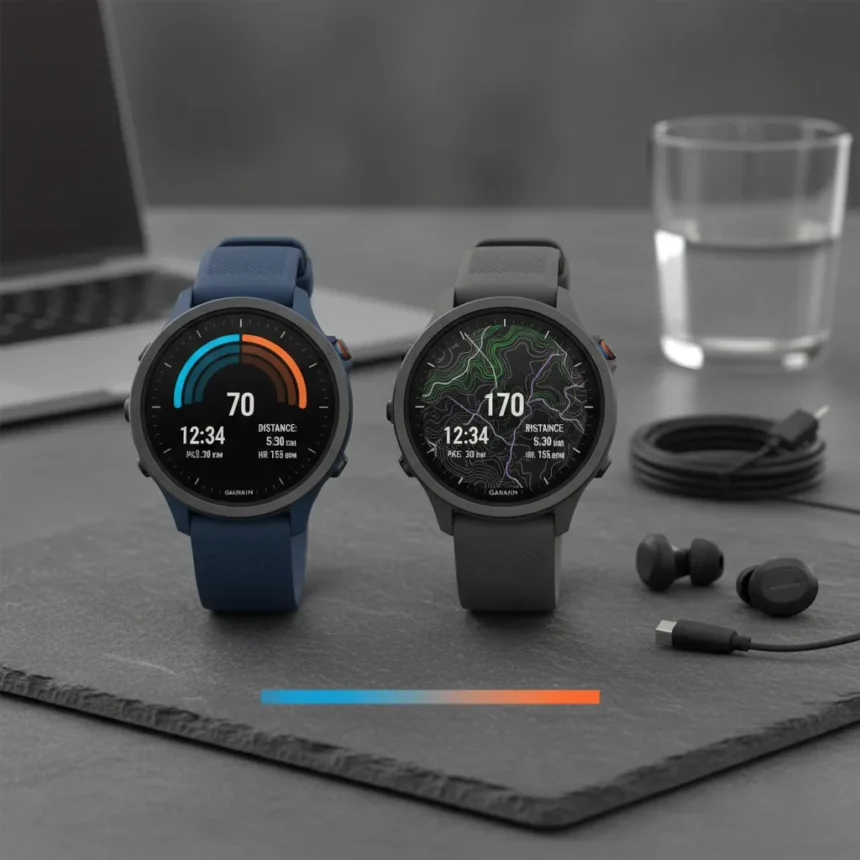
The Garmin Forerunner 70 and 170 are new running watches that bring AMOLED displays and premium training features to the sub-$300 market, marking a significant shift in what budget runners can expect from affordable wearables. Garmin announced these models quietly via its website on May 23, 2025, skipping the usual fanfare that typically accompanies new product launches. Both watches share a 42mm case size and 1.2-inch AMOLED display with 390×390 pixel resolution, but differ in materials and sensors—the Forerunner 170 steps up with a stainless steel bezel and additional navigation capabilities.
Key Takeaways
- Garmin Forerunner 70 and 170 debut AMOLED screens on entry-level Forerunner models for the first time
- Forerunner 70 priced at $249.99 USD; Forerunner 170 at $299.99 USD (Music edition $349.99)
- Both deliver up to 18 hours GPS battery or 11 days in smartwatch mode on the 170
- Adaptive training plans, Training Readiness scoring, and Body Battery tracking included on both models
- Stainless steel bezel and additional sensors distinguish the 170 from the more basic 70
AMOLED Comes to Garmin’s Entry-Level Lineup
For years, AMOLED displays were reserved for Garmin‘s premium Forerunner models, leaving budget runners stuck with memory-in-pixel (MIP) screens that looked dull by comparison. The Garmin Forerunner 70 and 170 change that equation. Both feature the same 1.2-inch AMOLED panel with 390×390 resolution, delivering vibrant colors and sharp text that makes reading metrics during runs far more satisfying than previous generations. This is not a minor upgrade—AMOLED screens consume power more efficiently when displaying dark content, which matters for watches that need to last days between charges.
The Forerunner 70 uses an aluminum bezel and fiber-reinforced polymer case, keeping weight to around 39 grams. The Forerunner 170 adds a stainless steel bezel for a more polished appearance, though it maintains the same lightweight polymer construction and identical 39-gram weight. Color options reflect this positioning: the 70 comes in Black/Slate Grey and Lilac, while the 170 offers Black/Slate Grey and Light Gold/Mint. Neither watch compromises on water resistance—both carry a 5 ATM rating suitable for swimming and snorkeling.
Training Features That Challenge Pricier Rivals
What makes the Garmin Forerunner 70 and 170 genuinely competitive is not just the display but the coaching intelligence underneath. Both models include adaptive training plans that adjust based on your fitness level and recovery status, a feature Garmin previously reserved for watches costing significantly more. The Training Readiness score uses heart rate variability (HRV) data to tell you whether your body is primed for hard effort or needs easier recovery work—exactly the kind of personalized guidance that separates smart watches from basic fitness trackers.


The Forerunner 170 edges ahead with a compass, altimeter, and gyroscope, making it better suited for trail runners and those who navigate without a phone. The Forerunner 70 skips these extras but retains the Elevate Gen5 optical heart rate sensor, accelerometer, and all the core training metrics. Both include sleep tracking, Body Battery (Garmin‘s proprietary energy reserve metric), and Garmin Pay for contactless payments during runs. The 170 Music edition adds 170GB of onboard storage for music, though this bumps the price to $349.99 USD.
Battery Life and Real-World Usability
Battery longevity claims from manufacturers often disappoint in practice, and Garmin estimates the Forerunner 170 reaches 11 days in smartwatch mode and 18 hours in continuous GPS mode. The Forerunner 70 specifications are less clearly documented, but both watches use the same display technology and similar processors, suggesting comparable endurance. For daily runners logging 5-10 miles per session, 18 hours of GPS time means you can track multiple workouts before needing a charge, though heavy GPS users will find themselves plugging in every few days.


The quiet launch strategy—announcing via Garmin’s website rather than a press event—suggests confidence without hype. This approach also positions the Garmin Forerunner 70 and 170 as pragmatic upgrades rather than revolutionary leaps. Compared to predecessors like the Forerunner 55 (which used MIP displays and lacked music support) and Forerunner 65, these new models deliver substantially better visuals and training intelligence. Against premium alternatives like the Forerunner 265 and 965, which add multi-band GPS, ECG monitoring, and flashlight features, the 70 and 170 trade advanced capabilities for affordability.
Positioning in a Crowded Market
Garmin’s entry-level running watches now face competition from other brands pursuing the same AMOLED-at-budget-price strategy. Coros Pace 3 remains a credible alternative, though it sticks with MIP displays and costs roughly the same. Polar Vantage M3 offers AMOLED but commands a higher price. Amazfit Cheetah Pro represents a budget AMOLED rival from a different ecosystem. The Garmin Forerunner 70 and 170 compete by combining Garmin’s established training algorithms, broad app ecosystem, and watch-to-phone integration with display quality that finally matches what runners see on more expensive models.
The color options and material choices suggest Garmin is targeting runners who care about aesthetics as much as function. The Light Gold/Mint combination on the Forerunner 170 appeals to a broader audience than the traditional black-and-grey options that dominate the market. At $249.99 for the Forerunner 70 and $299.99 for the Forerunner 170, both watches undercut premium AMOLED models while offering training features that justify the investment for serious runners.
Should you buy the Garmin Forerunner 70 or 170?
Choose the Forerunner 70 if you run on roads, prefer simplicity, and want AMOLED without paying for features you won’t use. Pick the Forerunner 170 if you trail run, value navigation, or want the compass and altimeter for varied terrain. The Music edition makes sense only if you run without your phone and have a Spotify subscription or music library to sync.



What is the difference between Forerunner 70 and 170?
The Forerunner 170 adds a stainless steel bezel, compass, altimeter, and gyroscope compared to the Forerunner 70’s aluminum bezel and basic sensors. Both share the same AMOLED display, battery life, and core training features. The 170 costs $50 more, or $100 more for the Music edition.
How long does the Garmin Forerunner 170 battery last?
Garmin estimates up to 11 days in smartwatch mode and 18 hours in continuous GPS mode for the Forerunner 170. Real-world battery life depends on GPS usage frequency, display brightness, and sensor activity—heavy users may see shorter intervals between charges.
The Garmin Forerunner 70 and 170 represent a watershed moment for budget running watches: AMOLED is no longer a luxury reserved for premium models. Garmin’s quiet launch reflects confidence that the specs speak for themselves. For runners shopping under $300, these watches deliver training intelligence and display quality that challenge watches costing twice as much. The 70 suits straightforward road runners, while the 170 justifies its $50 premium with navigation smarts and a more refined aesthetic. Either way, the entry-level Forerunner lineup just got significantly more compelling.
Edited by the All Things Geek team.
Source: T3