





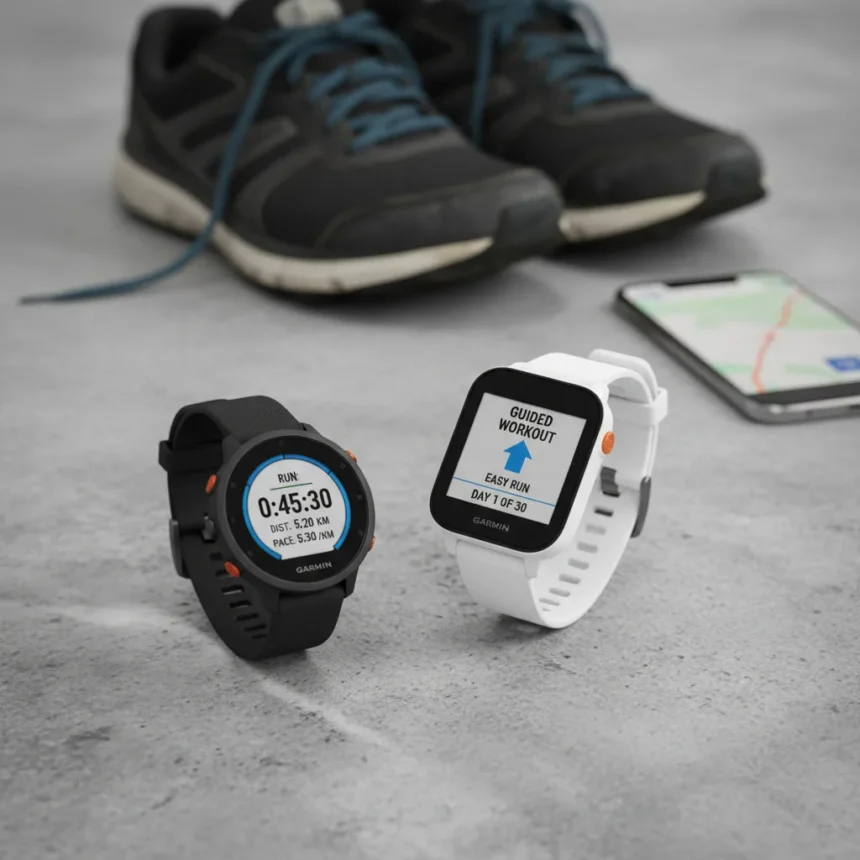
The Garmin Forerunner 70 and 170 are entry-level running smartwatches designed for beginners, launched in 2026 to address a specific market gap: runners who want GPS tracking and training guidance without the feature bloat that comes with mid-range models. These watches prioritize simplicity and affordability, stripping away dual-band GPS, onboard maps, and advanced analytics that most first-time runners will never use.
Key Takeaways
- Garmin Forerunner 70 and 170 are new 2026 entry-level running watches targeting beginners with GPS and guided workouts.
- Core features include GPS tracking, heart rate monitoring, Garmin Coach training plans, and suggested workouts for 5Ks and 10Ks.
- Both models include recovery recommendations, sleep tracking, Body Battery energy monitoring, and women’s health tracking.
- The watches avoid premium features like dual-band GPS and onboard maps, keeping the interface simple and the price low.
- Garmin Forerunner 165 remains a strong alternative if you can stretch the budget for music storage and better training analysis.
Why Garmin is targeting beginners right now
Running watch demand peaks at the start of the year and during marathon training season. Garmin‘s Forerunner 70 and 170 arrive at exactly the right moment—when New Year’s resolutions meet serious marathon training. The company recognized that entry-level runners don’t need the Forerunner 970’s dual-band GPS precision or the Forerunner 265’s multisport analysis. They need guidance, reliability, and a watch that doesn’t overwhelm them with metrics.
The beginner running watch market has been underserved. The older Forerunner 55 was solid but dated. The Forerunner 165 stepped up with AMOLED displays and better design but at a price point that pushes some beginners away. Garmin Forerunner 70 and 170 sit in the sweet spot: affordable enough for someone trying running for the first time, capable enough that they won’t outgrow it immediately.
What the Forerunner 70 and 170 actually do
These watches handle the fundamentals with precision. GPS tracking lets you map every kilometer. Heart rate monitoring shows whether you’re training in the right zone. Garmin Coach training plans guide you through a structured 5K or 10K program—no guesswork, no endless scrolling through apps looking for a workout that fits your pace.


Mid-run guidance is a standout feature. Instead of checking your watch only at the end, the Forerunner 70 and 170 nudge you during the run with real-time coaching cues. That’s the kind of feature that transforms a casual jog into purposeful training. Recovery recommendations tell you when to push hard and when to ease off. Body Battery energy monitoring shows your readiness for the day ahead. Sleep tracking and women’s health tracking (menstrual cycle and pregnancy monitoring) round out a feature set that addresses beginner runners’ actual needs.
What’s conspicuously absent? Dual-band GPS, which improves accuracy in dense urban environments but adds cost and complexity. Onboard maps, which most beginners don’t need since they run familiar routes. Advanced training status and readiness metrics, which require weeks of baseline data to be useful. This is restraint, not limitation.


How Garmin Forerunner 70 and 170 compare to alternatives
The Forerunner 165 costs more—around $249.99 to $299.99 depending on whether you want music storage—but it offers AMOLED display quality and better training analysis tools. If you can afford the jump, the 165 is the stronger choice for someone committed to running long-term. If you’re testing whether running sticks, the Forerunner 70 and 170 are the safer bet.
The older Forerunner 55 still exists in the market at under $199, but it’s outclassed. It lacks the mid-run guidance and Body Battery features that make the new models genuinely helpful. The Forerunner 970, priced from $749.99, is overkill for beginners—a powerhouse for advanced runners with features and durability that matter only at higher mileage.
Against non-Garmin competitors, the Forerunner 70 and 170 hold their own. Fitbit Versa 3 appeals to runners who prioritize fashion over training depth, but Garmin’s ecosystem of coaching and metrics is superior for anyone serious about improving. The choice comes down to whether you want a smartwatch that runs or a running watch that also handles notifications.
Pricing and availability questions
Exact pricing for the Garmin Forerunner 70 and 170 has not been publicly confirmed, but based on the positioning of the Forerunner 55 (under $199) and Forerunner 165 ($249.99–$299.99), these new models should land in that $199–$250 range. They launched in 2026 and are widely available through Garmin and major retailers globally.



Should you buy the Garmin Forerunner 70 or 170?
If you’re starting your running journey and want a watch that simplifies training without overwhelming you, yes. The Garmin Forerunner 70 and 170 deliver GPS, guided workouts, and recovery insights at a price that doesn’t sting if you decide running isn’t for you. They’re not the fanciest watches or the most feature-rich—and that’s precisely why they work for beginners.
What’s the difference between the Forerunner 70 and 170?
The research brief does not specify detailed differences between the two models. Both are positioned as entry-level watches with the same core features: GPS tracking, heart rate monitoring, Garmin Coach plans, and beginner-friendly interfaces. The numbering suggests the 170 may offer incremental upgrades, but without confirmed specs, treating them as comparable options in the same lineup is most accurate.
Can you use Garmin Coach training plans offline?
Garmin Coach plans are designed to work with your watch and phone in sync. While GPS tracking works offline, accessing new workouts and training guidance typically requires connectivity. Check Garmin’s app documentation for the latest offline capabilities, as features vary by model.
The Garmin Forerunner 70 and 170 prove that Garmin understands what beginners actually want: a watch that teaches you to run better without drowning you in data. In a market where every brand packs in features to justify higher prices, Garmin chose restraint instead—and that’s a decision that will resonate with runners lacing up their first serious season.
Edited by the All Things Geek team.
Source: Tom's Guide




