





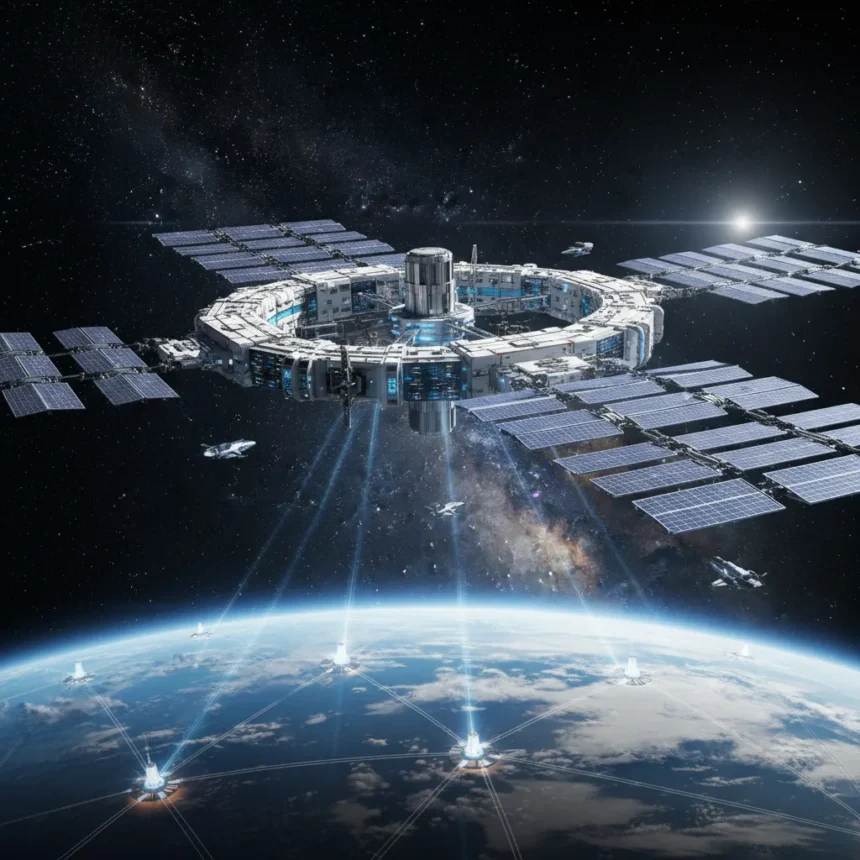
Orbital data centers represent a radical shift in how the technology industry plans to power artificial intelligence. Tech giants like NVIDIA, Google, SpaceX, and Blue Origin are no longer treating space-based compute as speculative—they are filing FCC permits, publishing feasibility studies, and announcing launch timelines. The reason is urgent: global data center electricity demand is projected to nearly double by 2030 to 945–980 terawatt-hours annually due to AI and cloud services, straining terrestrial grids to their breaking point.
Key Takeaways
- Orbital data centers receive sunlight nearly 24 hours daily in sun-synchronous orbits, eliminating night and weather interruptions.
- Space-based solar panels operate up to 8 times more efficiently than Earth surface panels due to zero atmospheric filtering.
- Natural radiation cooling into space eliminates the need for water-based cooling systems.
- SpaceX, Blue Origin, Google, and China have all announced orbital data center initiatives with deployment timelines between 2027 and 2030.
- The combined market for orbital satellites, in-orbit data centers, and solar-powered digital infrastructure is projected to exceed 700 billion dollars over the next decade.
Why Orbital Data Centers Matter Right Now
The idea of launching data centers into space has transitioned from science fiction to urgent infrastructure strategy in just months. In October 2025, researchers at Nanyang Technological University published a study on carbon-neutral space data centers in Nature Electronics. Google released its own feasibility study in November 2025. By January 2026, SpaceX filed FCC plans for millions of satellites integrating Starlink for orbital cloud and AI computing, while Blue Origin announced its TeraWave constellation of approximately 5,400 satellites for high-throughput networking. These are not theoretical exercises—they are regulatory filings and published research backing a fundamental shift in data center architecture.
The power crisis is real. Data centers already consume staggering amounts of electricity, and AI workloads are accelerating demand exponentially. Terrestrial grids cannot keep pace. Orbital data centers solve this by tapping into continuous solar energy in space, where atmospheric interference disappears entirely.
The Physics Advantage of Orbital Data Centers
Satellites positioned in sun-synchronous orbits or low Earth orbits between 310 and 1,000 kilometers altitude experience near-constant daylight. They avoid the night-day cycle that limits Earth-based solar farms, the cloud cover that reduces output, and the weather systems that interrupt power generation. This alone is transformative—but the efficiency gains are even more dramatic.



Solar irradiance in Earth orbit is 36 percent higher than on the surface, and orbital solar panels operate at efficiencies up to 8 times higher than ground-based systems because they bypass atmospheric filtering entirely. No air molecules scatter light, no dust accumulates, and no weather blocks the sun. A startup called Starcloud is proposing 5 gigawatts of solar panels spanning several kilometers to power a large orbital data center—delivering more compute capacity than many terrestrial facilities. The second advantage is cooling. Orbital data centers can radiate heat directly into the vacuum of space, eliminating the massive water-based cooling infrastructure that consumes billions of gallons annually on Earth. This is not incremental improvement—it is a complete reimagining of data center physics.
The Race: Who Is Building Orbital Data Centers First
SpaceX and Elon Musk have the most aggressive timeline. Musk envisions a constellation of up to 1 million satellites in low Earth orbit and predicts that within two to three years, this orbital approach will become the lowest-cost method for AI compute, transforming the industry by enabling unprecedented expansion without blackouts or soaring utility bills. SpaceX’s January 2026 FCC filing signals serious intent to integrate orbital cloud and AI computing into its Starlink infrastructure.



Blue Origin and Jeff Bezos are moving more cautiously but no less seriously. Bezos stated the company will start building gigawatt-scale data centers in space and expects to beat the cost of terrestrial data centers within 10 to 20 years. His TeraWave constellation is positioned to provide the networking backbone for orbital compute.
Google and Eric Schmidt are supporting the transition through research and acquisition. Schmidt has stated the industry is running out of electricity and supports orbital computing via Google’s 2025 acquisition of Relativity Space to enable space-based data centers. Google’s November 2025 feasibility study provides technical credibility to the concept.
Smaller players are moving fast too. Axiom Space plans to deploy data center modules on its private space station by 2027. PowerBank Corporation and Orbit AI announced their Orbital Cloud project on November 19, 2025, which includes DeStarlink, a decentralized low Earth orbit network, and DeStarAI, solar-powered orbital AI data centers with blockchain verification. These startups position themselves as alternatives to Musk’s centralized Starlink model, aiming to offer censorship-resistant, decentralized infrastructure.
China is also entering the race. The country announced a 200,000-satellite constellation for data sovereignty and in-orbit processing, signaling that orbital compute is now a geopolitical priority.



Real Challenges and Degradation
Orbital data centers are not without complications. Solar arrays in space degrade over time, losing 0.5 to 0.8 percent of efficiency annually due to ultraviolet radiation, space weather, and thermal cycling. This means panels must be replaced or serviced regularly—an expensive logistics problem. Sun-synchronous orbits are also a limited resource requiring careful management and international coordination. Launching and maintaining massive solar arrays and data center hardware in space remains extraordinarily expensive, though reusable rockets like SpaceX’s Starship are beginning to reduce these costs.
The timeline claims from Musk and Bezos remain unproven. Musk’s prediction of cost dominance within two to three years is aggressive and unverified. Bezos’ 10 to 20-year estimate for gigawatt-scale viability is more conservative but still speculative. These are intelligent executives making informed bets, but they are bets nonetheless.
The Market Opportunity
PowerBank CEO Dr. Richard Lu estimates that the combined markets for orbital satellites, in-orbit data centers, blockchain verification, and solar-powered digital infrastructure will exceed 700 billion dollars over the next decade. This projection is from an industry participant with obvious incentive to hype the market, so it should be treated as an upper-bound estimate rather than a conservative forecast. Still, even a fraction of that figure would justify the massive capital investment underway.
What Orbital Data Centers Mean for AI
If orbital data centers reach commercial scale by 2028 to 2030, they will fundamentally reshape the AI industry’s economics. The bottleneck for AI expansion has shifted from compute capability to power availability. Every new large language model, every training run, every inference server requires kilowatts of electricity that terrestrial grids struggle to provide. Orbital data centers bypass that constraint entirely by tapping into the sun 24 hours a day with eight times the efficiency of ground panels. This is not a marginal improvement—it is a potential inflection point.
For companies like Google, Microsoft, Meta, and OpenAI, orbital compute represents a path to scaling AI without negotiating with power utilities or building new terrestrial data centers in politically contentious locations. For SpaceX and Blue Origin, it is a new market worth hundreds of billions of dollars. For startups like PowerBank and Orbit AI, it is a chance to build decentralized alternatives to centralized cloud providers.
When Will Orbital Data Centers Actually Arrive?
The first small-scale deployments are likely between 2027 and 2029. Axiom Space’s data center modules on its private station arrive in 2027. PowerBank and Orbit AI are moving toward pilot projects. SpaceX and Blue Origin have filed permits and are integrating orbital compute into their roadmaps. By 2030, expect the first operational orbital data centers handling real AI workloads, though likely at small scale and premium pricing.
Mass adoption and cost parity with terrestrial data centers will take longer. Bezos’ 10 to 20-year timeline for gigawatt-scale viability is probably more realistic than Musk’s two to three-year cost dominance prediction. But even a partial transition to orbital compute would ease the power crisis enough to let AI continue its explosive growth without hitting hard infrastructure limits.
Is orbital data center technology proven?
The physics is proven—satellites have used solar power and radiated heat into space for decades. What is new is applying this at data center scale with thousands of servers and petawatts of power handling. Axiom Space, Google, and the Nature Electronics study suggest the engineering is solvable, but full-scale deployment remains untested.
How much faster are orbital solar panels than Earth-based ones?
Orbital solar panels operate up to 8 times more efficiently than ground-based systems and receive 36 percent higher solar irradiance due to the absence of atmospheric filtering. This makes them dramatically more productive per square meter of panel area.
Who will dominate the orbital data center market?
SpaceX and Elon Musk have the most aggressive timeline and the Starship capability to launch massive payloads regularly. Blue Origin and Amazon Web Services have deep pockets and cloud infrastructure expertise. Google has published research and strategic investments. China is building a sovereign network. The market will likely fragment across multiple players rather than consolidate around a single winner.
Orbital data centers are no longer a speculative technology—they are an industry-wide response to an imminent power crisis. Whether the timeline is two years or ten, the direction is clear. The next generation of AI will be powered from space.
Edited by the All Things Geek team.
Source: TechRadar




