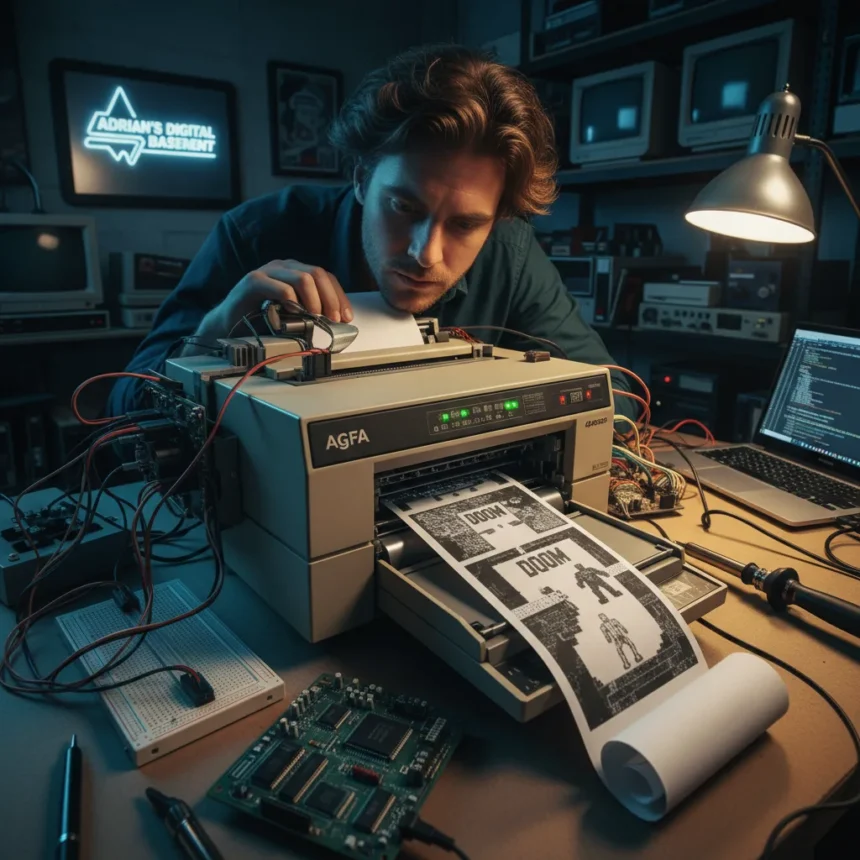
Doom on vintage hardware just hit a new frontier: a 40-year-old printer controller. Adrian’s Digital Basement, a YouTube channel with 243,000 subscribers, reverse-engineered the Agfa Compugraphic 9000PS—a specialized PostScript raster image processor from 1986—and successfully ported the legendary first-person shooter to run on it.
Key Takeaways
- Adrian’s Digital Basement ported Doom to a 1986 Agfa Compugraphic 9000PS printer controller via full reverse engineering.
- The Agfa contains a Motorola 68020 CPU, 213 MB hard drive, and runs only PostScript code from ROMs—no traditional OS.
- The project required custom monitor ROM code, hardware modifications for video and audio output, and ROM/drive dumps.
- Doom runs fully on the printer controller after approximately 1:17:44 into Adrian’s demonstration video.
- All code, documentation, and ROM dumps are publicly available on GitHub and Internet Archive for replication.
What Makes Doom on Vintage Hardware So Difficult
The Agfa Compugraphic 9000PS is not a computer in the traditional sense. It is a printer controller—a specialized device designed to accept PostScript page descriptions, render high-resolution images into a frame buffer, then stream those images to a printing engine. The machine contains no operating system, no processes, no threads, no multitasking. It boots into a dedicated PostScript engine loaded from ROMs and does nothing else without external intervention.
That architecture is precisely what makes porting Doom on vintage hardware to this device so remarkable. The Agfa lacks the software infrastructure modern programmers take for granted. There is no Linux, no Unix, no console. Adrian had to reverse-engineer the entire hardware design, dump the ROMs containing the original PostScript engine, extract the machine’s boot sequence, and then write custom code to replace the PostScript engine with a Doom runtime.
How Adrian Built Doom on Vintage Hardware
Adrian’s approach unfolded in distinct stages, documented in his video timeline. First came the hardware audit: disassembly, component identification, and understanding the Motorola 68020 CPU architecture. The 68020 is a capable processor—fast enough for 1980s graphics workstations—but it had never been asked to render Doom’s sprite-based engine.

Next came the ROM and drive dumps. Adrian extracted the original PostScript code from the Agfa’s read-only memory and backed up the 213 MB hard drive via a BlueSCSI adapter, which emulates SCSI storage using modern flash media. With the original firmware preserved, he could begin modifications without fear of permanent data loss.
The critical breakthrough came with the custom monitor ROM. Adrian wrote new boot code that replaced the PostScript engine with a minimal runtime capable of executing Doom. This was not a simple port—it required understanding the Agfa’s memory layout, interrupt handling, and I/O subsystem. He then added hardware modifications to enable video and audio output, features the original printer controller never needed. By the 1:06:17 mark in his video, general capability tests confirmed the system was stable. At 1:17:44, Doom ran.

Why This Project Matters Beyond the Novelty
Running Doom on vintage hardware has become a benchmark of reverse-engineering skill. The game’s low system requirements and open-source codebase make it an ideal target for hobbyists pushing 40-year-old machines beyond their original purpose. But the Agfa project differs from typical Doom ports because the hardware was never meant to be programmable in the conventional sense.
Adrian’s success demonstrates that even locked-down, single-purpose devices can be repurposed if someone understands their internals deeply enough. The Agfa Compugraphic 9000PS was a dead-end piece of equipment—too specialized for general computing, too old for modern printing. Now it runs one of gaming’s most iconic titles. That transformation required not just coding skill but hardware knowledge, reverse-engineering discipline, and access to tools like BlueSCSI that bridge vintage and modern storage standards.
The project also highlights why open documentation matters. Adrian shared his custom monitor ROM code, his reverse-engineering notes, ROM dumps, and drive backups on GitHub and Internet Archive. Other enthusiasts can now replicate the work, modify it, or apply the same techniques to other abandoned hardware. Adrian noted in one video that the machine he thought was beyond recovery is now doing far more than it was ever supposed to do.
The Technical Specs That Made This Possible
The Agfa Compugraphic 9000PS shipped with a Motorola 68020 processor, a CPU that was genuinely fast for 1986. The 68020 powered workstations and high-end Macintosh models—it was not a toy. The machine also included 213 MB of hard storage (generous for the era) and various I/O ports, though Adrian noted some had been removed or disabled over the decades. The combination of processing power and storage meant the hardware could theoretically run something more complex than PostScript rendering if given the right firmware.

What the Agfa lacked was flexibility. Its ROM-based PostScript engine was hardcoded. There was no BIOS setup, no bootloader menu, no way to load external software. Adrian had to replace the entire boot sequence to make the machine do anything else. The BlueSCSI adapter solved the storage problem by presenting modern flash memory as a legacy SCSI drive, allowing him to preserve and modify the original drive image.
Can You Replicate This Project?
Yes, if you have the hardware, the skills, and the patience. Adrian published the complete technical foundation: the custom monitor ROM source code via GitHub (AGFA-MON repository), the I/O board monitor ROM code, and full ROM and drive dumps archived on Internet Archive. The BlueSCSI project (bluescsi.com) provides the storage adapter needed to interface modern media with the Agfa’s SCSI bus.
The barrier is not documentation—it is expertise. You need to understand 68020 assembly language, PostScript internals, hardware-level I/O, and how to debug a system with no console. You also need to acquire an Agfa Compugraphic 9000PS, which is not cheap or common. These machines were industrial equipment, and surviving units are scattered in estates, auctions, and the collections of retro hardware enthusiasts.
What Does This Mean for Retro Gaming?
Doom on vintage hardware has become almost cliché—it runs on calculators, smartwatches, and printers (the latter being a running joke in gaming circles). But most of those ports target systems with at least some programmability. The Agfa is different because it started as a completely closed system. Porting Doom to it required not just coding but archaeology and reverse engineering. Adrian essentially excavated the machine’s secrets and rewrote its purpose from scratch.
This approach opens possibilities for other abandoned hardware. Industrial equipment, medical devices, and specialized electronics often contain capable processors locked behind proprietary firmware. If someone can dump and understand that firmware, they can unlock new uses for hardware that would otherwise end up in recycling. It is not practical for most machines, but for enthusiasts and hobbyists, it represents a form of digital preservation and creative repurposing.
FAQ
How long did it take Adrian to port Doom to the Agfa?
The research brief does not specify the total development time. Adrian’s video shows the project completed and running, with timestamps marking key milestones (ROM tour at 28:16, video output at 49:15, Doom execution at 1:17:44), but the brief does not disclose how many weeks or months the reverse engineering took.
Does the Agfa run Doom at full speed?
The research brief does not provide performance metrics like frame rate or stability data. Adrian’s video demonstrates Doom running on the hardware, but specific performance characteristics are not documented in the available sources.
Can you buy an Agfa Compugraphic 9000PS today?
The Agfa Compugraphic 9000PS is vintage industrial equipment from 1986, available only on the used market through auctions, estate sales, and specialist retailers. No new units are manufactured. Pricing varies widely depending on condition and location.
Adrian’s achievement proves that reverse engineering can resurrect dead hardware and push it into entirely new domains. Doom on vintage hardware is no longer just a novelty—it is a statement about what is possible when you understand a machine well enough to rewrite its entire purpose. The Agfa Compugraphic 9000PS will never print another page, but it will forever run Doom.
Edited by the All Things Geek team.
Source: Tom's Hardware