





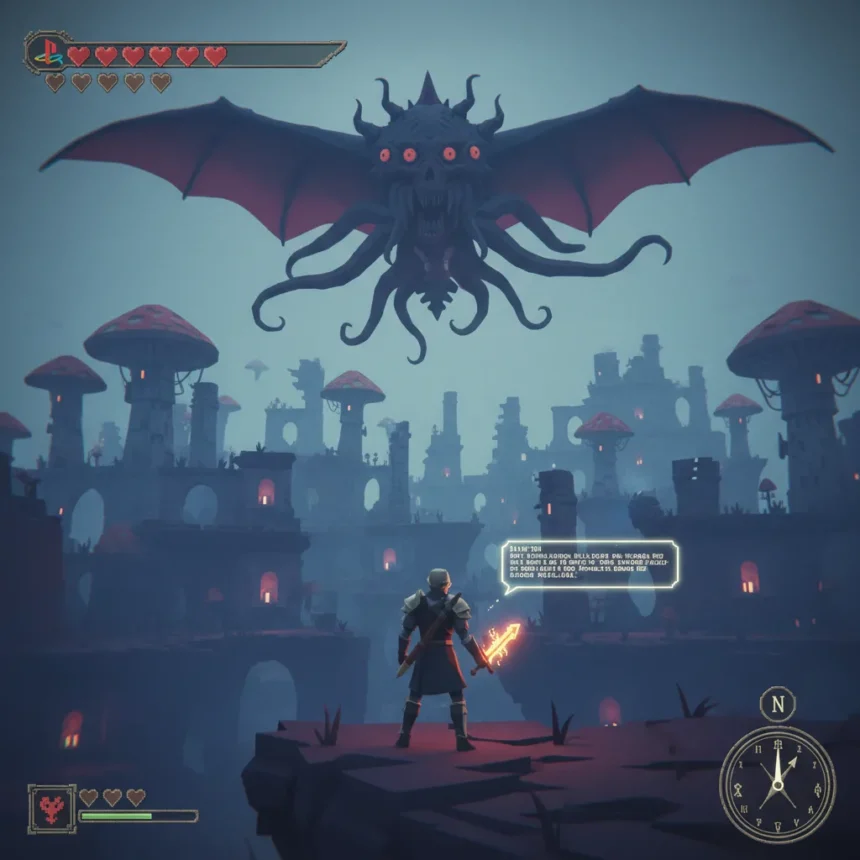
Dread Delusion retro RPG is a first-person open-world adventure developed by indie studio Lovely Hellplace and published by Dread XP, launching May 14, 2024, across PC, Xbox Series X, Xbox One, PlayStation 5, PlayStation 4, and Nintendo Switch 2 at £15.49 / $20. It is a deliberate rejection of modern RPG design—no map, minimal handholding, simplistic combat, and a world that feels deliberately hostile to convenience.
Key Takeaways
- Dread Delusion retro RPG strips away modern quality-of-life features for authentic PS1-era atmosphere and exploration-focused gameplay.
- Inspired by Morrowind, Thief, Deus Ex, and King’s Field, the game prioritizes world-building and player agency over combat mechanics.
- Available on PC (Steam Deck Verified), Xbox, PlayStation, and Nintendo Switch 2 for £15.49 / $20.
- Writing and setting earn praise; combat is simplistic and unvaried, with performance issues and poor sound design requiring patches.
- Cosmic horror elements and illegal gods create a genuinely unsettling world that respects player intelligence.
Why Dread Delusion Retro RPG Matters Now
The console expansion matters. Dread Delusion retro RPG launched on PC in May 2024, but Xbox and PlayStation releases bring this teeth-bared retro nightmare to players who never experienced Morrowind’s uncompromising design philosophy. In an era when AAA RPGs obsess over cinematic storytelling, skill trees that feel like spreadsheets, and quest markers that remove all mystery, Lovely Hellplace asks a radical question: what if we just didn’t do any of that?
The game’s design philosophy is almost confrontational. In true PS1 fashion, Dread Delusion retro RPG does not give the player a map. Instead, it provides barebones directions without indicating which direction you are facing. This forces genuine navigation, actual exploration, and the kind of spatial memory that modern games have trained out of us. Lovely Hellplace figures the player is smart and can use the clues given to move forward—and this works wonderfully.
What Makes Dread Delusion Retro RPG Stand Out
The setting is the star. A shattered land of flying continents hosts illegal gods, an inquisition hunting worshippers, hallucinogenic vision distillers, merchants, occult secrets, and a multi-legged brain parasite that feels less like a monster and more like cosmic wrongness. The writing is genuinely weird, the world is delightfully well-considered, and political intrigue threads through almost every interaction. This is not a game about saving the world—it is about understanding it, or trying to, while cosmic forces resist comprehension.


Character building is lean but purposeful. High Strength means harder hits, reduced damage taken, and the ability to bust doors. High Guile unlocks speed, lockpicking, and sneaky solutions. The game respects non-combat approaches. Not every RPG needs to be combat-centric, and Dread Delusion retro RPG proves this by emphasizing thinking, lore discovery, and world-building over hack-and-slash mechanics. Spellcasting exists, weapon upgrades are available, and secrets reward exploration—but the game never forces you into a fight you could talk, sneak, or think your way around.
Where Dread Delusion Retro RPG Stumbles
Combat is the weakest link. Reviews consistently describe it as simplistic, with unvaried AI and unrewarding encounters. Enemy design lacks the sophistication that the game’s writing and world-building deserve. Hack-and-slash mechanics feel functional rather than engaging, which matters less in a game that de-emphasizes combat but still stings when fights do occur.


Technical execution is rough. Performance issues, bugs, and janky elements require patches. Steam Deck runs the game well with only a minor map quirk, but sound design is poor throughout. The barren level design in places undermines the atmosphere, and the final act wobbles in pacing and coherence. These are not deal-breakers for a £15.49 indie RPG, but they prevent Dread Delusion retro RPG from reaching the polish of its spiritual predecessors like Morrowind.
How Dread Delusion Retro RPG Compares to Morrowind
Morrowind is the obvious ancestor. Both games strip away quest markers, both trust player intelligence, both feature alien worlds that refuse to explain themselves. But Morrowind is a 2002 game with 20+ years of modding community support—it is massive, baroque, sometimes impenetrable. Dread Delusion retro RPG is compact, brisk, and respectful of player time. It borrows Morrowind’s philosophy but condenses it. Where Morrowind sprawls across hundreds of hours, Dread Delusion retro RPG delivers a manageable experience with substantial side content. That is not a weakness—it is a design choice that acknowledges modern players have less tolerance for busywork.
The cosmic horror elements distinguish it. Thief, Deus Ex, and King’s Field all influenced the mechanical DNA, but the PS1-era aesthetic and nightmare creature designs (inspired by Nightmare Creatures’ grotesque enemy art) create something distinctly unsettling. This is not Morrowind with better graphics—it is Morrowind filtered through cosmic dread and low-poly PS1 grotesqueness.
Is the Performance Stable Enough to Recommend?
On Steam Deck, yes. The Verified status is earned—it runs well with minimal quirks. On base PlayStation 4 and Xbox One, performance issues are more pronounced, though the game remains playable. PC is the safest bet, though patches continue rolling out based on community feedback. The jank is real but not game-breaking for players who accept indie roughness as part of the charm.


Does Dread Delusion Retro RPG Respect Your Time?
Absolutely. The game is designed to be completed, with side content adding depth without padding. It respects player agency—multiple quest outcomes and routes mean your choices actually reshape the world. This is not a 100-hour completionist grind. It is a focused, atmospheric experience that knows when to end.
Should You Play Dread Delusion Retro RPG?
If you loved Morrowind, miss games that trust player intelligence, or crave cosmic horror wrapped in PS1 aesthetics, Dread Delusion retro RPG is essential. If you need combat to carry an RPG or expect modern polish, wait for patches or skip it entirely. The game’s refusal to accommodate modern sensibilities is not a bug—it is the entire point. The console releases mean more players can finally experience what Lovely Hellplace built: a world that wants to unsettle you, confuse you, and make you feel genuinely lost. That is not a flaw. That is the feature.
Edited by the All Things Geek team.
Source: Windows Central




