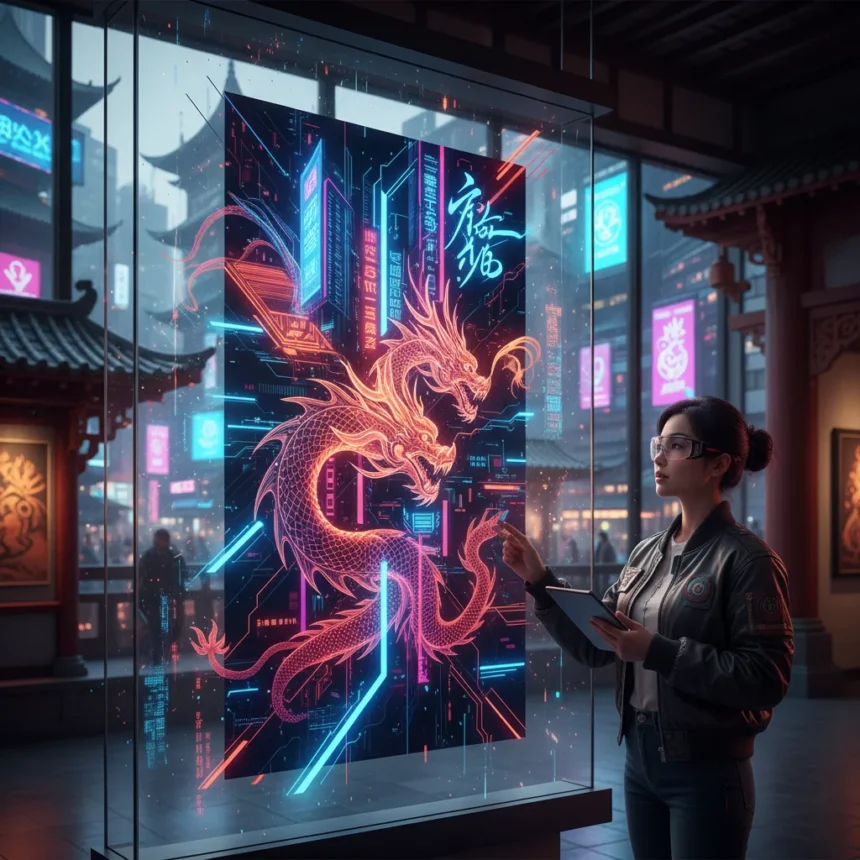
The Eastern cyberpunk aesthetic represents a fundamental shift in how digital artists approach science fiction visuals, moving beyond the neon-soaked, dystopian frameworks that have dominated Western cyberpunk for decades. A new generation of creators is synthesizing cyberpunk’s technological edge with Eastern cultural, architectural, and philosophical traditions, resulting in work that feels simultaneously futuristic and rooted in specific cultural identity.
Key Takeaways
- Eastern cyberpunk aesthetic blends sci-fi technology with Eastern cultural and architectural traditions
- This approach challenges the Western-dominated cyberpunk visual language established by 1980s and 1990s media
- Digital artists are using traditional Eastern design elements alongside neon, chrome, and digital effects
- The movement represents a broader global shift toward culturally specific interpretations of futurism
- Eastern cyberpunk work often incorporates philosophy, spirituality, and historical aesthetics alongside technology
What defines the Eastern cyberpunk aesthetic
The Eastern cyberpunk aesthetic combines futuristic technology with visual and conceptual elements drawn from East Asian, Southeast Asian, and broader Eastern cultures. Rather than the alienated, individualistic tone of Western cyberpunk—think neon Tokyo streets and corporate dystopias—Eastern interpretations often integrate harmony with technology, spiritual elements, and architectural traditions that predate industrialization. The result is a visual language where ancient temples sit alongside holographic interfaces, where traditional calligraphy merges with digital code, and where technological advancement does not necessarily mean cultural erasure.
This aesthetic distinguishes itself through intentional cultural specificity. Artists working in this space draw from actual Eastern design traditions, philosophical concepts, and historical contexts rather than treating Eastern elements as exotic window dressing. The approach respects source material while creating genuinely new visual possibilities that Western cyberpunk conventions had not explored. Colors shift beyond the primary neon palette—incorporating golds, deep blues, and natural earth tones that reference Eastern art history. Architectural elements reference actual Eastern building styles, from pagoda structures to traditional courtyard layouts, reimagined with technological integration.
Why the Eastern cyberpunk aesthetic matters now
For decades, cyberpunk as a genre remained overwhelmingly Western in origin and perspective. The aesthetic was defined by William Gibson’s novels, Japanese urban landscapes filtered through American eyes, and video game franchises that treated non-Western settings as backdrops for Western protagonists. The Eastern cyberpunk aesthetic inverts this dynamic—it centers Eastern artists, Eastern perspectives, and Eastern cultural continuity as the primary lens through which to imagine technological futures. This matters because how we imagine the future shapes what we build and who we include in those visions.


The timing reflects broader cultural shifts. As digital art tools have become more accessible globally, artists from East Asia, Southeast Asia, and diaspora communities can now reach audiences directly without gatekeeping from Western publishers or galleries. Simultaneously, global audiences are increasingly skeptical of Western-centric narratives and actively seeking alternative perspectives. The Eastern cyberpunk aesthetic fills a genuine demand for science fiction visuals that do not require viewers to adopt a Western ideological framework or assume Western cultural dominance in imagined futures.
How Eastern cyberpunk differs from traditional cyberpunk
Traditional Western cyberpunk, rooted in 1980s science fiction and 1990s video games, typically emphasizes alienation, corporate dominance, and individual rebellion against systems. The visual language is aggressive—sharp angles, overwhelming neon, chrome surfaces, and decay. The tone is cynical; technology is presented as corrupting or dehumanizing. Eastern cyberpunk retains technology as a central element but shifts the philosophical framework. Technology can coexist with nature. Progress does not require abandoning tradition. Individual and collective identity are not necessarily opposed.



Visually, this translates into distinct choices. Where Western cyberpunk defaults to gritty urban decay, Eastern cyberpunk might show meticulously maintained technological gardens. Where Western cyberpunk uses neon as an assault, Eastern cyberpunk integrates light more subtly, drawing from principles of balance and composition found in traditional Eastern art. Characters in Western cyberpunk are often isolated rebels; in Eastern cyberpunk narratives, they frequently exist within communities and family structures. The technology itself is depicted differently—not as inherently corrupting but as a tool whose moral weight depends on how it is used and who controls it.
Key Takeaways: Eastern cyberpunk in practice
Artists pioneering the Eastern cyberpunk aesthetic employ specific techniques that distinguish their work. They research historical architectural styles and integrate them authentically rather than approximating them. They study traditional art movements—calligraphy, scroll painting, textile design—and find ways to merge those visual languages with digital effects. They incorporate actual Eastern philosophical concepts rather than using Eastern imagery as decoration. This rigor creates work that feels coherent and intentional, not borrowed or superficial.
The tools remain digital—Photoshop, 3D software, digital painting applications—but the conceptual framework is distinctly Eastern. Some artists work in animation, others in still illustration or 3D modeling. Some focus on character design, others on environment and architecture. What unites them is a commitment to centering Eastern perspectives and aesthetics in science fiction worldbuilding, refusing to default to Western conventions as the baseline.
Is the Eastern cyberpunk aesthetic gaining mainstream recognition
Yes, though recognition remains uneven. The aesthetic has strong presence in digital art communities, concept art for games and film, and among audiences actively seeking alternatives to Western sci-fi dominance. Major game studios and streaming platforms have begun commissioning work that incorporates Eastern cyberpunk elements, recognizing both its visual distinctiveness and its appeal to global audiences. However, mainstream art institutions and traditional galleries have been slower to feature this work prominently, reflecting broader institutional biases toward Western art movements and Western-defined aesthetic categories.


This gap between digital community recognition and institutional validation is narrowing. As digital art gains legitimacy in fine art contexts, and as cultural institutions face pressure to diversify their programming, Eastern cyberpunk work is receiving more prominent placement in exhibitions and critical discourse. The movement is no longer niche—it is becoming a recognized aesthetic category that influences broader science fiction design across media.
What can Western cyberpunk artists learn from the Eastern approach
The Eastern cyberpunk aesthetic offers Western artists a clear lesson: specificity and cultural depth create stronger work than generic futurism. Rather than defaulting to established tropes, asking what actual cultural traditions, architectural styles, and philosophical frameworks could inform a science fiction vision produces more compelling results. Western cyberpunk artists who engage seriously with non-Western aesthetics—not as decoration but as foundational conceptual material—create work that feels fresher and more thoughtful than those who recycle familiar neon-and-chrome imagery.
The approach also suggests that audiences crave futures that feel culturally grounded rather than culturally erased. A science fiction world that incorporates specific cultural elements, historical awareness, and philosophical coherence engages viewers more deeply than one that treats all cultures as interchangeable backdrop material. This does not mean Western artists must abandon cyberpunk aesthetics; it means approaching the genre with the same cultural intentionality that Eastern artists bring to their work.
How does the Eastern cyberpunk aesthetic influence game design
Video games have become a primary medium for Eastern cyberpunk aesthetics, both in games created by Eastern studios and in Western games that incorporate Eastern design influences. Game environments built around Eastern cyberpunk principles tend to feel more lived-in and coherent than those that simply layer Eastern visual elements onto Western cyberpunk structures. Designers working in this space make deliberate choices about how technology integrates into spaces—not as an overlay but as something that has evolved organically within a specific cultural context over time.
Character design in Eastern cyberpunk games similarly reflects cultural specificity. Rather than generic futuristic clothing, characters wear garments that reference actual Eastern fashion traditions while incorporating technological elements. Dialogue and narrative often incorporate Eastern philosophical concepts or cultural values that Western cyberpunk typically ignores. The cumulative effect is immersive worldbuilding that feels authentically grounded rather than aesthetically borrowed.
FAQ
What countries and cultures inform the Eastern cyberpunk aesthetic
The Eastern cyberpunk aesthetic draws from East Asian cultures (particularly Japanese, Chinese, and Korean traditions), Southeast Asian influences, and broader Eastern philosophical frameworks. However, artists working in this space emphasize that the aesthetic is not monolithic—a Japanese cyberpunk vision differs meaningfully from a Thai or Indian one. The shared element is centering Eastern perspectives and cultural traditions rather than treating them as exotic additions to Western cyberpunk frameworks.
Can Western artists create authentic Eastern cyberpunk work
Western artists can create respectful, thoughtful work influenced by Eastern cyberpunk principles, but authenticity requires genuine engagement with source material and cultural context. The distinction lies between artists who study Eastern aesthetics, philosophy, and history seriously versus those who superficially borrow visual elements. The most compelling Eastern cyberpunk work comes from artists with direct cultural connection, but Western artists who approach the aesthetic with intellectual rigor and cultural respect can contribute meaningfully to the conversation.
Where can you find Eastern cyberpunk art
Eastern cyberpunk work appears across digital art platforms, concept art portfolios, independent game projects, and increasingly in mainstream game studios and streaming content. Social media platforms like ArtStation and Instagram host thriving communities of Eastern cyberpunk artists. Independent games and animated projects often showcase this aesthetic more prominently than AAA studios, though that is shifting as major publishers recognize the market appeal and creative potential of Eastern-centered science fiction design.
The Eastern cyberpunk aesthetic represents more than a visual trend—it signals a fundamental shift in who gets to define the future. As digital tools democratize creative production and global audiences demand more diverse perspectives, artists from Eastern cultures are claiming space to imagine technological futures rooted in their own traditions, philosophies, and aesthetic frameworks. This is not a rejection of Western cyberpunk but an expansion of what cyberpunk can be, creating room for multiple visions of how technology and culture might evolve. The result is richer, more culturally specific science fiction that challenges viewers to imagine futures beyond the neon-soaked Western default.
Edited by the All Things Geek team.
Source: Creativebloq