





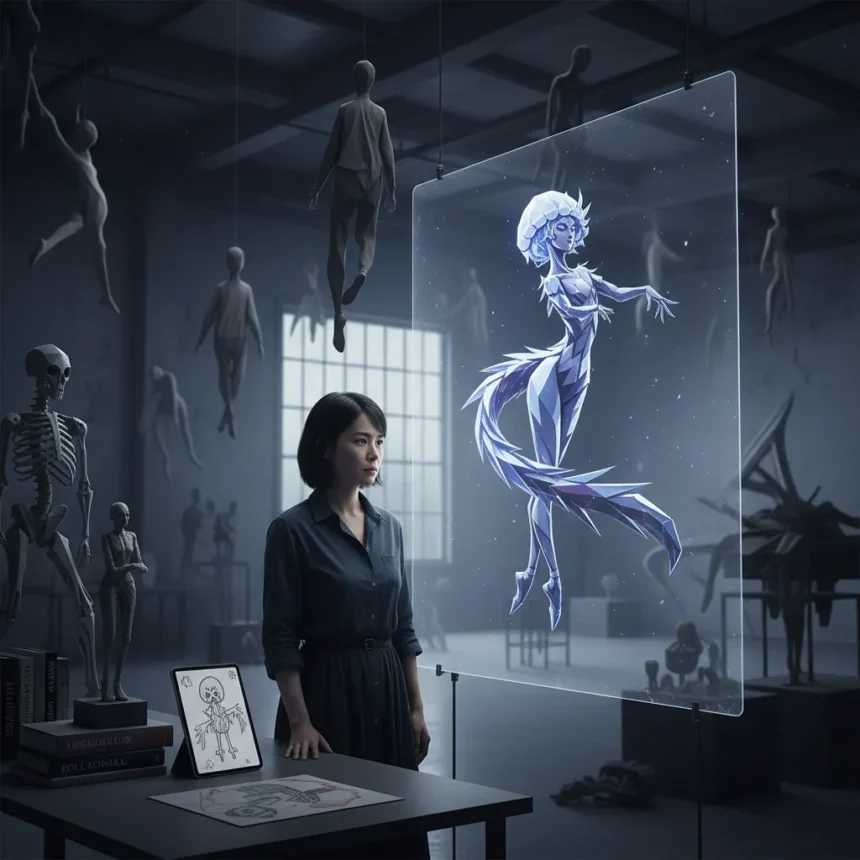
Game artist Liuyazi (Arya) Hou creates haunting creature designs by fusing emotion, dance, and geometry into 3D sculptures that evoke both dread and wonder. Her approach transforms childhood fears and storytelling into visual forms that unsettle and fascinate simultaneously, earning her recognition in publications like ImagineFX and work with clients across gaming and publishing.
Key Takeaways
- Liuyazi Hou captures a combination of dread and wonder inspired by petrifying childhood experiences.
- Her haunting creature designs blend intuition with surreal elements drawn from mythology and religious symbolism.
- She creates work primarily for story-driven projects, with many clients in RPG games and publishing.
- Her artistic process begins with doodling and experimentation, guided by intuition rather than rigid planning.
- She created Jumbom Zombie, a 2013 mobile game featuring four animal warriors as a personal project.
Where Childhood Fear Becomes Art
Liuyazi Hou’s creative philosophy stems from a simple but powerful observation: everything feels terrifying when you are small. That childhood vulnerability shapes every haunting creature design she produces. As she explains, “Everything is petrifying when you’re little, and I strive to capture a combination of dread and wonder in my work.” This dual emotion—the fear and the fascination it generates—forms the emotional core of her sculptures. Rather than designing creatures that are purely grotesque or purely beautiful, she balances both impulses, creating forms that pull viewers in even as they instinctively recoil.
This emotional honesty distinguishes her work from purely technical creature design. Many game artists prioritize anatomical accuracy or cinematic appeal. Hou prioritizes feeling. Her haunting creature designs function as visual translations of psychological states—the uncanny sensation of encountering something both alive and wrong, both compelling and disturbing. That balance is harder to achieve than pure horror or pure beauty, yet it is precisely what makes her work memorable.
The Process: Intuition Over Planning
Hou’s creative method rejects rigid frameworks. She begins with doodling and experimentation, combining ideas from multiple sketches until something resonates. This intuitive approach extends to the surreal elements that define her haunting creature designs. Rather than designing every detail rationally, she trusts her instincts to guide the composition toward mystery. “I use my intuition to create the more surreal elements, and when I come up with something that is mysterious even to me, it’s the best feeling,” she notes.


This philosophy reveals a fundamental truth about creature design: the most compelling forms often emerge from play rather than predetermined blueprints. By allowing mystery to remain even in her own creative process, Hou ensures that her designs retain an ineffable quality—something viewers cannot quite rationalize or dismiss. Her early work drew heavily on mythical creature imagery, which she later enriched by incorporating textures and symbols relating to different religions. That layering of cultural and mythological references adds depth to her haunting creature designs, making them feel rooted in human storytelling traditions rather than invented from scratch.
Storytelling as the Foundation
Hou’s work exists in service of narrative. “I enjoy working with story – everything I do has been somehow inspired by writing,” she explains. This story-first approach shapes her client base: many work in publishing or RPG games, where creature design must serve character and plot rather than exist in isolation. Her personal project, Jumbom Zombie, exemplifies this philosophy. Released as a mobile game in 2013, it featured four animal warriors who return from death, with splash art that brought her creature designs to interactive life.


The distinction matters. A haunting creature design in an RPG or novel carries narrative weight—it represents a character, an obstacle, a moment of revelation. Hou’s designs work within that context, enhancing story rather than overwhelming it. This collaborative instinct sets her apart from artists who view creature design as a standalone discipline. For Hou, the form must serve the emotional arc of the story it inhabits.
Haunting Creature Designs in a Competitive Field
Creature design has become a recognized discipline within game development and concept art. Other artists in the space, such as self-taught concept designer Maciej Kuciara, have built careers designing creatures for blockbuster films and games like The Avengers, Spider-Man: No Way Home, and The Last of Us. Yet Kuciara’s work emphasizes technical precision and cinematic appeal—a different philosophy than Hou’s emphasis on emotional mystery. Where Kuciara designs creatures that fit smoothly into action-driven narratives, Hou designs creatures that provoke psychological response. Both approaches are valid; they simply serve different creative goals.
The field itself has grown as gaming and publishing increasingly prioritize visual distinctiveness. Creature designers now command significant roles in AAA studios and indie teams alike. Hou’s haunting creature designs stand out not because they are technically superior but because they communicate emotional complexity—a quality harder to teach or replicate than anatomical accuracy or rendering skill.
What Makes a Design Truly Haunting?
Hou’s work suggests that haunting creature designs require more than unsettling visuals. They require gesture—the implied movement and emotion embedded in posture and form. They require geometry that feels both organic and wrong, balanced on the edge between life and artifice. And they require the artist’s willingness to remain partially surprised by their own creation, to allow mystery to persist even after the work is complete.



Her publications in ImagineFX, including features in July 2016 and August 2022 issues, have showcased this philosophy to a global audience of artists and designers. These appearances validate an approach that prioritizes emotional resonance over technical flashiness—a reminder that the most effective creature designs are those that haunt the viewer’s imagination long after viewing.
How does Liuyazi Hou approach designing a new creature?
Hou begins with doodling and experimentation, combining ideas from multiple sketches. She uses intuition to guide surreal elements rather than planning every detail rationally, and she considers it a success when she creates something mysterious even to herself.
What inspired Liuyazi Hou’s artistic philosophy?
Her work stems from childhood experiences of fear and wonder. She intentionally captures both dread and awe in her designs, translating the petrifying feelings of being young into visual form that fascinates viewers despite—or because of—its unsettling qualities.
What types of projects does Liuyazi Hou work on?
Hou primarily works on story-driven projects, with many clients in RPG games and publishing. She has also created personal projects like Jumbom Zombie, a 2013 mobile game featuring four animal warriors, which showcased her creature designs in interactive form.
Liuyazi Hou’s haunting creature designs prove that the most memorable visual art emerges not from technical mastery alone but from emotional honesty. By grounding her work in the genuine fear and wonder of childhood, and by trusting intuition over rigid planning, she creates forms that linger in the viewer’s mind. In a field crowded with technically proficient designers, that psychological resonance is what separates forgettable work from unforgettable art.
Where to Buy
$34.30 at Amazon US | $25.42 at Amazon US | $30.49 at Amazon US | $139.39 at Amazon US
This article was written with AI assistance and editorially reviewed.
Source: Creativebloq