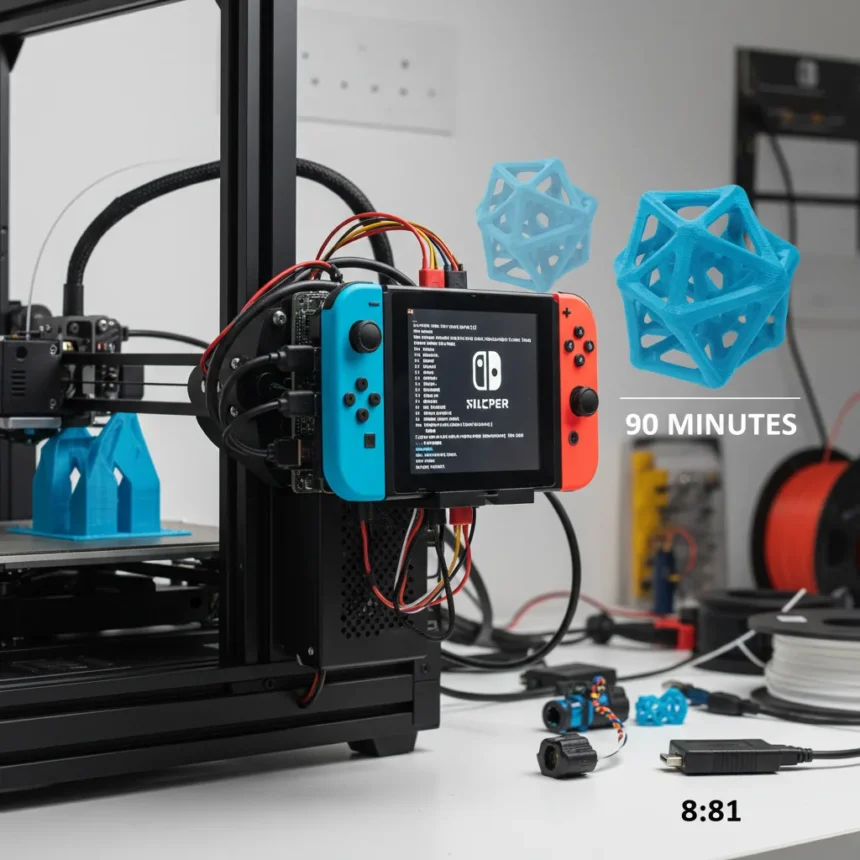
A Nintendo Switch 3D printer hack has demonstrated that a consumer gaming handheld can dramatically accelerate print speeds when running Klipper firmware. The modder, known as Cocoanix, installed Ubuntu Linux on a jailbroken Nintendo Switch and configured it as the host computer for a Prusa MK3S 3D printer, cutting the time to print a 3DBenchy test model from 90 minutes down to 8 minutes and 41 seconds.
Key Takeaways
- Nintendo Switch 3D printer setup reduced Benchy print time from 90 minutes to 8:41
- Klipper firmware offloads motion processing to a faster host computer than the printer’s stock microcontroller
- Print speed reached 400 mm/s with acceleration of 17,000 mm/s² after tuning
- Raspberry Pi is the conventional host for Klipper, making the Switch choice unusual but functional
- Input Shaper tuning improved both speed and print quality claims
The real innovation here isn’t the Nintendo Switch itself—it’s what running Klipper on a faster host computer can accomplish. The Prusa MK3S ships with Marlin firmware running on the printer’s own microcontroller. Marlin is capable but limited by the processing power available on the printer’s board. Klipper moves the motion calculations to a separate computer, which handles the intensive math while the printer’s microcontroller focuses on executing commands. By using the Switch’s quad-core Tegra X1 processor instead of the printer’s stock board, the modder unlocked dramatically faster motion profiles.
How the Nintendo Switch 3D Printer Setup Works
The installation process follows a straightforward path. The modder installed Ubuntu Linux on the jailbroken Switch, then used KIAUH (Klipper Installation And Update Helper) to deploy Klipper, Moonraker, and Mainsail—the control stack that manages printer communication and web interface. The Prusa MK3S firmware was flashed with Klipper support, and printer.cfg was edited to define the printer’s geometry and motion parameters. Input Shaper, a Klipper feature that compensates for mechanical resonance, was then tuned to smooth vibrations and improve surface quality.
Once configured, the modder pushed the printer to 400 mm/s print speed and 17,000 mm/s² acceleration—settings that would have been impossible on the stock Marlin setup. These numbers represent the claimed performance ceiling before the toolhead itself became the bottleneck rather than the electronics. The speed increase is genuine, but it comes from Klipper’s architecture, not from the Switch’s gaming GPU or any special console feature.


Nintendo Switch 3D Printer vs. Traditional Klipper Hosts
Most Klipper users run the firmware on a Raspberry Pi, a single-board computer designed for exactly this kind of task. The Switch is an unusual choice because it’s a gaming device, not a printer controller. Hackaday noted that the Switch and Nvidia Jetson Nano developer kit are architecturally similar, both using stripped-down Tegra X1 processors. The Switch actually has twice as many GPU cores as the Jetson Nano, though GPU performance is irrelevant for Klipper’s CPU-bound motion calculations.
The practical difference between a Switch and a Raspberry Pi comes down to availability and cost. A Raspberry Pi is purpose-built and typically costs less than a used Switch on the secondhand market. However, the Switch hack demonstrates that any sufficiently fast Linux-capable computer can run Klipper effectively. The novelty lies in the repurposing, not in superior hardware. A standard Raspberry Pi running the same Klipper configuration would deliver comparable results.

Speed Gains and Quality Claims
The jump from 90 minutes to 8 minutes 41 seconds for a Benchy is visually dramatic, but context matters. The Prusa MK3S is a bed-slinger style printer—an older architecture by modern standards. Stock Marlin firmware prioritizes reliability over speed, which is why the baseline print took so long. Klipper’s approach of offloading motion processing to a faster host allows aggressive acceleration and velocity without losing precision. Input Shaper further tightens the system by predicting and compensating for vibrations before they affect print quality.
The modder claims that quality improved alongside speed, a benefit of Input Shaper tuning that Klipper enables. Faster print speeds can introduce ringing and layer shifts if the printer’s mechanical resonance isn’t addressed. By running Input Shaper, the system learns the printer’s vibration signature and adjusts motion commands to cancel it out. This is a real advantage of the Klipper ecosystem that Marlin cannot match without external hardware modifications.
Is This Practical for Your 3D Printer?
The Nintendo Switch 3D printer hack is impressive as a proof of concept, but it’s not a practical upgrade path for most users. Jailbreaking a Switch requires technical skill and voids any warranty. A Raspberry Pi is cheaper, easier to set up, and purpose-built for this role. If you own an aging Marlin-based printer and want Klipper’s benefits, a Pi 4 or Pi 5 is the sensible choice. The Switch hack proves that Klipper’s speed advantage is real and that the firmware can run on unconventional hardware, but novelty doesn’t translate to recommendation.
What makes Klipper faster than Marlin?
Klipper offloads motion planning from the printer’s microcontroller to a faster host computer. Marlin handles everything on the printer’s own board, which limits acceleration and speed due to processor constraints. Klipper’s architecture allows much more aggressive motion profiles while maintaining precision through Input Shaper compensation for vibrations.
Can you use a Nintendo Switch 3D printer setup with any printer?
Any printer with an open-source firmware option can potentially run Klipper, not just the Prusa MK3S. Ender 3, Voron, and many other printers have Klipper support. The Switch itself is irrelevant to compatibility—what matters is whether your printer’s control board can be flashed with Klipper firmware. A Raspberry Pi or similar Linux computer is still the conventional choice.
Does the Nintendo Switch 3D printer hack improve print quality?
Speed alone doesn’t guarantee quality, but Klipper’s Input Shaper feature can improve surface finish by reducing vibration-induced artifacts like ringing. The modder claims quality improved, which aligns with how Input Shaper works. However, faster speeds can also introduce new quality issues if acceleration and jerk limits aren’t tuned carefully for your specific printer and materials.
The Nintendo Switch 3D printer hack is a creative demonstration of Klipper’s potential, but it’s a solution in search of a problem. The real story is that Klipper works, that it’s dramatically faster than stock Marlin, and that Input Shaper delivers tangible quality improvements. The Switch is just the novelty wrapper around a genuinely useful firmware upgrade. If you want to accelerate your aging 3D printer, Klipper is worth exploring—but grab a Raspberry Pi, not a gaming console.
Edited by the All Things Geek team.
Source: Tom's Hardware