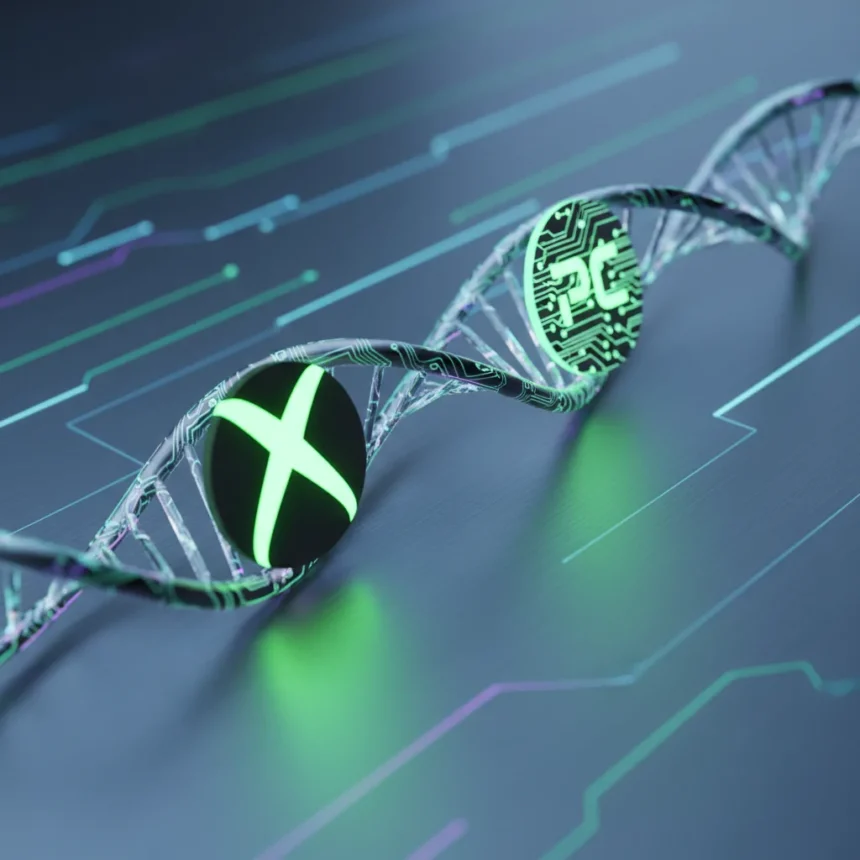
Project Helix unified build strategy represents Microsoft’s most ambitious push yet to collapse the technical barriers between console and PC gaming. Chris Charla, Xbox’s portfolio and programs general manager, confirmed at GDC 2026 that the next-generation Xbox—codenamed Project Helix and deep in development—will make it “easier” for developers to create a single build that runs on both the console and Windows PC. This shift signals a fundamental rethinking of how Xbox hardware evolves.
Key Takeaways
- Project Helix unified build enables one codebase to run on both console and PC hardware
- Custom AMD SoC powers the console with next-gen DirectX, FSR Diamond upscaling, and neural rendering
- Delivers order of magnitude leap in ray tracing performance and AI-integrated graphics pipeline
- Alpha developer kits ship in 2027; Xbox Mode arrives on Windows 11 in April 2026 in select markets
- Microsoft advises studios to prioritize current-gen and PC development first
What Project Helix unified build means for developers
The core promise of Project Helix unified build is radical simplification. Instead of maintaining separate codebases for console and PC—a costly, time-consuming process that has fragmented Xbox development for years—studios will author once and deploy everywhere. Microsoft is “working hard so developers can make one Xbox build in the future” that scales across hardware tiers, according to Charla. This eliminates redundant optimization work, shrinks testing surface area, and reduces the financial burden on independent studios that typically lack the resources of AAA publishers.
The unified approach targets a real pain point in modern game development. Console and PC have historically required different rendering paths, memory management strategies, and input handling. By designing the next-gen Xbox around a custom AMD SoC that shares architectural DNA with Windows 11 hardware, Microsoft is removing those friction points at the silicon level. The result is a development environment where a single DirectX implementation can target both platforms without compromise.
Hardware architecture powering the unified vision
Project Helix unified build rests on a custom AMD system-on-chip co-designed specifically for this vision. The SoC integrates a next-generation RDNA GPU focused on advanced ray tracing, paired with a neural rendering chip embedded directly on the processor. Xbox VP of Next Generation Jason Ronald described the hardware as delivering “an order of magnitude leap in ray tracing performance and capability, integrates intelligence directly into the graphics and compute pipeline, and drives meaningful gains in the efficiency, scale, and visual ambition”. This is not incremental—it is architectural rethinking.

The console supports AMD’s next-generation FSR technology, branded FSR Diamond or FSR Next, which uses machine learning for upscaling, multi-frame generation, and ray regeneration for ray tracing and path tracing. The SoC also incorporates next-gen DirectX features including work graphs and neural texture compression, alongside DirectStorage with Zstd compression for SSD-to-GPU data transfer. These are not marketing bullets—they are the technical foundation that makes Project Helix unified build feasible. Without this GPU-level AI integration and advanced texture compression, the promise of a single build scaling across different hardware would collapse under memory and bandwidth constraints.
Timeline and developer access
Microsoft is moving deliberately. Alpha hardware versions will ship to developers starting in 2027, giving studios two years to familiarize themselves with Project Helix unified build architecture before any public launch. In the interim, Xbox Mode—a full-screen, controller-optimized Xbox experience—is rolling out to Windows 11 in April 2026 in select markets, debuting on ROG Xbox Ally handhelds. This staged rollout serves a dual purpose: it lets Microsoft validate the hybrid console-PC approach on existing hardware while giving developers a preview of the unified experience.


Charla’s guidance to studios is pragmatic: focus on current-generation Xbox and PC development first. Do not wait for Project Helix unified build to launch. This is sensible advice for a market where next-gen hardware is still years away, but it also signals that Microsoft does not expect immediate adoption once alpha kits arrive. Early access will be limited to committed partners willing to experiment with new tooling and workflows.
Contrasting Project Helix unified build with traditional console architecture
The unified build strategy diverges sharply from how Xbox One, PlayStation 5, and Nintendo Switch operate. Those consoles run proprietary operating systems and require developers to maintain separate PC versions using different rendering engines, input systems, and optimization techniques. Project Helix unified build, by contrast, boots on custom AMD silicon running Windows 11 with an Xbox Mode overlay, allowing backward compatibility with Xbox One, Xbox Series, Xbox 360, and original Xbox titles through emulation. This is not a thin compatibility layer—it is architectural integration.
The competitive implication is significant. PlayStation 5 and Nintendo Switch have no announced plans for a unified codebase strategy. PlayStation continues to treat PC ports as secondary releases, often arriving months or years after console launch. Project Helix unified build, if executed as promised, would give Xbox an efficiency advantage that translates directly to faster ports, lower development costs, and more stable cross-platform performance parity.
Why this matters now
GDC 2026 announcements confirm what industry observers suspected: Microsoft is betting the next generation of Xbox on architectural convergence, not raw horsepower alone. The company is signaling that the future of gaming hardware is not about bigger consoles or faster GPUs in isolation—it is about removing artificial barriers between platforms. Project Helix unified build is that bet made concrete.


How does Project Helix unified build compare to current Xbox development?
Current Xbox development requires separate optimization passes for console and PC, with different memory hierarchies, GPU architectures, and driver behaviors creating friction. Project Helix unified build eliminates these divergences by standardizing on a common AMD architecture and DirectX implementation across both platforms. Developers will write to a single API surface and target one hardware profile, drastically reducing the complexity that currently fragments Xbox development.
When will Project Helix unified build reach consumers?
No consumer launch date has been announced. Alpha developer kits ship in 2027, which means developers will have at least a year or more to familiarize themselves with the hardware before any public release. Xbox Mode on Windows 11 arrives in April 2026 in select markets, offering a preview of the unified experience on existing hardware, but the actual Project Helix unified build console remains years away.
Will Project Helix unified build support backward compatibility?
Yes. The hybrid console-PC design enables emulation of Xbox One, Xbox Series, Xbox 360, and original Xbox titles through Windows 11’s compatibility layer. This is not a promise of perfect compatibility across all legacy titles, but the architectural foundation makes it possible in a way that previous-generation consoles could not achieve.
Project Helix unified build represents the logical endpoint of a decade-long shift toward platform convergence in gaming. Microsoft is no longer chasing raw performance metrics or exclusive features—it is chasing simplicity for developers and seamlessness for players. If the company executes on these promises, the next Xbox could redefine how the industry thinks about console development itself.
Edited by the All Things Geek team.
Source: TechRadar