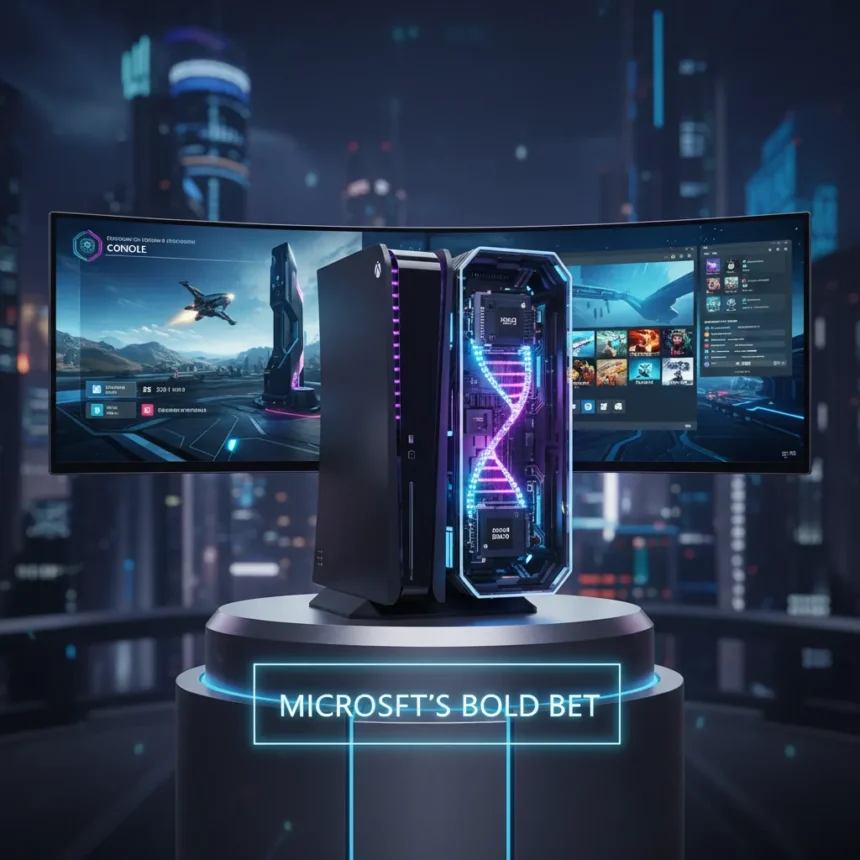
Project Helix is Microsoft’s next-generation Xbox console designed to play both Xbox and PC games using a single hybrid hardware setup, powered by a custom AMD SoC and arriving to developers in 2027. Microsoft officially confirmed the project at GDC in March 2026, revealing an architecture that attempts to solve one of gaming’s trickiest engineering puzzles: how to make a device that is simultaneously a traditional console and a full PC without compromising either experience.
Key Takeaways
- Project Helix plays Xbox console and PC games on unified hardware, launching alpha units to developers in 2027.
- Custom AMD SoC co-designed for next-gen DirectX and FSR, with massive ray tracing performance gains.
- Xbox mode rolling out to Windows starting April 2026 in select markets.
- Hybrid architecture targets wider 192-bit memory bus compared to PS6’s projected 160-bit interface.
- Copilot AI integration confirmed, with leadership changes positioning AI-focused executives.
Project Helix Xbox Console Architecture: One Box, Two Systems
The core innovation of Project Helix is its hybrid design. Rather than building a traditional console that plays console games or a PC that happens to run Xbox titles, Microsoft is engineering a single device that genuinely functions as both. This is not a marketing gimmick—it is an architectural challenge that has forced the team to rethink how hardware, firmware, and software interact. The device will ship to developers beginning in 2027 as alpha hardware, allowing studios to optimize for the new platform before consumer release.
This hybrid approach directly addresses a growing market reality: the line between console and PC gaming has blurred. Players want access to their entire library—Game Pass titles, PC exclusives, console-optimized games—without maintaining separate hardware. Project Helix attempts to collapse that fragmentation. However, the engineering cost is real. As one analysis noted, Xbox has created a fascinating challenge for itself, requiring a device that is genuinely two machines in one box.
AMD Custom SoC and Next-Generation Performance Leaps
Project Helix is powered by a custom AMD SoC co-designed specifically for next-generation DirectX and FidelityFX Super Resolution (FSR). Microsoft claims the hardware will deliver an order of magnitude leap in ray tracing performance, integrate intelligence into the graphics and compute pipeline, and drive efficiency gains that enable more ambitious, visually immersive worlds.

The leaked specifications suggest the device uses AMD’s Zen 6 CPU architecture paired with up to 68 RDNA 5 compute units, backed by a 192-bit memory interface. For context, this is wider than PS6’s projected 160-bit memory bus, suggesting Microsoft is prioritizing bandwidth for ray tracing and AI-driven graphics workloads. Both consoles use AMD’s latest CPU and GPU families, but Helix’s memory architecture and focus on PC compatibility represent a different engineering philosophy.
These are plausible technical directions based on industry trends, though Microsoft has not officially confirmed the specific compute unit count or memory configuration. What is confirmed is the partnership with AMD and the commitment to pushing rendering and simulation boundaries across a multi-year roadmap.

Xbox Mode on Windows: The PC Gateway
Alongside Project Helix, Microsoft is rolling out Xbox mode to Windows starting in April 2026 in select markets. This feature brings the Xbox experience to PC while maintaining Windows flexibility, essentially preparing the PC ecosystem to function more like a console when desired. This is the bridge between today’s fragmented ecosystem and tomorrow’s unified Helix experience.
The Xbox mode rollout is strategic: it tests the hybrid concept, gathers feedback from early adopters, and primes Windows users for a future where console and PC gaming are not separate categories. By the time Project Helix hardware arrives, the software layer will already be familiar to millions of Windows gamers.
Why This Matters: The Ecosystem Gamble
Project Helix represents Microsoft’s boldest bet since the original Xbox. Rather than chasing raw power like a traditional console generation, Microsoft is betting that the future of gaming is unified access across form factors. This is fundamentally different from Sony’s approach with PS6, which remains a dedicated console targeting a specific audience. Helix instead nudges players toward a broader PC ecosystem while maintaining console simplicity.
The risk is real. A device that tries to be two things can end up being neither. Gamers who want a simple, plug-and-play console experience might be frustrated by PC complexity. PC gamers might ask why they should buy Helix over a gaming PC. Critics argue this hybrid approach potentially sacrifices console identity in pursuit of a market that may not exist. Yet Microsoft leadership, including Asha Sharma who now oversees Xbox and brings AI-focused expertise, is betting that this convergence is inevitable.


Copilot Integration and AI-First Gaming
Project Helix will include Copilot, Microsoft’s AI assistant, integrated into the gaming experience. Copilot is already rolling out to Xbox Series X/S in 2026, and Helix will ship with this feature built in from day one. This signals Microsoft’s intent to make AI a core part of next-generation gaming, not an afterthought.
The integration has drawn mixed reactions. Some see potential for AI-assisted gameplay, dynamic difficulty, and smarter NPC behavior. Others view it as feature bloat—adding complexity to a device that is already attempting to bridge console and PC gaming. Either way, it reflects Microsoft’s strategic pivot toward AI as a competitive differentiator.
When Will Project Helix Launch?
Developer alpha hardware ships beginning in 2027, but consumer availability remains unannounced. Microsoft has not revealed pricing, final product name, or a specific consumer launch window. Project Helix is still a code name; the final name will be revealed closer to launch. Based on typical hardware development timelines, a consumer release in late 2027 or 2028 is plausible, but this is speculation rather than confirmed information.
How Does Project Helix Compare to PS6?
Both consoles use AMD Zen 6 CPUs and RDNA 5 GPUs, but their philosophies diverge sharply. Helix targets a 192-bit memory bus versus PS6’s projected 160-bit interface, giving Helix a bandwidth advantage for ray tracing and AI workloads. However, Helix must share its silicon budget between console and PC modes, while PS6 can dedicate all resources to console optimization. The real difference is ecosystem: Helix is Microsoft’s play to own gaming across devices, while PS6 remains a dedicated console. Sony is now partnering with Microsoft on game distribution, a shift that reflects the changing competitive landscape.
Is Project Helix Worth Waiting For?
That depends on what you value. If you want a traditional console that simply plays games, PS6 or a refreshed Xbox Series X might be more straightforward. If you want unified access to your entire gaming library—console, PC, Game Pass—across a single device, Helix is the bet Microsoft is making. The hybrid approach is ambitious and risky, but it reflects a genuine shift in how gamers consume games.
What Is the Final Name of Project Helix?
Microsoft has not revealed the final product name yet. Project Helix is a code name used internally and in official announcements. The final branding will likely arrive closer to the 2027 developer alpha or consumer launch window.
Project Helix is Microsoft’s answer to a question the industry has been asking for years: what happens when console gaming and PC gaming fully converge? The answer is not a console or a PC—it is both, in one device, backed by custom AMD silicon and integrated AI. Whether gamers actually want this unified experience, or whether the engineering complexity collapses under its own weight, will be answered when alpha hardware reaches developers in 2027.
Edited by the All Things Geek team.
Source: Windows Central