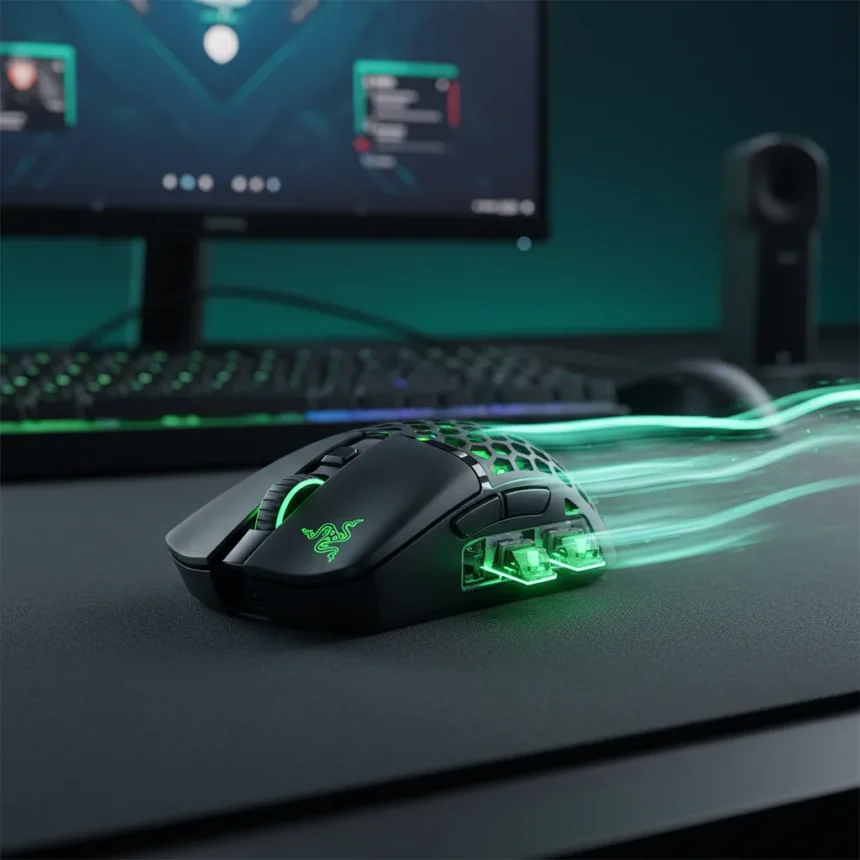
The Razer Viper V4 Pro is an ultra-lightweight gaming mouse made by Razer, weighing just 49 grams in black or 50 grams in white, with a Focus Pro 50K Optical Sensor Gen-3, HyperSpeed Wireless Gen-2 technology, and optical switches—launched in March 2026 at 159.99 USD.
Key Takeaways
- Weighs 49-50g, making it 9% lighter than the Viper V3 Pro predecessor.
- Motion latency drops to 0.36ms, up to 2.5x faster than competing mice.
- HyperSpeed Wireless Gen-2 delivers true 8000 Hz polling with 55% lower latency than the previous generation.
- Optical scroll wheel is 3.3x more reliable than mechanical designs, eliminating ghost scrolls.
- Battery lasts up to 180 hours at 1000 Hz, double the V3 Pro’s runtime.
Razer just refreshed its industry-standard Viper line, and the result is a mouse that feels like a cheat code for anyone who plays shooters or MOBAs. The Razer Viper V4 Pro strips away weight, slashes latency, and fixes the scroll-wheel annoyances that plagued its predecessor—all without raising the price tag.
Why Weight and Latency Matter More Than You Think
At 49 grams, the Razer Viper V4 Pro is aggressively light. That 9% reduction from the V3 Pro’s 54 grams sounds minor on paper, but in extended gaming sessions it means less arm fatigue and faster flick accuracy. The mouse sits in your hand without feeling hollow or cheap—Razer reinforced the internal structure up to 2x stronger than before, so the lightness comes from material choices, not cost-cutting.
More important than weight is motion latency. The HyperSpeed Wireless Gen-2 system achieves 0.36 milliseconds of motion latency, which Razer claims is 2.5 times faster than equivalent competitors. In FPS games, that margin matters. When you flick to target, your aim registers faster than opponents using standard wireless mice. The mechanical side buttons drop to 0.33 milliseconds of latency, or roughly 0.204 milliseconds on click—5 times lower than competitors. You notice this in games like Valorant or CS2 where reaction speed is the difference between a frag and a respawn.

Razer’s new Frame Sync feature synchronizes sensor frames with the mouse’s polling cycle, eliminating the micro-stutters that happen when sensor data and polling cycles drift out of sync. It sounds technical, but the practical result is steadier aim, especially at extreme sensitivity levels where jitter becomes visible.
The Optical Scroll Wheel Fixes a Real Problem
The Razer Viper V4 Pro swaps the mechanical scroll wheel for an optical one. This is not a downgrade—it is a correction. Mechanical scroll wheels ghost (register phantom scrolls), reverse (scroll down when you scroll up), or miss inputs entirely, especially after six months of use. Razer’s optical scroll is 3.3 times more reliable, according to internal testing. In games like World of Warcraft or Diablo, where weapon swapping happens via scroll, this reliability matters. You will not accidentally switch to your wrong ability mid-raid.
The Razer Optical Mouse Switches Gen-4 also deliver 100 million clicks with zero debounce delay, giving the primary buttons a crisper, more responsive feel than the Gen-3 switches in the V3 Pro. Combined with an all-optical sensor and optical scroll, the entire input path is now optical—no mechanical friction, no debounce lag.
Battery Life and Connectivity You Can Trust
The Razer Viper V4 Pro doubles down on endurance. At 1000 Hz polling, it runs for up to 180 hours on a single charge. That is over a week of continuous use. Even at 8000 Hz polling—the competitive standard—you get 45 hours, which is roughly a week of nightly gaming sessions. The 99.8% power efficiency rating means Razer squeezed every milliamp out of the battery without sacrificing performance.
Wireless connectivity uses a 2.4 GHz RF low-latency connection or Bluetooth, with an improved hemispherical dongle that Razer claims offers better stability and range than the previous version. The mouse also supports wired mode if you want zero-latency assurance at a LAN tournament. Plug-and-play compatibility spans Windows, Mac, and Linux.
The Price Versus the Viper V3 Pro
The Razer Viper V4 Pro costs 159.99 USD, the same as the V3 Pro. That seems generous—Razer added a lighter weight, faster sensor, lower-latency wireless, optical switches, optical scroll, and doubled battery life without raising the entry price. The V3 Pro maxed out at 35,000 DPI with a Gen-2 sensor; the V4 Pro jumps to 50,000 DPI with a Gen-3 sensor, and the polling efficiency improved by over 60%. If you own a V3 Pro and play competitively, the upgrade is worth considering. If you use a budget mouse or a mechanical gaming mouse, the V4 Pro is the single most impactful upgrade you can make to your setup.

Compared to Logitech’s G Pro X 2 Superstrike, which offers adjustable esports focus modes, the Razer Viper V4 Pro doubles down on speed and consistency instead of customization. Logitech’s mouse targets a wider audience; Razer’s targets players who want the fastest possible option.
Who Should Buy the Razer Viper V4 Pro?
If you play FPS games, MOBAs, or MMOs competitively—or aspire to—this mouse closes the gap between your hardware and pro-level gear. The 0.36ms motion latency, optical switches, and optical scroll eliminate hardware bottlenecks. You will feel the difference within the first hour.
Casual gamers and productivity users should skip it. The Razer Viper V4 Pro is built for speed, not comfort or ergonomics. It is ambidextrous and small, which suits claw and fingertip grips but may feel cramped if you use a palm grip. If you play turn-based strategy, roguelikes, or indie games, a heavier mouse with better cushioning will serve you better.
Does the Razer Viper V4 Pro have RGB lighting?
No. The Razer Viper V4 Pro ships with no RGB lighting. This design choice keeps weight down and power consumption minimal, prioritizing performance over aesthetics. If you want RGB, the V3 Pro or other Razer models offer it, but you sacrifice latency and battery life.
How long does the Razer Viper V4 Pro battery last at 8000 Hz polling?
At 8000 Hz polling—the competitive standard—the Razer Viper V4 Pro runs for 45 hours on a single charge. That is roughly one week of nightly gaming. At 1000 Hz polling, it stretches to 180 hours, or over two weeks.
Is the Razer Viper V4 Pro better than the Logitech G Pro X 2?
The Razer Viper V4 Pro prioritizes raw speed and latency; the Logitech G Pro X 2 Superstrike offers more customizable esports modes. If you want the fastest mouse for flick-heavy games like Valorant, pick the Razer. If you want flexibility across multiple game types, Logitech’s adjustable focus modes may suit you better. Both are top-tier, but they target different priorities.
The Razer Viper V4 Pro is the most complete refresh of Razer’s flagship line in years. It is lighter, faster, and more reliable than the V3 Pro, without any price increase. If you take gaming seriously—whether you stream, compete, or just want to feel like a pro—this mouse delivers. The question is not whether it is good; it is whether the 159.99 investment fits your setup and ambitions.
Where to Buy
Edited by the All Things Geek team.
Source: Windows Central