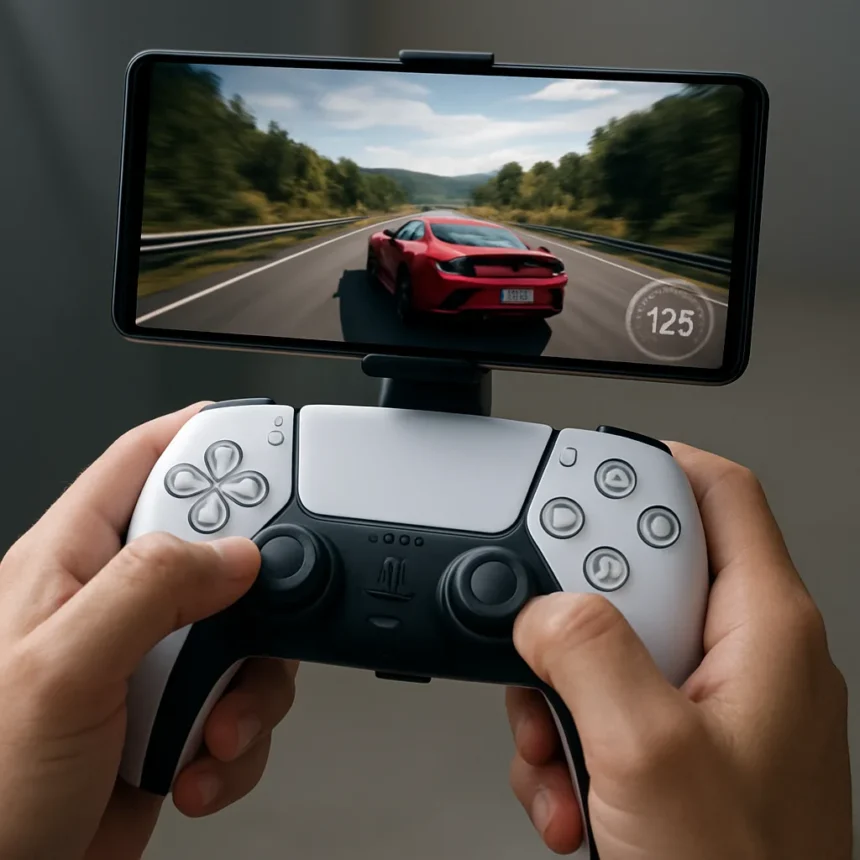
Dual-screen gaming is making a comeback. Sony has filed a patent for a system that clips a smartphone directly above the DualSense PS5 controller, transforming the phone’s display into a secondary gaming surface alongside the controller’s inputs. This approach echoes Nintendo’s Wii U concept from roughly 2012, but Sony’s version could sidestep the hardware costs that sank the Wii U by repurposing devices most players already own.
Key Takeaways
- Sony’s patent mounts smartphones to DualSense controllers using a clip-like attachment for dual-screen gameplay.
- The system recognizes simultaneous inputs from both the controller and the phone’s touchscreen and sensors.
- Dual-screen gaming last appeared prominently with Nintendo’s Wii U, which failed commercially despite innovative gameplay ideas.
- PS5 and anticipated PS6 games could use the phone screen for maps, alternate perspectives, or inventory management.
- The patent remains theoretical; no product launch date or confirmation has been announced.
How Sony Plans to Resurrect Dual-Screen Gaming
The patent describes a straightforward mechanical solution: a clip-like mount that positions a smartphone directly above the DualSense controller, similar to existing third-party phone mounts already sold for gaming. What makes Sony’s approach different is the software integration. PS5 and future PS6 games would recognize inputs from both the controller and the attached phone simultaneously, allowing developers to split gameplay across two screens. One screen could display the main action while the other shows a tactical map, inventory system, or an alternate camera angle.
Sony’s goal, according to the patent filing, is to “increase the variety of input control types that may be provided by an input device” by leveraging the smartphone’s built-in display, sensors, and touchscreen capabilities alongside the DualSense’s haptic feedback and adaptive triggers. This dual-input architecture could unlock gameplay interactions that neither device alone could deliver—imagine using the phone’s touchscreen for precision aiming while the controller’s triggers provide tactile feedback, or vice versa.
Why Nintendo’s Wii U Failed Where Sony Might Succeed
The Wii U, released around 2012, introduced dual-screen gaming as a core feature by bundling a touchscreen controller with every console. The concept was innovative—maps on the gamepad, inventory management, asymmetrical multiplayer where one player controlled the TV and another the tablet. Yet the Wii U failed commercially, becoming one of Nintendo’s biggest missteps. The reasons were complex: confusing marketing, a weak game library, and the perception that the second screen felt gimmicky rather than essential.
Sony’s approach sidesteps these pitfalls. Rather than forcing every PS5 owner to buy new hardware, the system works with devices people already carry. A smartphone mount costs far less to produce than a proprietary tablet controller. Developers can choose whether to implement dual-screen features, avoiding the forced integration that plagued Wii U third-party ports. And unlike the Wii U’s relatively niche appeal, smartphones are ubiquitous—Samsung Galaxy, iPhone, and other Android devices are anticipated to remain in “common use and typically comprise a display and at least one sensor” well into the PS6 era.
What Dual-Screen Gaming Could Actually Enable
The practical applications are compelling. Racing games could display a full-track map on the phone while the main action unfolds on the TV. Strategy games could use the phone for unit management and ability selection, freeing the main screen for immersive battle visuals. Puzzle or detective games could split clues across screens, requiring players to reference both simultaneously. Horror games could use the phone for inventory or sanity mechanics, creating an asymmetrical experience where the controller handles movement and interaction while the phone handles psychological or logistical pressure.
The DualSense’s haptic feedback and adaptive triggers add another layer. These features already simulate everything from bowstring tension in archery games to brake resistance in racing sims. Combined with a phone’s touchscreen sensitivity and motion sensors, dual-screen gameplay could feel significantly more immersive than either input method alone. A game could require you to swipe on the phone to reload while the controller’s trigger provides resistance, or tilt the phone to aim a scope while the controller delivers recoil feedback.
The Patent Reality Check
It is crucial to note: this is a patent, not a confirmed product. Sony files hundreds of patents annually, and many never become commercial products. The patent describes the concept and its potential benefits, but there is no announcement of production, no prototype demonstration, and no timeline for release. The setup would also be somewhat awkward—balancing a smartphone above a controller while playing demands a specific grip and could feel cumbersome compared to traditional gaming.
Additionally, developer adoption is uncertain. The Wii U had mandatory dual-screen hardware that forced developers to support it; Sony’s optional system requires game studios to invest time and resources into features some players may not use. Whether publishers see enough value in dual-screen gameplay to justify the development cost remains an open question.
Is Dual-Screen Gaming Actually the Future?
Sony is not alone in experimenting with multi-screen gaming. The DualSense itself is undergoing broader evolution—a January patent filing describes a stickless, buttonless controller variant with a touchscreen surface that maps inputs dynamically. Sony is clearly exploring how to expand input variety beyond traditional button-and-stick layouts. The phone-mount patent fits into this larger strategy of making the DualSense ecosystem more flexible and adaptable to different game genres and player preferences.

Whether dual-screen gaming becomes mainstream depends on adoption. If even a handful of major PS5 titles demonstrate genuinely compelling dual-screen mechanics, the install base could grow rapidly—most PS5 players already own capable smartphones. If the feature remains niche and feels tacked-on, it could fade into obscurity like the Wii U’s gamepad features. The difference will be execution: games that integrate the phone screen as a core gameplay element, not an optional novelty.
Does Sony’s dual-screen gaming concept actually work for practical play?
In theory, yes. The mechanical design is simple and proven by existing third-party mounts. The technical challenge is software integration—ensuring PS5 and PS6 games recognize phone inputs reliably. The practical challenge is ergonomics: holding a controller with a phone mounted above it requires a stable grip, and extended play sessions could become tiring. Developers would need to design games that respect these physical constraints rather than demanding constant phone interaction.
Will this kill the Wii U comparison?
Not entirely. The Wii U failed for reasons beyond hardware design—marketing, game library, and the novelty factor all played roles. Sony’s phone-mount system avoids some of these pitfalls by being optional and cheaper, but it still depends on developers choosing to support it. If the industry treats dual-screen features as optional flourishes rather than core mechanics, the comparison to Wii U’s forced integration will fade. If developers embrace it strategically, Sony could prove that dual-screen gaming was ahead of its time, not inherently flawed.
Sony’s patent represents a calculated bet that dual-screen gaming failed not because the concept was wrong, but because it was implemented as mandatory hardware at the wrong time. By tethering the feature to devices players already own and making it optional for developers, Sony may have finally cracked the formula that eluded Nintendo. Whether the company actually ships this product and whether players adopt it remain open questions—but the patent shows Sony is serious about exploring what comes next for the DualSense and PS5 gaming.
Where to Buy
Edited by the All Things Geek team.
Source: T3