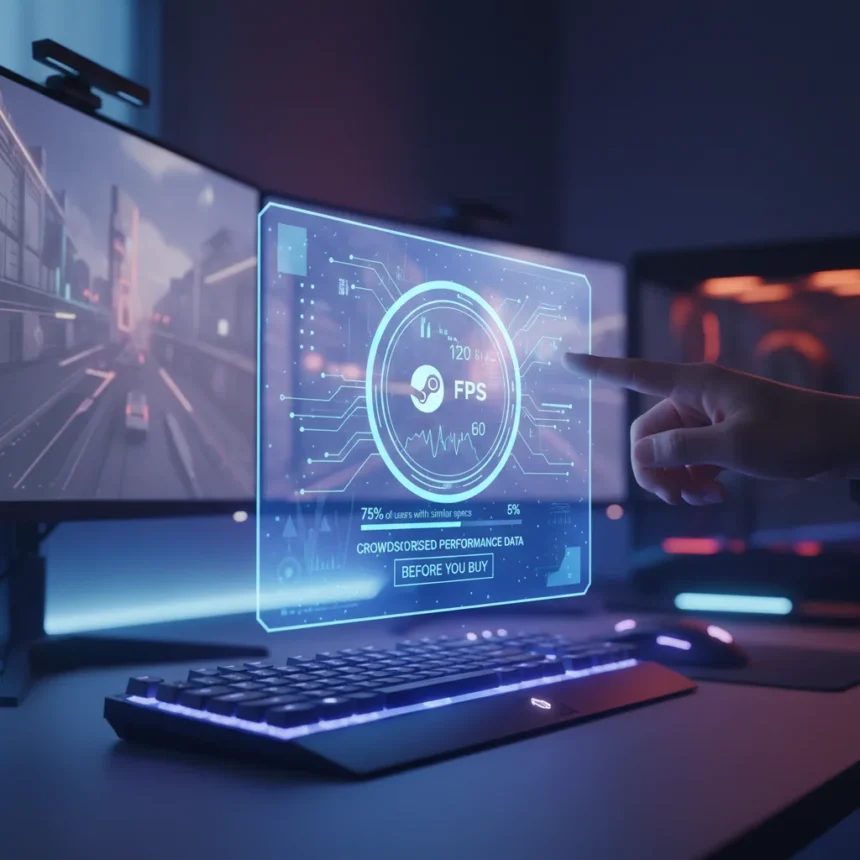
Steam’s FPS estimator is a forthcoming feature that will let players see expected frame rates before buying games, based on real-world performance data from users with similar hardware. Code spotted by ResetEra user Dex3108 in the Steam client reveals the feature’s core function: “Select an App and a PC config to get a chart of estimated frame rates, based on the frame rates of other users”. This addresses one of PC gaming’s most frustrating problems—vague minimum and recommended specs that tell you almost nothing about actual performance on your specific hardware.
Key Takeaways
- Steam FPS estimator uses crowdsourced gameplay data from similar hardware configurations
- Feature will show performance charts before purchase, reducing buyer regret and refunds
- Benefits Steam Deck, custom PCs, and upcoming Steam Machine hardware
- Code suggests automatic hardware detection with opt-in/opt-out options
- Complements other Steam transparency features like bundle purchase warnings
Why Steam’s FPS Estimator Solves a Real Problem
PC gaming has always suffered from a transparency crisis. Developers post minimum and recommended specs, but those numbers mean nothing until you actually launch a game and watch your frame rate tank. A “recommended” spec for a 2019 GPU tells you almost nothing about 2025 performance expectations. The Steam FPS estimator flips this model on its head by replacing developer guesses with actual user data. If 500 people with your exact GPU and CPU combo are playing a game at 60 FPS on high settings, Steam will show you that—not some vague promise from the publisher.
This crowdsourced approach transforms purchase confidence. Right now, buyers either take a gamble or rely on third-party YouTube benchmarks and forum posts. Steam’s FPS estimator puts that transparency directly into the store page, where it matters most. The feature will automatically detect your hardware, so estimates could appear instantly without any manual configuration. For players hesitant about whether a game will run smoothly, this is a significant shift.
Steam FPS Estimator and the Hardware Ecosystem
The timing of this feature is significant. Steam Machine is now on the horizon, and Steam Deck has already proven that PC gaming works outside the traditional tower-and-monitor setup. A unified FPS estimator benefits all three: custom PC builders, Steam Deck handheld players, and future SteamOS devices. Each has different performance ceilings, and crowdsourced data scales across all of them. A Steam Deck player considering a port can see exactly how it performs on the handheld; a custom PC builder can compare their specific configuration against thousands of others. This creates a virtuous cycle where more hardware diversity feeds better data, which makes the tool more useful.

The feature also complements Valve’s broader push for transparency. Steam has already rolled out shopping cart synchronization across devices—PC, smartphone, tablet, and Steam Deck—so you can build your wishlist anywhere. It’s also added inline gifting to multiple friends and bundle purchase warnings that alert you if a collection is cheaper than buying games individually. The FPS estimator is the logical next step: transparency about performance, not just price.
When Will Steam’s FPS Estimator Actually Launch?
The feature is still in development. The code was discovered in the Steam client, but Valve has not made an official announcement, and no release date has been confirmed. This is typical for Steam features—they appear in the client code long before public rollout, sometimes weeks or months ahead. The fact that code is already present suggests the feature is closer to testing than to pure concept stage, but “closer” is relative in Valve time.

What we do know: the implementation will likely be automatic, with users able to opt out if they prefer not to share their frame rate data. Privacy-conscious players will have control, which aligns with Steam’s general approach to user data. The feature should roll out as a free update to all Steam users whenever it launches, with no paywall or regional restrictions.
What This Means for PC Gaming Culture
If the Steam FPS estimator ships as described, it could reshape how players evaluate games. Right now, “Can I run this?” requires external research. With crowdsourced FPS data built into Steam, that question becomes answerable in seconds. Refund rates might drop because players will have realistic expectations before purchase. Developers might also face pressure to optimize more transparently, knowing their performance will be publicly visible and comparable across hardware tiers.
The feature also levels the playing field for smaller publishers and indie developers. A solo developer’s game won’t get the same YouTube benchmark coverage as a AAA title, but the Steam FPS estimator gives it equal visibility on the store page. That’s democratizing in a way the current system is not.
Does Steam’s FPS estimator work on all games?
The feature should work on any game in the Steam catalog, but the accuracy depends on how much crowdsourced data exists for that title. Popular games will have thousands of data points; niche indie titles might have fewer. Early data will be sparse, but the pool should grow as more players opt in.


Will the Steam FPS estimator require sharing my hardware specs?
Steam already auto-detects your hardware, so the feature can work without explicit sharing. Players will likely have the option to opt out of data collection if they prefer privacy, but opting in means your frame rate data helps other players make better purchasing decisions.
Can I use the Steam FPS estimator on Steam Deck?
Yes. The feature is designed to benefit Steam Deck players specifically, since handheld performance varies widely depending on game optimization and settings. Seeing expected FPS on the Deck before purchase is one of the feature’s core use cases.
The Steam FPS estimator represents a fundamental shift in how PC gaming transparency works. Instead of trusting developer specs or hunting down YouTube benchmarks, players will have real-world data at their fingertips. For Steam Deck users, custom PC builders, and anyone tired of guessing whether a game will run smoothly, this feature cannot arrive fast enough. Valve has yet to announce it officially, but the code is already in the client—and that usually means it is closer than we think.
Edited by the All Things Geek team.
Source: TechRadar