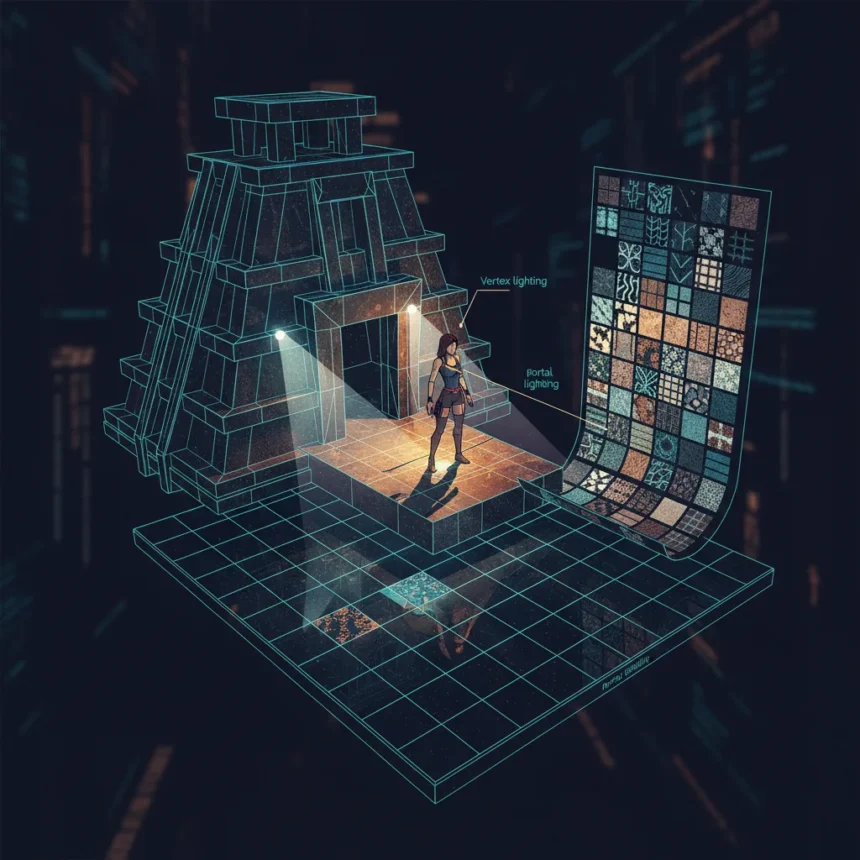
Tomb Raider III rendering techniques represent one of gaming’s most impressive technical achievements—a 1998 adventure that delivered complex 3D environments without the GPU acceleration modern developers take for granted. The game rewrote almost all main engine elements from its predecessor, combining smart systems and lightweight rendering to create a world that felt expansive despite severe hardware constraints.
Key Takeaways
- Portal-based visibility systems rendered only what players could see, cutting computational overhead dramatically.
- Vertex lighting replaced per-pixel calculations, enabling realistic multicolored environments without expensive math.
- Triangle-based level geometry replaced square-based height mapping, creating organic shapes instead of blocky terrain.
- Texture atlases and low-resolution tiling reduced memory footprint while maintaining visual detail.
- Distance fog served dual purposes: atmospheric effect and performance optimization.
How Portal Systems Optimized Tomb Raider III Rendering Techniques
The core innovation behind Tomb Raider III rendering techniques was portal-based visibility—a system that calculated which rooms and geometry were actually visible from the player’s position and skipped rendering everything else. This architectural approach meant the engine never wasted cycles drawing caves behind walls or chambers across the map. Instead of checking millions of polygon calculations per frame, the game asked a simpler question: what can Lara see right now? Portal systems transformed how developers thought about level design, turning the entire world into interconnected visibility zones rather than one massive mesh.
This visibility optimization was paired with distance fog, which served a brilliant dual purpose. Fog faded distant geometry into the background, both creating atmospheric depth and allowing the engine to stop rendering objects beyond a certain threshold. What looked like artistic choice was actually performance necessity—but the technique proved so effective that modern games still use it today, even with GPUs that could render without it. The psychological impact mattered as much as the technical savings.
Vertex Lighting and Texture Atlases: Building Realism on a Budget
Multicolored lighting made Tomb Raider III’s environments, enemies, and Lara herself appear far more realistic than the flat-shaded geometry of earlier 3D games. But per-pixel lighting was computationally impossible on 1998 hardware. Instead, developers used vertex lighting—calculating light values only at polygon corners and interpolating the color across each triangle’s surface. This lightweight approach meant a single torch could illuminate an entire chamber with believable color gradients, all computed in a fraction of the time pixel-perfect lighting would require.


Texture memory was another severe constraint. Tomb Raider III rendering techniques addressed this through texture atlases combined with low-resolution tiling—packing multiple textures into single large images and reusing small tiles across surfaces. The game deliberately avoided mipmapping (pre-scaled texture versions for distant objects), which would have consumed more memory. This choice caused visual artifacts when textures appeared far away, but it was an acceptable trade-off. Developers prioritized the close-up experience where players actually noticed detail.
Triangle-Based Geometry and the End of Blocky Worlds
Earlier Tomb Raider games used square-based height mapping—essentially a grid where each cell was either filled or empty, creating the characteristic stepped, blocky appearance of early 3D environments. Tomb Raider III replaced this with triangle-based level geometry, allowing individual points to be manipulated independently. Designers could now sculpt rounded backgrounds, domes, and organic shapes that made tombs feel like real architecture rather than Lego structures.


The 16-bit color screen option on the PC version enabled transparency effects—water, fire, and foliage—without requiring a dedicated 3D graphics card. This was crucial for accessibility. Many players in 1998 did not own dedicated GPUs; their graphics came from integrated chipsets or software rendering. By supporting 16-bit color transparency, Tomb Raider III reached a wider audience while still delivering visual richness. The enhanced level editor allowed developers to iterate on these complex shapes rapidly, turning technical constraints into creative tools.
Flipbook Animation and Vertex-Based Effects
Water ripples, fire flickers, and caustic light patterns were not computed in real-time on a per-frame basis. Instead, Tomb Raider III rendering techniques used flipbook texture animation—pre-drawn sequences of textures that cycled through frames. A fire effect was simply four or five hand-painted textures displayed in rapid succession. Vertex-based animation handled waves and caustics by shifting vertex positions slightly each frame, creating the illusion of fluid motion without physics simulation. These workarounds look crude when examined closely, but at normal gameplay speed and viewing distance, they created convincing environmental effects.
Why These Techniques Still Matter Today
Modern game engines have access to computational power that would have seemed like science fiction in 1998. Yet developers working under real-world constraints—mobile games, indie projects, retro-style experiences—still study Tomb Raider III rendering techniques because the principles remain sound. Portal visibility influenced level design for decades. Vertex lighting still appears in stylized games. Texture atlases are standard practice in modern development. The game proved that clever engineering and artistic vision could overcome hardware limitations, a lesson that applies whenever budgets shrink or platforms prove less powerful than expected.
What made Tomb Raider III’s approach different from its predecessor?
Almost all main engine elements were rewritten for Tomb Raider III, moving from simple square-based height mapping to triangle-based geometry that enabled organic shapes. The addition of multicolored lighting, improved texture palettes, and an enhanced level editor gave developers far more creative control than the original engine allowed.


Could Tomb Raider III run without a graphics card?
Yes, the PC version supported 16-bit color screens without requiring a dedicated 3D graphics card, enabling transparency effects through software rendering. This made the game accessible to players with integrated graphics or older systems, though dedicated GPU owners experienced better performance.
Why did Tomb Raider III avoid mipmapping?
Mipmapping—storing pre-scaled versions of textures for distant objects—would have consumed additional memory that the 1998 hardware could not spare. Instead, the game accepted visual artifacts on far-away textures as a necessary trade-off to fit the entire game in available RAM.
Tomb Raider III’s rendering techniques represent a masterclass in constraint-driven design. Every optimization served a purpose, every limitation became a creative decision. The game remains a reference point for developers who understand that the best technical solutions are often born from scarcity, not abundance. Modern GPUs have made brute-force rendering possible, but they have not made clever engineering obsolete.
Edited by the All Things Geek team.
Source: Creativebloq