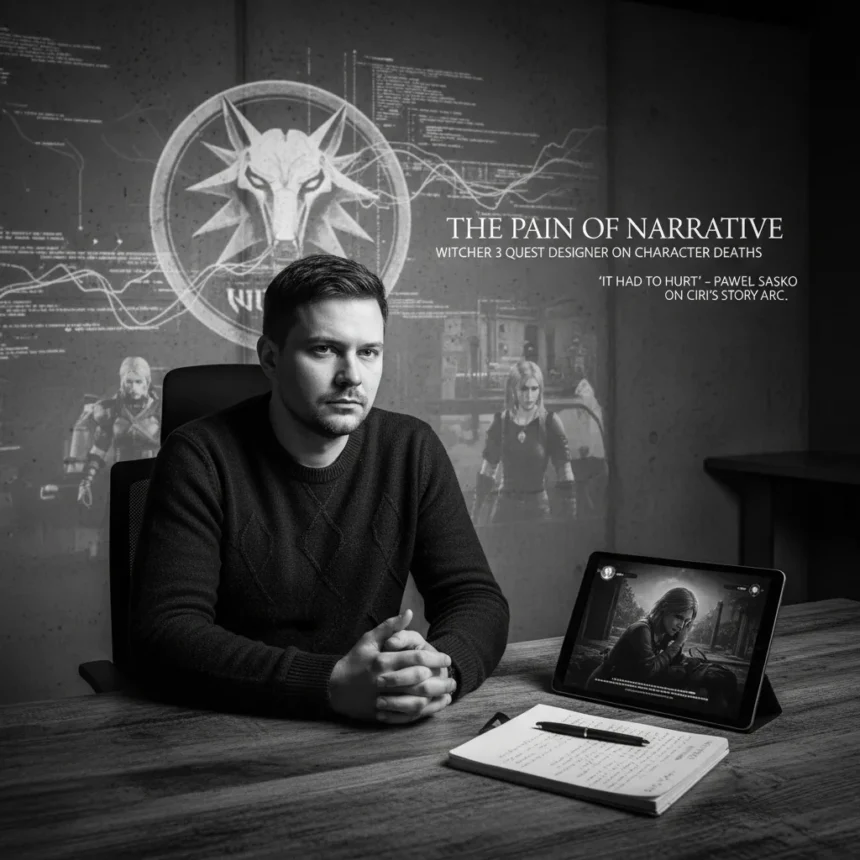
Paweł Sasko, lead quest designer at CD Projekt Red, recently recalled the moment he proposed one of The Witcher 3’s most shocking narrative decisions—and the stunned silence that followed. Witcher 3 narrative design hinges on moments that feel earned, not arbitrary, and Sasko’s suggestion crossed a line the team hadn’t expected to cross. The proposal was so bold that when he pitched it, the room fell silent. Wide eyes. No immediate response. Just the weight of what he was asking them to do.
Key Takeaways
- Paweł Sasko proposed killing off a character to anchor Ciri’s story arc and justify her later actions
- The team’s reaction was stunned silence—the proposal was shocking enough to give everyone pause
- Sasko argued that a weaker trigger (like a simple defeat and escape) would not have been credible
- The narrative moment needed emotional weight to make subsequent character behavior believable to players
- The design philosophy prioritized impact over comfort: make it hurt so it matters
Why Witcher 3 Narrative Design Demanded a Devastating Moment
Sasko faced a creative problem that many narrative designers encounter: how do you justify a character’s transformation? He needed Ciri to be anchored in the story by exposing her to something so dramatic that her subsequent actions would be credible to players. A simple setback wouldn’t work. A defeat followed by escape wouldn’t work. The event had to be a real shocker—something that would fundamentally alter how players understood her journey.
The alternative was weak storytelling. If the events unfolding in that sequence lacked magnitude, there would be no suitable trigger for her actions. Sasko knew this. He also knew that proposing a character death was not a casual suggestion in a development meeting. It required justification, conviction, and the willingness to argue for something that would hurt—both narratively and emotionally.
The Weight of Consequence in Witcher 3 Narrative Design
What makes Sasko’s approach to Witcher 3 narrative design distinctive is his refusal to settle for narrative convenience. It just had to be powerful. How to achieve that? Make it hurt. And that would always hurt. This is not a philosophy of shock for shock’s sake. It is a philosophy that recognizes emotional pain as a narrative tool—one that, when deployed correctly, makes everything that follows feel earned and real.


The moment a character dies in a story, the remaining characters are forever changed. Their motivations shift. Their choices carry different weight. Sasko understood that Ciri’s arc required this kind of anchor point. Without it, her later decisions would feel hollow to players, no matter how well-written the dialogue. With it, every action she takes afterward becomes an extension of that trauma, making her choices believable and compelling.
How This Compares to Weaker Narrative Alternatives
Many games opt for softer story triggers. A defeat, a narrow escape, a betrayal that resolves quickly—these are safer choices. They allow character growth without demanding the player process genuine loss. But Sasko rejected this path. He recognized that a lesser event would not carry the weight required to justify Ciri’s transformation. The narrative logic was simple: if you want players to believe a character has been fundamentally changed, you cannot give them a story that allows them to dismiss that change as temporary or reversible.



This approach to Witcher 3 narrative design reflects a broader philosophy about what makes RPG storytelling matter. It is not enough for a character to say they have changed. Players must witness the event that changed them. They must feel its consequences. They must understand, on a visceral level, why that character is now different. Sasko’s willingness to propose something painful—something that would make the room go silent—is what separates strong narrative design from competent but forgettable storytelling.
Did the team ultimately accept the proposal?
The research brief does not explicitly confirm whether the team approved Sasko’s proposal or whether the narrative moment he suggested ultimately made it into the final game. The brief indicates that Sasko described the moment he proposed the idea and explained his reasoning, but does not detail the full outcome of the team’s discussion or decision-making process.
What other narrative decisions shaped The Witcher 3’s story?
The research brief focuses specifically on Sasko’s account of proposing a character death and the reasoning behind it. It does not provide details about other major narrative decisions in The Witcher 3’s development or design process.
How does this approach to storytelling differ from other RPGs?
The brief does not compare Witcher 3 narrative design to other RPG franchises or discuss how other games handle similar story moments. Sasko’s philosophy emphasizes emotional weight and credibility over safety, but the brief does not contextualize this against competing design philosophies in the industry.


Paweł Sasko’s reflection on Witcher 3 narrative design reveals something essential about why some stories linger with players long after the credits roll: they refuse to let you off easy. They make you hurt because that hurt is what makes the rest of the story matter. A character’s transformation must be earned through genuine loss, not smoothed over with convenient plot devices. That moment of wide eyes and silence in the meeting room was not a moment of rejection—it was a moment of recognition that Sasko was proposing something that would change the game, and that change would always hurt. That is exactly what the story needed.
Edited by the All Things Geek team.
Source: TechRadar