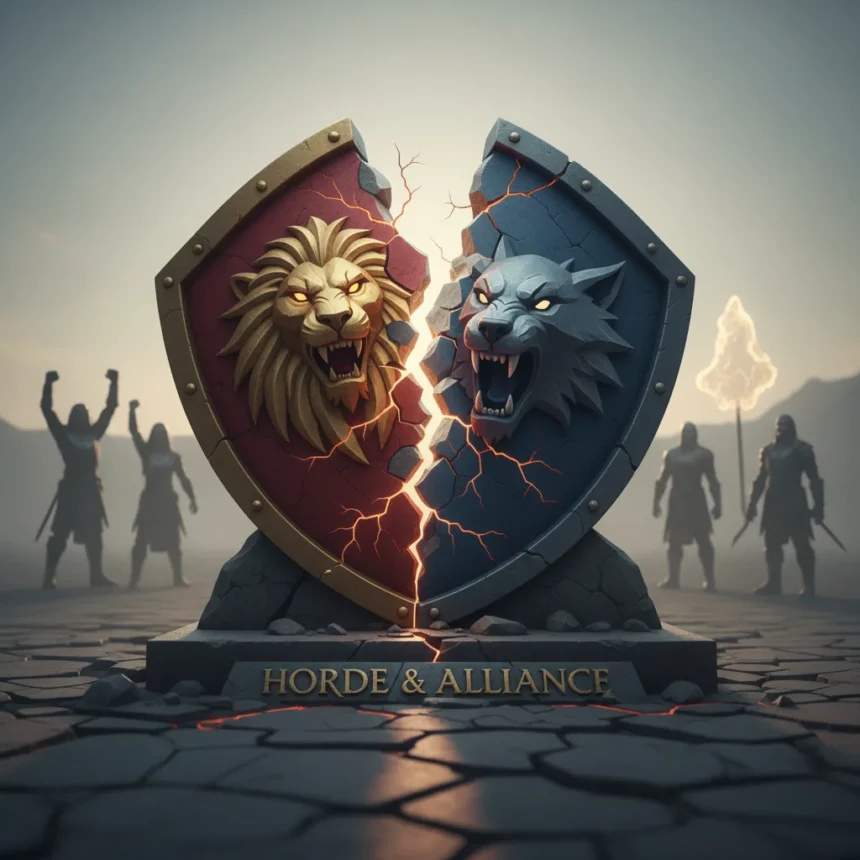
World of Warcraft’s faction split has defined the game for two decades, but Blizzard’s steady dismantling of the Horde-Alliance divide represents a fundamental erosion of what made the MMO iconic. What started as a controversial design decision locked in just 9-12 months before WoW’s 2004 launch has become the game’s identity cornerstone—and abandoning it will likely be remembered as a historic mistake.
Key Takeaways
- Horde-Alliance faction split was finalized only 9-12 months before WoW’s 2004 launch, making it a last-minute but foundational decision.
- Cross-faction guilds and PvE content were introduced in Shadowlands 9.2.5 (May 2022), allowing mixed-faction cooperation.
- US servers show Horde majority in 2026, while EU servers maintain balanced populations across top servers.
- Player proposals suggest replacing permanent factions with temporary, expansion-based alternatives like Lightsworn vs. Voidbound.
- Faction change services remain available via Battle.net, converting characters between Horde and Alliance.
The Faction Split Was Always Controversial—Until It Became Sacred
The Horde-Alliance divide was never inevitable. Former Blizzard VP Jeff Kaplan revealed that the decision was genuinely contested internally and only locked in 9-12 months before the game shipped. That last-minute commitment became the bedrock of two decades of storytelling, server culture, and player belonging. Factions meant something beyond gameplay mechanics—they shaped how players saw themselves in Azeroth. Horde players had an identity separate from Alliance, and that separation created genuine stakes for PvP, raiding politics, and world events.
Cross-faction features introduced in Shadowlands 9.2.5 have systematically eroded this identity. Guilds can now mix Horde and Alliance players, and dungeons and raids allow cross-faction cooperation. These were sold as quality-of-life improvements—and for many, they solved real problems around guild recruitment and friend groups split by faction choice. But they also removed the friction that made faction identity meaningful. When you can raid with anyone regardless of faction, what does your faction actually represent?
Cross-Faction Features Solve Logistics, Not Lore
The current state of World of Warcraft faction split reflects a pragmatic but hollow compromise. In 2026, EU servers show balanced Horde and Alliance populations across the top 10 most populated realms, creating stable PvP and grouping ecosystems. US servers, by contrast, show a Horde majority, making it easier for Horde players to find guilds and groups but intensifying PvP imbalance. These population disparities reveal the real problem: cross-faction systems address logistics without addressing why factions mattered in the first place.


What makes this shift particularly damaging is that it abandons the lore framework without replacing it with something equally compelling. The Horde and Alliance were not just gameplay teams—they were narrative anchors. Players made moral and cultural choices when they picked their faction. Removing that structure doesn’t create freedom; it creates narrative ambiguity. A player logging in today no longer knows what their faction stands for because Blizzard has spent years systematically removing the reasons to care.
Player Proposals Show There Were Better Paths
Rather than dismantling factions entirely, some players have proposed a middle ground that preserves identity while improving accessibility. Forum discussions suggest replacing permanent Horde and Alliance structures with temporary, expansion-based factions tied to each expansion’s conflict. For example, a void-themed expansion could introduce Lightsworn, Voidbound, and Old Gods Cult as temporary allegiances, allowing players to choose new identities each expansion while maintaining the structure that makes faction meaningful.


These proposals acknowledge what Blizzard seems to have forgotten: faction systems work because they create meaningful choice. Temporary, rotating factions would preserve that choice while solving the population imbalance problem that plagued servers for years. They would also allow races to remain independent of faction identity, a compromise that addresses longtime player frustrations without erasing the core mechanic entirely.
The Real Cost: Player Identity Beyond the Game
The deepest damage from dismantling the World of Warcraft faction split is psychological. Faction identity extended far beyond the game client. Players wore their faction allegiance as part of their social identity—in guild Discord servers, in conversations with friends, in how they approached the game’s moral landscape. Horde players had a distinct culture; Alliance players had another. This created genuine community differentiation.
Cross-faction features have eroded this external identity marker. When everyone can join the same guild regardless of faction, when everyone raids together against the same enemies, the reason to identify as Horde or Alliance weakens. Some players report increasing faction changes to Alliance, driven partly by population concerns but also by the declining meaning of faction affiliation. Without a clear reason to stay, players choose based on logistics rather than identity.
Could This Be Fixed?
Blizzard could still reverse course by introducing the kind of temporary, expansion-based faction system that preserves choice without permanent splitting. Such a system would require significant narrative restructuring but would acknowledge that factions served a purpose beyond mechanics. Alternatively, the studio could lean fully into the cross-faction direction and rebuild narrative around something other than Horde versus Alliance—but that work has not yet begun, leaving players in a lore vacuum.


The World of Warcraft faction split removal will likely be remembered as the moment Blizzard chose short-term convenience over long-term identity. It solved a real problem—population imbalance, guild recruitment friction—but it solved it by removing the thing that made the problem meaningful in the first place. That is not a solution; it is an amputation dressed up as a quality-of-life improvement.
Is World of Warcraft removing factions completely?
Blizzard has not announced a complete removal of the Horde and Alliance factions, but cross-faction features introduced in Shadowlands 9.2.5 have significantly reduced their practical impact. Players can now guild together, raid together, and quest together regardless of faction, making the split increasingly cosmetic.
Can you change your faction in World of Warcraft?
Yes, faction change services are available through the Battle.net shop for both retail World of Warcraft and WoW Classic, allowing players to convert characters from Horde to Alliance or vice versa.
What would happen if World of Warcraft ended the faction divide?
Ending the faction divide would remove decades of narrative identity and world-building that defined player communities. Some players propose temporary, expansion-based factions as an alternative that preserves meaningful choice without permanent splitting.
The World of Warcraft faction split removal represents a critical missed opportunity. Blizzard had the chance to evolve the system while preserving what made it matter. Instead, it chose convenience over identity, leaving players with a game that works better mechanically but feels less like home. That is the real cost of this historic mistake.
Edited by the All Things Geek team.
Source: Windows Central