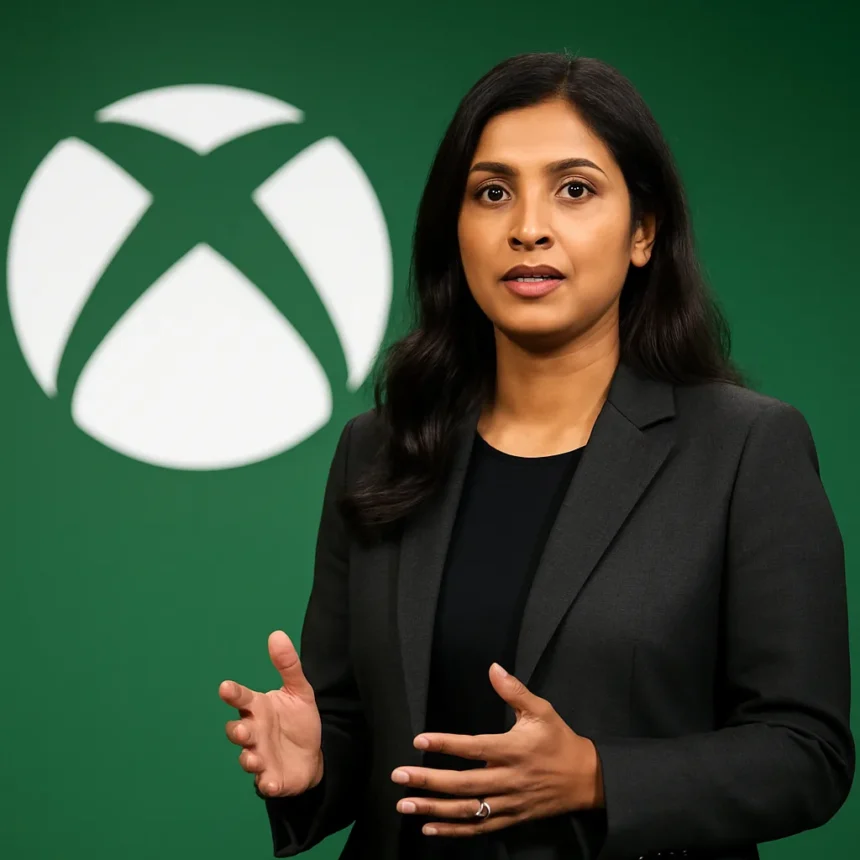
Xbox exclusives strategy is undergoing a quiet but significant recalibration under new CEO Asha Sharma, who has publicly reaffirmed that exclusive titles remain central to defining what Xbox actually is. Asha Sharma is the new Xbox CEO, known for her commitment to returning Xbox to its console-first roots while maintaining presence across PC, mobile, and cloud platforms. In recent internal communications and public statements, she has made clear that the company’s previous strategy of spreading games everywhere may have diluted Xbox’s platform identity.
Key Takeaways
- Xbox CEO Asha Sharma says exclusives are still central to Xbox’s platform identity.
- Sharma believes previous Game Pass decisions hurt subscription retention and loyalty.
- Hardware investment and console focus are priorities in the new strategic direction.
- The company is reassessing exclusivity, windowing, and AI as part of a broader reset.
- Sharma’s goal is “proof over promise” — demonstrating results through action rather than announcements.
Why Xbox Is Reassessing Its Exclusives Strategy
For years, Xbox messaging emphasized reaching players everywhere — on PlayStation, Nintendo Switch, mobile, and cloud. That approach, Sharma now argues, undermined the reason someone would buy an Xbox console in the first place. “We are building a stronger XBOX,” Sharma stated, signaling a departure from the “everything everywhere” posture that characterized the previous strategy. The new CEO believes that by flooding the market with Xbox games on competing platforms, the company inadvertently reduced the value proposition of its own hardware.
Sharma’s reassessment extends beyond just exclusivity windows. She has outlined four strategic priorities: hardware, content, experiences, and services. This framework suggests Xbox is no longer treating hardware as a secondary concern but as foundational to the platform’s future. The shift reflects a recognition that exclusives — games you can only play on Xbox — create the fundamental reason consumers choose one console over another. Without that differentiation, Xbox becomes just another service, competing on price and convenience rather than unique experiences.
The timing of this stance is notable because it directly contradicts the messaging that dominated Xbox strategy under previous leadership. For years, the company positioned itself as platform-agnostic, willing to put games on PlayStation and other devices. Sharma’s public reaffirmation suggests internal data and market performance have convinced leadership that this approach was counterproductive. Recent Xbox Game Pass Ultimate pricing adjustments have started to reverse negative subscription and retention trends, according to Sharma’s internal communications, but she clearly believes more fundamental changes are needed.


What “Proof Over Promise” Means for Xbox’s Future
Sharma has committed to a philosophy of “proof over promise,” rejecting what she calls “slop” and “derivative work” in favor of carefully curated, high-quality output. This is a direct rebuke to years of Xbox messaging that overpromised and underdelivered. Instead of announcing 10 upcoming exclusives and delivering three, Sharma is signaling a tighter, more selective approach to game development and publishing. “I will not flood our ecosystem with slop. We won’t have careless output. We won’t have derivative work,” she stated bluntly.
This quality-first stance has real implications for how Xbox will compete. PlayStation and Nintendo have built their ecosystems on exclusive franchises that define their platforms — God of War and Spider-Man for PlayStation, Mario and Zelda for Nintendo. Xbox’s exclusive roster, by contrast, has been thinner and less culturally dominant. Sharma’s commitment to quality exclusives suggests Xbox is finally acknowledging this gap and committing resources to close it, rather than hoping multi-platform reach would solve the problem.


Sharma has also emphasized that “nothing is off the table” as Xbox finalizes its strategy. This language suggests the company is still evaluating which games remain exclusive, how long exclusivity windows should last, and where AI fits into content creation. Rather than making sweeping announcements, she is taking time to gather data and make deliberate choices. This measured approach contrasts sharply with the reactive, crisis-driven decision-making that has characterized Xbox’s recent history.
Hardware Investment and the Console-First Pivot
Central to Sharma’s vision is a renewed commitment to console hardware. “I am committed to returning to Xbox and that starts with console, that starts with hardware,” she said explicitly. This is not merely rhetorical — it signals real investment in developing and marketing Xbox consoles as the primary way players experience Xbox games. For years, Xbox treated hardware almost as an afterthought, emphasizing Game Pass subscriptions and cloud gaming as the future. Sharma is reversing that priority.
However, Sharma acknowledged a real constraint: memory procurement for gaming products is currently difficult. This suggests that even with renewed commitment, Xbox may face supply or cost challenges in manufacturing competitive hardware. The company will need to balance ambition with the practical realities of global chip shortages and component costs. Still, the commitment is there — hardware matters again at Xbox in a way it hasn’t for several years.
Sharma’s strategy also includes expanding Xbox’s reach across PC, mobile, and cloud while maintaining console as the centerpiece. This is a delicate balance: the company wants to meet players where they are, but not in a way that makes the console irrelevant. The goal is to “break down barriers so developers can build once and reach players everywhere without compromise,” according to the broader “return to Xbox” statement. This suggests a more unified development approach where games are built for Xbox-ecosystem devices rather than ported as afterthoughts to other platforms.


How This Compares to PlayStation and Nintendo’s Approach
PlayStation and Nintendo have never wavered from their exclusive-first strategy. Both companies use exclusive franchises to drive hardware sales — you buy a PlayStation for God of War and Final Fantasy, a Switch for Mario and Zelda. Xbox’s pivot back toward exclusives essentially acknowledges that it should have followed this playbook from the start. By positioning exclusives as central rather than peripheral, Sharma is aligning Xbox with proven, industry-standard console strategy rather than continuing an experiment in platform-agnostic gaming.
Is Xbox finally committing to exclusives permanently?
Sharma’s language suggests a genuine shift, but she has left room for flexibility. Saying “nothing is off the table” and committing to data-driven decisions means exclusivity policy may still evolve. What appears certain is that Xbox will no longer automatically port every game to PlayStation and other platforms — that era is ending. Whether specific franchises remain exclusive long-term or eventually come to other platforms will likely depend on performance data and market conditions.
What does “proof over promise” mean for Xbox game announcements?
It means Xbox will announce fewer games but deliver more consistently on those announcements. Instead of revealing a 10-game slate and shipping three, Sharma is signaling a smaller, higher-quality pipeline where each announcement is backed by near-completion development. This is a tacit admission that Xbox’s announcement-heavy approach has damaged trust with players who have been disappointed by delays and cancellations.
Will Xbox exclusives include major franchises like Halo and Starfield?
The research materials do not specify which franchises will remain exclusive under Sharma’s strategy. She has emphasized that exclusivity decisions are part of the ongoing strategic review, meaning no franchise is automatically off-limits for reconsideration. However, her commitment to hardware and platform identity suggests that flagship franchises will likely remain exclusive to maintain Xbox’s competitive position.
Asha Sharma’s reaffirmation of exclusives as central to Xbox’s identity marks a turning point after years of mixed messaging. The company is finally acknowledging what PlayStation and Nintendo have always known: platforms succeed when they offer experiences you cannot get elsewhere. Whether Sharma can translate this philosophy into a compelling exclusive lineup will determine whether Xbox’s reset succeeds or becomes another false start. The next 12 to 24 months will reveal whether this is genuine strategic clarity or another promise that fails to materialize.
Edited by the All Things Geek team.
Source: Windows Central